Physics
나의 코스
배우기
시험 준비
AI 튜터
학습 가이드
교과서적 해결책
플래시카드
탐험해 보세요
앱을 사용해 보세요
나의 코스
배우기
시험 준비
AI 튜터
학습 가이드
교과서적 해결책
플래시카드
탐험해 보세요
앱을 사용해 보세요
뒤로
Types of Collisions definitions
카드를 뒤집기 위해 탭할 수 있습니다.
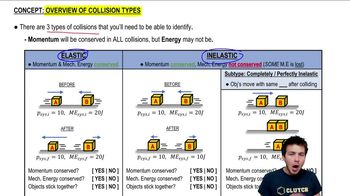
Elastic collision
카드를 뒤집기 위해 탭할 수 있습니다.
👆
Elastic collision
A type of collision where both momentum and mechanical energy are conserved, with no energy loss.
진행 상황 추적
컨트롤 버튼이 '내비게이션' 모드로 변경되었습니다.
1/11
관련 플래시카드
관련 실천
추천 영상
Types of Collisions quiz #1
Types of Collisions
40 용어
Types of Collisions quiz #2
Types of Collisions
12 용어
Types of Collisions
11. Momentum & Impulse
7 문제점
주제

Emilee
Completely Inelastic Collisions
11. Momentum & Impulse
8 문제점
주제

Patrick
11. Momentum & Impulse - Part 1 of 3
5 주제
11 문제점
장
Patrick
11. Momentum & Impulse - Part 2 of 3
5 주제
11 문제점
장
Patrick
11. Momentum & Impulse - Part 3 of 3
5 주제
11 문제점
장
Patrick
VideoThumbView.guidedCourse
04:47
Overview of Collision Types
12227
views
212
rank
2
comments
이 집합의 용어 (11)
하이드의 정의
Elastic collision
A type of collision where both momentum and mechanical energy are conserved, with no energy loss.
Inelastic collision
A collision where momentum is conserved but mechanical energy is not, resulting in energy loss.
Perfectly inelastic collision
A collision where objects stick together post-impact, conserving momentum but not mechanical energy.
Momentum
A conserved quantity in all collisions, representing the product of an object's mass and velocity.
Mechanical energy
The sum of potential and kinetic energy in a system, conserved only in elastic collisions.
Energy conservation
A principle stating that energy remains constant in an isolated system, applicable in elastic collisions.
Energy loss
The reduction of mechanical energy in a system, characteristic of inelastic collisions.
Velocity
The speed and direction of an object's motion, crucial in determining post-collision movement.
Collision
An event where two or more bodies exert forces on each other for a short duration.
System
A set of interacting or interdependent components forming an integrated whole, especially in physics.
Spectrum
A range used to describe the degree of elasticity in collisions, from perfectly elastic to perfectly inelastic.