Skip to main content
Physics with Calculus
나의 코스
배우기
시험 준비
AI 튜터
학습 가이드
교과서적 해결책
플래시카드
탐험해 보세요
앱을 사용해 보세요
나의 코스
배우기
시험 준비
AI 튜터
학습 가이드
교과서적 해결책
플래시카드
탐험해 보세요
앱을 사용해 보세요
뒤로
Motion in a Circle - Physics with Calculus
카드를 뒤집기 위해 탭할 수 있습니다.
Define angular displacement.
카드를 뒤집기 위해 탭할 수 있습니다.
👆
Define angular displacement.
The angle \(\theta\) through which an object moves from its starting position on a circle.
진행 상황 추적
컨트롤 버튼이 '내비게이션' 모드로 변경되었습니다.
1/19
추천 영상
VideoThumbView.guidedCourse
03:48
Intro to Circular Motion
16634
views
397
rank
VideoThumbView.guidedCourse
01:50
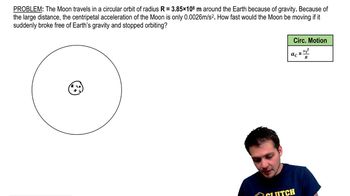
Circular Orbit of the Moon
10358
views
351
rank
1
comments
이 집합의 용어 (19)
하이드의 정의
Define angular displacement.
The angle \(\theta\) through which an object moves from its starting position on a circle.
What is a radian?
One radian is the angle subtended at the center of a circle by an arc equal in length to the radius.
How do you convert degrees to radians?
Multiply degrees by \(\frac{\pi}{180}\) to get radians.
What is angular velocity \(\omega\)?
The rate of change of angular displacement with respect to time.
How is linear speed related to angular velocity?
Linear speed \(v\) equals radius \(r\) times angular velocity \(\omega\): \(v = r\omega\).
Why does velocity change in uniform circular motion despite constant speed?
Because velocity is a vector, its direction changes continuously, making velocity change even if speed is constant.
What is centripetal force?
A resultant force acting towards the center of the circle that causes centripetal acceleration.
What direction does centripetal force act relative to velocity?
Centripetal force acts at right angles (perpendicular) to the object's velocity.
Does centripetal force do work on the object? Why or why not?
No, because the force is perpendicular to displacement, so no work is done and kinetic energy remains constant.
List the conditions for uniform circular motion.
1) Resultant force of constant magnitude, 2) Force normal to velocity, 3) Constant acceleration normal to velocity, 4) Constant angular speed.
What provides centripetal force for a car cornering on a level road?
The frictional force between the tires and the road.
What provides centripetal force for a car on a banked road?
The horizontal component of the normal force from the road surface.
What is centripetal acceleration?
Acceleration directed towards the center of the circle, causing the change in velocity direction.
How does velocity and acceleration vary in vertical circular motion?
Velocity and acceleration are maximum at the lowest point and minimum at the highest point of the circle.
Why does the tension in the string vary in vertical circular motion?
Because gravity affects the net force needed for centripetal acceleration, tension changes with position.
What happens if centripetal acceleration is less than gravitational acceleration in vertical motion?
The object will not stay on the circular path and may fall off the track.
What is the direction of the velocity vector in uniform circular motion?
Tangential to the circular path at the object's position.
What is the direction of centripetal acceleration?
Always directed towards the center of the circle.
Why is an object in uniform circular motion not in equilibrium?
Because its velocity direction changes continuously, causing acceleration and requiring a resultant force.
 뒤로뒤로
뒤로뒤로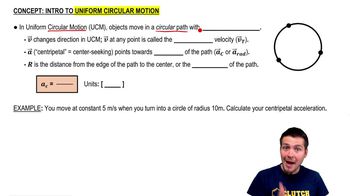
 03:48
03:48