 뒤로
뒤로Physics: Density Concepts
 8:42
8:42
이 집합의 용어 (15)
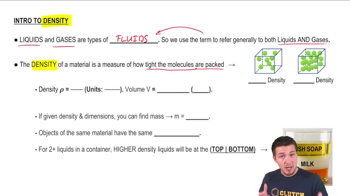
Density is the mass of a substance per unit volume.
Density is calculated using \(\rho = \frac{m}{V}\), where \(\rho\) is density, m is mass, and V is volume.
Common units of density are kilograms per cubic meter (kg/m³) and grams per cubic centimeter (g/cm³).
Density increases if mass increases for the same volume, or if volume decreases for the same mass.
A high density means the material has a large mass packed into a small volume.
Mass can be found by \(m = \rho \times V\).
Volume can be found by \(V = \frac{m}{\rho}\).
Density is intensive because it does not depend on the amount of substance present.
Increasing temperature usually decreases density because volume expands while mass stays constant.
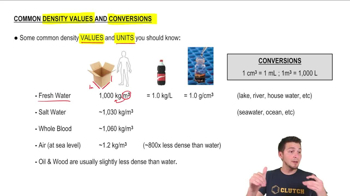
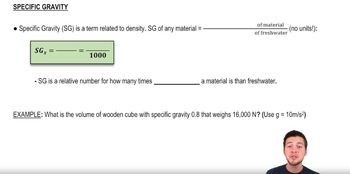
The density of water is approximately 1 g/cm³ or 1000 kg/m³ at 4°C.
Each substance has a characteristic density, so measuring density helps identify materials.
Density usually decreases because volume increases when melting, but mass remains constant.
Objects float if their density is less than the fluid's density and sink if it is greater.
Measure mass with a balance and volume by displacement or geometric calculation, then calculate density.
Density helps explain buoyancy, material properties, and behavior under different conditions.