Skip to main content
Physics with Calculus
나의 코스
배우기
시험 준비
AI 튜터
학습 가이드
교과서적 해결책
플래시카드
탐험해 보세요
앱을 사용해 보세요
나의 코스
배우기
시험 준비
AI 튜터
학습 가이드
교과서적 해결책
플래시카드
탐험해 보세요
앱을 사용해 보세요
뒤로
Physics: Electric Circuits and Capacitors
카드를 뒤집기 위해 탭할 수 있습니다.
Equivalent resistance of resistors in series
카드를 뒤집기 위해 탭할 수 있습니다.
👆
Equivalent resistance of resistors in series
The equivalent resistance is the sum: \(R_{eq}=R_1+R_2+R_3+\dots\).
진행 상황 추적
컨트롤 버튼이 '내비게이션' 모드로 변경되었습니다.
1/20
추천 영상
VideoThumbView.guidedCourse
02:33
Current Through Unknown Resistor
8483
views
168
rank
VideoThumbView.guidedCourse
03:07
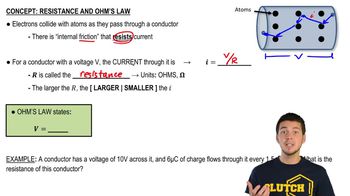
Resistance and Ohm's Law
13490
views
300
rank
1
comments
VideoThumbView.guidedCourse
05:25
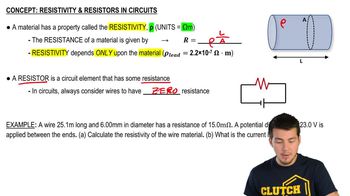
Resistivity & Resistors in Circuits
11475
views
246
rank
4
comments
이 집합의 용어 (20)
하이드의 정의
Equivalent resistance of resistors in series
The equivalent resistance is the sum: \(R_{eq}=R_1+R_2+R_3+\dots\).
Current in resistors connected in series
The current is the same through all resistors: \(I_{tot}=I_1=I_2=I_3=\dots\).
Voltage drops across resistors in series
The total voltage drop is the sum of individual drops: \(V_{tot}=V_1+V_2+V_3+\dots\).
Equivalent resistance of resistors in parallel
The reciprocal of equivalent resistance is the sum of reciprocals: \(\frac{1}{R_{eq}}=\frac{1}{R_1}+\frac{1}{R_2}+\frac{1}{R_3}+\dots\).
Current in resistors connected in parallel
The total current is the sum of currents through each resistor: \(I_{tot}=I_1+I_2+I_3+\dots\).
Voltage across resistors in parallel
The voltage across each resistor is the same: \(V_{tot}=V_1=V_2=V_3=\dots\).
Kirchhoff's Junction Rule
The sum of currents entering a junction equals zero: \(\sum I_i=0\) (currents into junction positive, out negative).
Kirchhoff's Loop Rule
The sum of potential changes around any closed loop is zero: \(\sum \Delta V_i=0\).
Potential change moving in direction of current over resistor
Potential drop is negative: \(\Delta V = -RI\).
Potential change moving against direction of current over resistor
Potential change is positive: \(\Delta V = +RI\).
Potential change moving from negative to positive terminal of battery
Potential change is positive: \(\Delta V = +E\).
Potential change moving from positive to negative terminal of battery
Potential change is negative: \(\Delta V = -E\).
Time constant of an RC circuit
The time constant is \(\tau=RC\), representing the characteristic time for charging or discharging.
Charging current in an RC circuit
Current decreases exponentially: \(i(t)=I_0 e^{-t/\tau}\), where \(I_0=\frac{\varepsilon}{R}\).
Charging charge on capacitor in RC circuit
Charge increases as: \(q(t)=Q_0(1-e^{-t/\tau})\), with \(Q_0=\varepsilon C\).
Discharging charge on capacitor in RC circuit
Charge decreases exponentially: \(q(t)=Q_0 e^{-t/\tau}\).
Definition of capacitance
Capacitance relates charge and voltage: \(Q=VC\).
Equivalent capacitance of capacitors in series
Reciprocal of equivalent capacitance is sum of reciprocals: \(\frac{1}{C_{eq}}=\frac{1}{C_1}+\frac{1}{C_2}+\frac{1}{C_3}+\dots\).
Equivalent capacitance of capacitors in parallel
Equivalent capacitance is sum: \(C_{eq}=C_1+C_2+C_3+\dots\).
Potential energy stored in a capacitor
Energy stored is \(U_C=\frac{1}{2}CV^2 = \frac{Q^2}{2C} = \frac{1}{2}QV\).
 뒤로뒤로
뒤로뒤로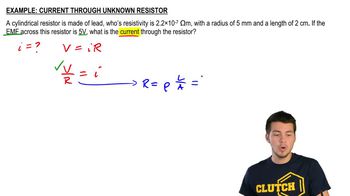
 02:33
02:33