뒤로

Physics: Electromagnetic Waves and Optics

컨트롤 버튼이 '내비게이션' 모드로 변경되었습니다.
1/15
  • What is the index of refraction and its symbol?

    The index of refraction symbolized by \(n\). It is unitless.

  • What is the index of refraction of air?

    The index of refraction of air is \(n_{air}=1.000\).
  • What is the index of refraction of water?

    The index of refraction of water is \(n_{water}=1.333\).
  • What is the index of refraction of crown glass?

    The index of refraction of crown glass is \(n_{crown\ glass}=1.52\).
  • What is the speed of light in vacuum?

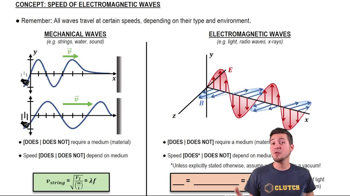
    The speed of light in vacuum is \(c=3.00\cdot10^{8}\ m/s\).
  • Write the equations describing changes in EM wave motion in a medium.

    The equations are \(c_n=c_0/n\), \(\lambda_n=\lambda_0/n\), and \(f_n=f_0\).
  • What is the law of reflection equation?

    The law of reflection is \(\theta_{a}=\theta^{\prime}_{b}\)

  • Does the law of reflection apply to rough surfaces? Explain.

    Yes, it applies. On rough surfaces, normals point in different directions, so reflection angles vary and no clear mirror image forms.
  • Write Snell's law equation.

    Snell's law is \(n_a\sin\theta_a=n_b\sin\theta_b\), relating angles and indices of refraction between two media.
  • How does the direction of an EM wave change when moving between media?

    If light slows in the second medium, it refracts toward the normal; if it speeds up, it refracts away from the normal.
  • Write the equation defining the critical angle.

    The critical angle is defined by \(\sin\theta_{crit}=\frac{n_b}{n_a}\).
  • When can total internal reflection occur?

    When an EM wave moves from a medium where it was moving more slowly, into a

    medium where it would be moving faster.

  • Write the equation defining the Brewster angle.

    The Brewster angle is given by \(\tan\theta_B=\frac{n_b}{n_a}\).
  • How does intensity change when unpolarized light becomes polarized?

    The intensity of polarized light is half the original: \(I_p=\frac{1}{2}I_0\).
  • How does intensity change when polarized light is polarized in a new direction?

    𝐼𝑛𝑒𝑤,𝑝 = 𝐼𝑝cos^2 𝜙 ; where the new polarization axis differs from the previous polarization

    axis by an angle 𝜙