뒤로

Physics: Motion and Vectors Study Guide
컨트롤 버튼이 '내비게이션' 모드로 변경되었습니다.
1/20
  • What type of quantity is speed?

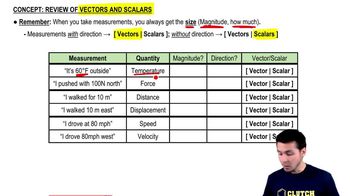
    Speed is a scalar quantity, meaning it has magnitude only and no direction.

  • Name two vector quantities in mechanics.

    Examples include velocity, acceleration, force, and displacement.

  • Can a ball on a frictionless incline accelerate faster than g?

    No, the acceleration along the incline is always between 0 and g, never exceeding free-fall acceleration.

  • What is the acceleration of a ball on a perfectly horizontal frictionless surface?

    The acceleration is zero because gravity acts perpendicular to the surface and does not cause acceleration along it.

  • How do you find the ground speed of an airplane flying at 100 km/h into a 100 km/h crosswind at 90°?

    Use vector addition with the Pythagorean theorem: \(\sqrt{100^2 + 100^2}\) ≈ 141 km/h.

  • Why can't you just add 100 + 100 to get the resultant speed in a crosswind?

    Because velocities are vectors, perpendicular components combine using the Pythagorean theorem, not simple arithmetic addition.

  • Why is hang time longer on the Moon than on Earth for the same jump?

    The Moon's gravity is about 1/6 of Earth's, so gravity pulls you down more slowly, increasing hang time.

  • What happens to hang time if gravity is doubled?

    Hang time decreases because stronger gravity pulls you back down faster.

  • What is the ground speed of a plane flying at 100 km/h with a 100 km/h tailwind?

    Speeds add directly in the same direction: 200 km/h.

  • Is the ground speed 200 km/h for a plane flying at 100 km/h with a 100 km/h crosswind at 90°?

    No, the ground speed is about 141 km/h due to vector addition.

  • What does a car's speedometer measure?

    It measures instantaneous speed, the speed at a specific moment in time.

  • If you stop for 30 minutes during a trip, what does your speedometer read during the stop?

    The speedometer reads 0 km/h because it shows instantaneous speed.

  • On a planet where g = 20 m/s², how fast is a dropped object moving after 3 seconds from rest?

    Speed = acceleration × time = 20 m/s² × 3 s = 60 m/s.

  • Does a faster-moving falling object gain speed more quickly than a slower one on the same planet?

    No, the rate of speed increase equals g regardless of current speed.

  • Which quantity remains constant for a freely falling object: speed, velocity, acceleration, or distance per second?

    Acceleration remains constant (~10 m/s²); speed and velocity change continuously.

  • If speed is increasing during free fall, why isn't acceleration also increasing?

    Acceleration is the rate of change of velocity and remains constant; speed increases steadily but acceleration does not change.

  • A ball is thrown upward at 30 m/s. How fast is it moving after 2 seconds?

    Speed after 2 s = 30 m/s − (10 m/s² × 2 s) = 10 m/s upward.

  • How much speed does an upward-thrown object lose each second due to gravity?

    It loses 10 m/s of speed every second.

  • Is a car accelerating if it rounds a curve at constant speed?

    Yes, because its velocity direction changes, so it is accelerating.

  • What is the key difference between speed and velocity?

    Velocity includes both magnitude and direction; speed includes only magnitude.