 뒤로
뒤로Physics: Newtonian Mechanics and Forces
 04:46
04:46
이 집합의 용어 (21)
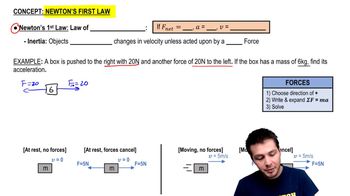
Inertia is a property of matter describing an object's resistance to changes in its state of motion; it is not a force.
Galileo introduced the concept of inertia before Newton formalized it.
An object moving at constant velocity or at rest will remain so unless acted on by an unbalanced force.
Your body's inertia keeps it moving straight forward while the bus turns beneath you; no real outward force pushes you.
No; the apparent outward force is due to inertia in a non-inertial reference frame.
Mechanical equilibrium occurs when the net force on an object is zero, resulting in zero acceleration.
Yes; zero net force means zero acceleration, not necessarily zero velocity.
Tension is a pulling force along a rope or wire that tends to stretch it.
More horizontal ropes require greater tension to provide the same vertical support.
The coin keeps its original horizontal velocity, so it lands behind you as the train moves forward.
The coin lands back in your hand because you and the coin share the same horizontal velocity.
Vectors have magnitude and direction; scalars have magnitude only.
Because direction affects how forces combine and cancel out.
The net force is zero because gravity and air resistance balance exactly.
No; it means all forces cancel out, but multiple forces can still be present.
A straight line at constant speed.
The string provides a centripetal force pulling the ball toward the center, causing circular motion.
Tension increases because only the vertical component supports the load; more horizontal means greater tension.
Each rope's tension is more than half the sign's weight due to the angle reducing vertical components.
The total tension equals 1000 N, matching the scaffold's weight.
No; the rope under the heavier side has greater tension, but tensions sum to total weight.