Why do all objects fall at the same rate in a vacuum?
Because the ratio of gravitational force (weight) to mass is the same for every object, equal to \(g\), resulting in identical acceleration.
What does the equation Weight = mg imply about acceleration in free fall?
Weight divided by mass equals \(g\), so acceleration due to gravity is constant for all masses.
Why do objects of different mass slide down a frictionless incline together?
Because both the gravitational component along the slope and inertia scale with mass, which cancel out, making acceleration depend only on the incline angle.
How does air resistance affect a ball thrown upward and caught at the same height?
Air resistance opposes motion both ways, so the ball returns slower than it was thrown due to energy loss.
What force does a bathroom scale read when you stand still on it?
The upward support (normal) force balancing gravity, equal in magnitude to your weight at equilibrium.
Are weight and mass the same physical quantity?
No, weight is a force measured in Newtons, while mass is the amount of matter; they are related but distinct.
When do action and reaction forces occur relative to each other?
They occur simultaneously at the exact same time, with no delay.
How does the normal force compare to weight on a horizontal surface?
On a flat horizontal surface, the normal force equals the full weight of the object.
How does the normal force compare to weight on an inclined surface?
The normal force equals weight times \(\cos(\theta)\), which is less than the full weight.
What does Newton's Third Law say about the magnitude of action and reaction forces?
They are always exactly equal in magnitude and opposite in direction.
Why can't a boxer punch tissue paper with more than 50 N of force if the paper can only push back with 50 N?
Because Newton's Third Law requires equal and opposite forces; the weaker object limits the maximum force.
What is the reaction force to Earth's gravity pulling a ball downward?
The ball's gravity pulling Earth upward with equal magnitude and opposite direction.
Is air resistance the reaction force to gravity on a falling ball?
No, air resistance is a separate force from the interaction between the ball and air, not paired with gravity.
When a bat hits a ball, when does the ball push back on the bat?
At the exact same instant the bat pushes the ball; the forces are simultaneous.
Why don't action-reaction forces cancel each other out?
Because they act on different objects, so they cannot cancel.
What two forces act on you when standing still on a bathroom scale?
Gravity pulling you down and the scale's support force pushing you up, equal and opposite.
If an elevator accelerates upward, how does the scale reading change?
The scale reads more than normal because it must provide extra upward force to accelerate you.
Why doesn't a heavier block slide faster on a frictionless incline?
Because increased gravitational force is balanced by increased inertia; acceleration is independent of mass.
What determines the maximum force in an interaction like a punch?
The weaker object limits the maximum force because it can only push back with a certain force.
How does the normal force change as the incline angle increases?
The normal force decreases because it equals weight times \(\cos(\theta)\), which gets smaller as the angle increases.
 뒤로
뒤로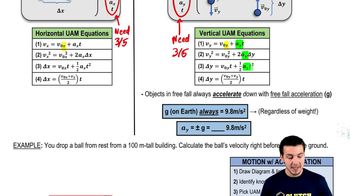
 08:36
08:36