 뒤로
뒤로Simple Harmonic Motion Concepts
 04:07
04:07
이 집합의 용어 (20)
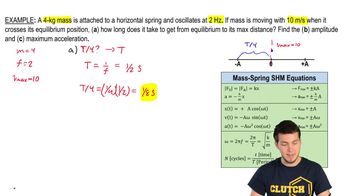
SHM is a type of periodic motion where the restoring force is directly proportional to the displacement and acts in the opposite direction.
The restoring force is the force that always acts to bring the system back to its equilibrium position.
The restoring force is given by \(F = -kx\), where k is the force constant and x is the displacement.
Displacement is the distance of the particle from its equilibrium position at any instant.
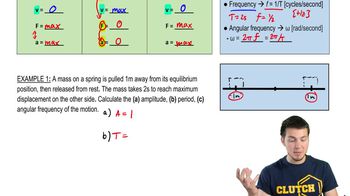
Amplitude is the maximum displacement from the equilibrium position.
The period is the time taken to complete one full oscillation.
Frequency is the number of oscillations per unit time, the inverse of the period.
The relation is \(f = \frac{1}{T}\), where f is frequency and T is period.
Phase indicates the state of the oscillation at a given time, often expressed as an angle in radians.
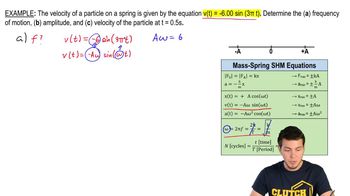
Displacement is \(x = A \cos(\omega t + \phi)\), where A is amplitude, \(\omega\) is angular frequency, and \(\phi\) is phase constant.
Angular frequency \(\omega\) is the rate of change of phase and is related to period by \(\omega = \frac{2\pi}{T}\).
Velocity is \(v = -A \omega \sin(\omega t + \phi)\), the time derivative of displacement.
Acceleration is \(a = -\omega^2 x\), proportional and opposite to displacement.
Total mechanical energy is \(E = \frac{1}{2}kA^2\), constant and sum of kinetic and potential energies.
Potential energy is \(U = \frac{1}{2}kx^2\), stored due to displacement.
Kinetic energy is \(K = \frac{1}{2}k(A^2 - x^2)\), energy of motion.
\(\omega = \sqrt{\frac{k}{m}}\), where m is mass and k is spring constant.
Phase constant \(\phi\) determines the initial position and velocity of the oscillating particle.
The force must be linear restoring, i.e., proportional to displacement and directed towards equilibrium.
A mass-spring system oscillating on a frictionless surface is a classic example of SHM.