Ch. 01 - Introduction, Measurement, Estimating
Giancoli Douglas - Physics for Scientists and Engineers 5th edition
Giancoli Douglas5th editionPhysics for Scientists and EngineersISBN: 9780137488179당신이 사용하는 게 아니라요?교과서 변경
1장, 문제 77

The following formula estimates an average person's lung capacity V (in liters, where 1 L = 10³ cm³): V = 4.1H ― 0.018A ―2.7, where H and A are the person's height (in meters) and age (in years), respectively. In this formula, what are the units of the numbers 4.1, 0.018, and 2.7?

검증된 단계별 안내
1
Step 1: Begin by analyzing the formula provided: \( V = 4.1H - 0.018A - 2.7 \). Here, \( V \) represents lung capacity in liters (L), \( H \) is height in meters (m), and \( A \) is age in years (yr). The goal is to determine the units of the constants 4.1, 0.018, and 2.7.
Step 2: Focus on the first term, \( 4.1H \). Since \( H \) has units of meters (m) and the result \( V \) must have units of liters (L), the constant 4.1 must have units of \( \text{L/m} \) to ensure the product \( 4.1H \) has units of liters.
Step 3: Next, consider the second term, \( 0.018A \). Here, \( A \) has units of years (yr), and the result must again have units of liters (L). Therefore, the constant 0.018 must have units of \( \text{L/yr} \) to ensure the product \( 0.018A \) has units of liters.
Step 4: Finally, examine the constant \( -2.7 \). Since this is a standalone term being subtracted, it must already have the same units as \( V \), which is liters (L). Thus, the constant \( -2.7 \) has units of liters.
Step 5: Summarize the findings: The units of 4.1 are \( \text{L/m} \), the units of 0.018 are \( \text{L/yr} \), and the units of 2.7 are \( \text{L} \). This ensures dimensional consistency throughout the formula.

비슷한 문제에 대한 검증된 영상 답변:

이 영상 해법은 위 문제에 도움이 된다고 튜터들이 추천한 것입니다.
도움이 되었나요?

주요 개념

질문에 올바르게 답하기 위해 반드시 이해해야 하는 핵심 개념들은 다음과 같습니다.

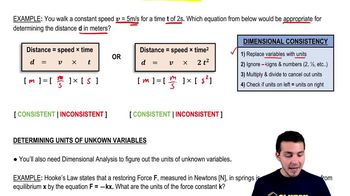
Dimensional Analysis

Dimensional analysis is a method used in physics and engineering to check the consistency of equations by ensuring that both sides of an equation have the same dimensions or units. It helps in understanding how different physical quantities relate to each other and is crucial for determining the units of constants in formulas.
추천 영상:
가이드 코스
05:00
Dimensional Analysis

Units of Measurement

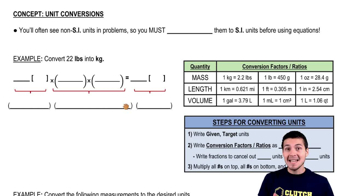
Units of measurement are standard quantities used to express physical properties. In the context of the given formula, understanding the units for height (meters) and age (years) is essential to deduce the units of the constants 4.1, 0.018, and 2.7, which must be consistent with the output unit of lung capacity (liters).
추천 영상:
가이드 코스
07:46
Unit Conversions

Linear Relationships

Linear relationships describe how one variable changes in relation to another in a straight-line manner. In the formula provided, the constants represent coefficients that define how height and age influence lung capacity, indicating that lung capacity increases linearly with height and decreases slightly with age.
추천 영상:
가이드 코스
07:31
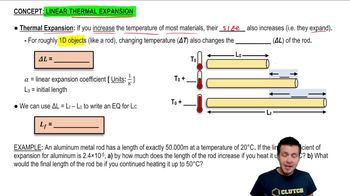
Linear Thermal Expansion
관련 실천
교과서 질문

The speed v of an object is given by the equation v = At³ ― Bt, where t refers to time. What are the SI units for the constants A and B?

2083
views

교과서 질문

Waves on the surface of the ocean do not depend significantly on the properties of water such as density or surface tension. The primary 'return force' for water piled up in the wave crests is due to the gravitational attraction of the Earth. Thus the speed v (m/s) of ocean waves depends on the acceleration due to gravity g. It is reasonable to expect that υ might also depend on water depth h and the wave's wavelength λ. Assume the wave speed is given by the functional form v = Cgᵅ hᵝ λᵞ, where α, β, γ\(\gamma\), and C are numbers without dimension. In shallow water, the speed of surface waves is found experimentally to be independent of the wavelength (i.e., γ = 0 in our assumed equation above for v). Using only dimensional analysis, determine the formula for the speed of waves in shallow water.

1985
views
교과서 질문

One mole of atoms consists of 6.02 x 10²³ individual atoms. If a mole of atoms were spread uniformly over the Earth's surface, how many atoms would there be per square meter?

1272
views
교과서 질문

Show that the following combination of the three fundamental constants of nature that we used in Example 1–10 (that is G, c, and h) forms a quantity with the dimensions of time: tₚ = Gh\(\sqrt{Gh}\)/c⁵. This quantity, tₚ, is called the Planck time and is thought to be the earliest time, after the creation of the Universe, at which the currently known laws of physics can be applied.

3095
views