
A robot used in a pharmacy picks up a medicine bottle at t = 0. It accelerates at 0.20 m/s² for 4.5 s, then travels without acceleration for 68 s and finally decelerates at ―0.40 m/s² for 2.5 s to reach the counter where the pharmacist will take the medicine from the robot. From how far away did the robot fetch the medicine?
Ch. 02 - Describing Motion: Kinematics in One Dimension
Giancoli Douglas5th editionPhysics for Scientists and EngineersISBN: 9780137488179당신이 사용하는 게 아니라요?교과서 변경
2장, 문제 100
Bill can throw a ball vertically at a speed 1.5 times faster than Joe can. How many times higher will Bill's ball go than Joe's?
검증된 단계별 안내1
Identify the relationship between the maximum height of a projectile and its initial velocity. The maximum height (h) is given by the formula: , where is the initial velocity and is the acceleration due to gravity.
Recognize that Bill's initial velocity is 1.5 times Joe's initial velocity. Let Joe's initial velocity be , so Bill's initial velocity is .
Substitute the initial velocities into the height formula for both Bill and Joe. For Joe: . For Bill: .
Simplify the expression for Bill's height. Using , Bill's height becomes: .
Find the ratio of Bill's height to Joe's height: . This shows that Bill's ball will go 2.25 times higher than Joe's.

비슷한 문제에 대한 검증된 영상 답변:
이 영상 해법은 위 문제에 도움이 된다고 튜터들이 추천한 것입니다.
영상 길이:
12m도움이 되었나요?
주요 개념
질문에 올바르게 답하기 위해 반드시 이해해야 하는 핵심 개념들은 다음과 같습니다.
Kinematics
Kinematics is the branch of mechanics that describes the motion of objects without considering the forces that cause the motion. It involves concepts such as displacement, velocity, and acceleration. In this context, understanding kinematics is essential to analyze how the initial speed of the ball affects its maximum height.
추천 영상:
가이드 코스
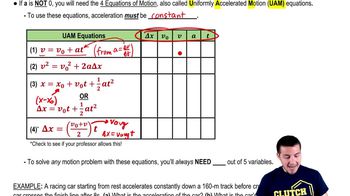
Kinematics Equations
Projectile Motion
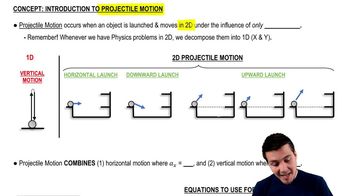
Projectile motion refers to the motion of an object that is thrown or projected into the air, subject only to the acceleration of gravity. For vertical throws, the maximum height reached by the projectile can be calculated using the initial velocity and the acceleration due to gravity. This concept is crucial for determining how the height of Bill's throw compares to Joe's.
추천 영상:
가이드 코스
Introduction to Projectile Motion
Energy Conservation
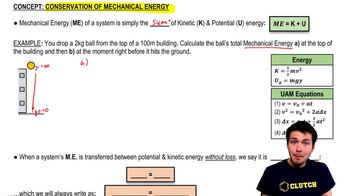
The principle of energy conservation states that energy cannot be created or destroyed, only transformed from one form to another. In the context of projectile motion, the kinetic energy of the ball at the moment of release is converted into gravitational potential energy at its peak height. This relationship helps in calculating the heights reached by Bill and Joe based on their respective throwing speeds.
추천 영상:
가이드 코스
Conservation Of Mechanical Energy
관련 실천
교과서 질문
1369
views
교과서 질문
Figure 2–55 shows the position vs. time graph for two bicycles, A and B. At which instant(s) are the bicycles passing each other? Which bicycle is passing the other?
1649
views
교과서 질문
A parachutist bails out of an airplane, and freely falls 75 m (ignore air friction). Then the parachute opens, and her acceleration is ― 1.5 m/s² (up). The parachutist reaches the ground with a speed of 1.5 m/s. From how high did she bail out of the plane?
1685
views
교과서 질문
Suppose a 65-kg person jumps from a height of 3.0 m down to the ground. What is the speed of the person just before landing (Chapter 2)?
<IMAGE>
1542
views
교과서 질문
Figure 2–55 shows the position vs. time graph for two bicycles, A and B. Which bicycle has the larger average velocity?
1679
views
