Ch. 02 - Describing Motion: Kinematics in One Dimension
2์žฅ, ๋ฌธ์ œ 27a

The position of an object is given by ๐“ = At + Btยฒ, where ๐“ is in meters and t is in seconds. What are the units of A and B?

๊ฒ€์ฆ๋œ ๋‹จ๊ณ„๋ณ„ ์•ˆ๋‚ด
1
Step 1: Start by analyzing the given equation for position: ๐“ = At + Btยฒ. Here, ๐“ represents position in meters (m), t represents time in seconds (s), and A and B are constants with unknown units.
Step 2: Focus on the term At. Since ๐“ is in meters, the product At must also have units of meters. The unit of t is seconds (s), so the unit of A must be meters per second (m/s) to ensure the product At has units of meters.
Step 3: Now, consider the term Btยฒ. Again, since ๐“ is in meters, the product Btยฒ must also have units of meters. The unit of tยฒ is seconds squared (sยฒ), so the unit of B must be meters per second squared (m/sยฒ) to ensure the product Btยฒ has units of meters.
Step 4: Summarize the findings: The unit of A is meters per second (m/s), and the unit of B is meters per second squared (m/sยฒ).
Step 5: Verify the consistency of units in the equation: Substitute the derived units of A and B into the equation ๐“ = At + Btยฒ. Confirm that both terms At and Btยฒ have units of meters, ensuring the equation is dimensionally consistent.

๋น„์Šทํ•œ ๋ฌธ์ œ์— ๋Œ€ํ•œ ๊ฒ€์ฆ๋œ ์˜์ƒ ๋‹ต๋ณ€:

์ด ์˜์ƒ ํ•ด๋ฒ•์€ ์œ„ ๋ฌธ์ œ์— ๋„์›€์ด ๋œ๋‹ค๊ณ  ํŠœํ„ฐ๋“ค์ด ์ถ”์ฒœํ•œ ๊ฒƒ์ž…๋‹ˆ๋‹ค.

์ฃผ์š” ๊ฐœ๋…

์งˆ๋ฌธ์— ์˜ฌ๋ฐ”๋ฅด๊ฒŒ ๋‹ตํ•˜๊ธฐ ์œ„ํ•ด ๋ฐ˜๋“œ์‹œ ์ดํ•ดํ•ด์•ผ ํ•˜๋Š” ํ•ต์‹ฌ ๊ฐœ๋…๋“ค์€ ๋‹ค์Œ๊ณผ ๊ฐ™์Šต๋‹ˆ๋‹ค.

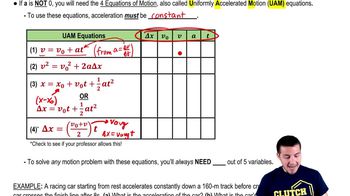
Kinematic Equations

Kinematic equations describe the motion of objects under constant acceleration. In this context, the equation ๐“ = At + Btยฒ represents the position of an object as a function of time, where A and B are coefficients that influence the object's motion. Understanding these equations is essential for analyzing how position changes with time.
์ถ”์ฒœ ์˜์ƒ:

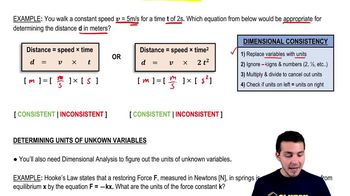
Dimensional Analysis

Dimensional analysis is a method used to convert units and check the consistency of equations. By analyzing the dimensions of each term in the equation, we can determine the units of A and B. This technique ensures that all terms in the equation are compatible, which is crucial for solving physics problems.
์ถ”์ฒœ ์˜์ƒ:

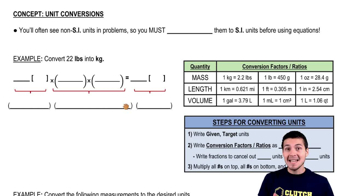
Units of Measurement

Units of measurement provide a standard for quantifying physical quantities. In this equation, ๐“ is measured in meters (m) and time t in seconds (s). The units of A and B can be derived from the equation by ensuring that the terms on both sides have the same dimensions, leading to a clear understanding of their physical significance.
์ถ”์ฒœ ์˜์ƒ: