
Ch. 03 - Kinematics in Two or Three Dimensions; Vectors
Giancoli Douglas - Physics for Scientists and Engineers 5th edition
Giancoli Douglas5th editionPhysics for Scientists and EngineersISBN: 9780137488179당신이 사용하는 게 아니라요?교과서 변경
3장, 문제 73a

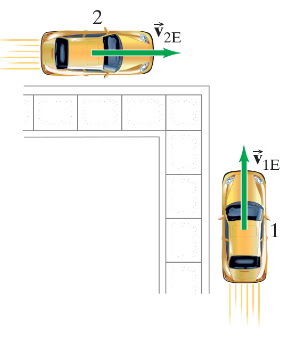
Two cars approach a street corner at right angles to each other (Fig. 3–57). Car 1 travels at a speed relative to Earth v₁ₑ = 35 km/h, and car 2 at v₂ₑ = 55 km/h. What is the relative velocity of car 1 as seen by car 2? What is the velocity of car 2 relative to car 1?

검증된 단계별 안내
1
Understand the problem: The goal is to find the relative velocity of car 1 as seen by car 2, and vice versa. This involves vector subtraction of velocities since the cars are moving at right angles to each other.
Define the velocity vectors: Let the velocity of car 1 relative to Earth be \( \vec{v}_{1e} \) and the velocity of car 2 relative to Earth be \( \vec{v}_{2e} \). Since the cars are moving at right angles, we can represent \( \vec{v}_{1e} \) as \( 35 \ \text{km/h} \) along the x-axis and \( \vec{v}_{2e} \) as \( 55 \ \text{km/h} \) along the y-axis.
Calculate the relative velocity of car 1 as seen by car 2: The relative velocity \( \vec{v}_{12} \) is given by \( \vec{v}_{12} = \vec{v}_{1e} - \vec{v}_{2e} \). Subtract the components of \( \vec{v}_{2e} \) from \( \vec{v}_{1e} \): \( \vec{v}_{12} = (35 \ \text{km/h}) \hat{i} - (55 \ \text{km/h}) \hat{j} \).
Calculate the relative velocity of car 2 as seen by car 1: The relative velocity \( \vec{v}_{21} \) is the negative of \( \vec{v}_{12} \), i.e., \( \vec{v}_{21} = -\vec{v}_{12} = -(35 \ \text{km/h}) \hat{i} + (55 \ \text{km/h}) \hat{j} \).
Determine the magnitude and direction of the relative velocities: Use the Pythagorean theorem to find the magnitude of \( \vec{v}_{12} \) or \( \vec{v}_{21} \): \( |\vec{v}_{12}| = \sqrt{(35)^2 + (55)^2} \). To find the direction, calculate the angle \( \theta \) using \( \tan^{-1}(\text{opposite}/\text{adjacent}) \), where opposite and adjacent are the y and x components of the velocity vector.

비슷한 문제에 대한 검증된 영상 답변:

이 영상 해법은 위 문제에 도움이 된다고 튜터들이 추천한 것입니다.
영상 길이:
8m
도움이 되었나요?

주요 개념

질문에 올바르게 답하기 위해 반드시 이해해야 하는 핵심 개념들은 다음과 같습니다.

Relative Velocity

Relative velocity is the velocity of one object as observed from another moving object. It is calculated by subtracting the velocity vector of the observer from the velocity vector of the object being observed. This concept is crucial for understanding how two objects interact in motion, especially when they are moving at angles to each other.
추천 영상:
가이드 코스
04:27
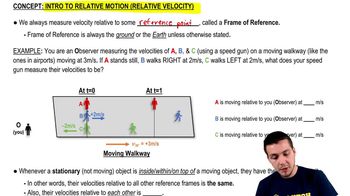
Intro to Relative Motion (Relative Velocity)

Vector Addition

Vector addition is the process of combining two or more vectors to determine a resultant vector. In the context of relative velocity, it involves adding the velocity vectors of the two cars, taking into account their directions. This is often done using the Pythagorean theorem when the vectors are perpendicular, as in this case.
추천 영상:
가이드 코스
07:30
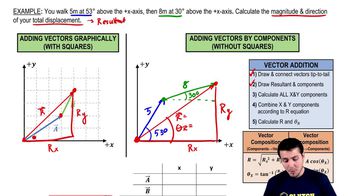
Vector Addition By Components

Coordinate System

A coordinate system provides a framework for describing the position and motion of objects in space. In this problem, a two-dimensional Cartesian coordinate system can be used, where one car's motion is along the x-axis and the other's along the y-axis. Understanding how to represent motion in a coordinate system is essential for accurately calculating relative velocities.
추천 영상:
가이드 코스
05:17
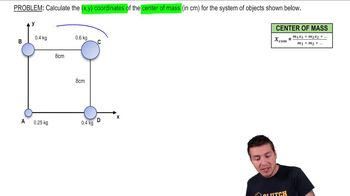
Coordinates of Center of Mass of 4 objects