
Ch. 05 - Using Newton's Laws: Friction, Circular Motion, Drag Forces
Giancoli Douglas - Physics for Scientists and Engineers 5th edition
Giancoli Douglas5th editionPhysics for Scientists and EngineersISBN: 9780137488179당신이 사용하는 게 아니라요?교과서 변경
5장, 문제 104b

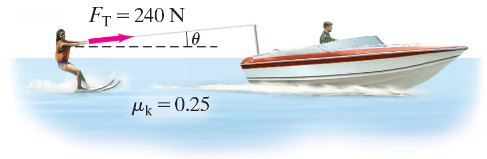
A 68-kg water skier is being accelerated by a ski boat on a flat ('glassy') lake. The coefficient of kinetic friction between the skier's skis and the water surface is μₖ = 0.25 (Fig. 5–59). What is the skier's horizontal acceleration if the rope pulling the skier exerts a force of FT = 240N on the skier at an upward angle θ = 12°?
A water skier being pulled by a boat on a lake, with force and friction details illustrated.

검증된 단계별 안내
1
Step 1: Break down the forces acting on the skier. The forces include the tension in the rope (F_T), the gravitational force (F_g = m * g), the normal force (F_N), and the kinetic friction force (F_f). The tension force has both horizontal and vertical components due to the angle θ.
Step 2: Resolve the tension force into its components. The horizontal component is F_Tx = F_T * cos(θ), and the vertical component is F_Ty = F_T * sin(θ). Use these components to analyze the net forces in the horizontal and vertical directions.
Step 3: Calculate the normal force (F_N). The normal force is affected by the vertical component of the tension force. It can be expressed as F_N = F_g - F_Ty, where F_g = m * g (gravitational force).
Step 4: Determine the kinetic friction force (F_f). The kinetic friction force is given by F_f = μₖ * F_N. Substitute the expression for F_N from Step 3 into this equation.
Step 5: Apply Newton's second law in the horizontal direction. The net horizontal force is F_net = F_Tx - F_f. Using F_net = m * a, solve for the horizontal acceleration a = F_net / m. Substitute the expressions for F_Tx and F_f to find the acceleration.

비슷한 문제에 대한 검증된 영상 답변:

이 영상 해법은 위 문제에 도움이 된다고 튜터들이 추천한 것입니다.
영상 길이:
7m
도움이 되었나요?

주요 개념

질문에 올바르게 답하기 위해 반드시 이해해야 하는 핵심 개념들은 다음과 같습니다.

Newton's Second Law of Motion

Newton's Second Law states that the acceleration of an object is directly proportional to the net force acting on it and inversely proportional to its mass. This relationship is expressed by the formula F = ma, where F is the net force, m is the mass, and a is the acceleration. In this scenario, understanding how to calculate the net force acting on the skier is crucial for determining their horizontal acceleration.
추천 영상:
가이드 코스
06:54
Intro to Forces & Newton's Second Law

Friction and Coefficient of Kinetic Friction

Friction is the force that opposes the relative motion of two surfaces in contact. The coefficient of kinetic friction (μₖ) quantifies this force, with a value that depends on the materials involved. In this case, the kinetic friction force acting on the skier can be calculated using the formula F_friction = μₖ * N, where N is the normal force. This concept is essential for understanding the forces acting against the skier's motion.
추천 영상:
가이드 코스
06:18
Kinetic Friction Problems

Components of Forces

When a force is applied at an angle, it can be resolved into horizontal and vertical components using trigonometric functions. For a force F_T at an angle θ, the horizontal component is F_T * cos(θ) and the vertical component is F_T * sin(θ). In this problem, resolving the pulling force into its components is necessary to analyze the net force acting on the skier and subsequently calculate their horizontal acceleration.
추천 영상:
가이드 코스
07:30
Vector Addition By Components