
Ch. 08 - Conservation of Energy
Giancoli Douglas - Physics for Scientists and Engineers 5th edition
Giancoli Douglas5th editionPhysics for Scientists and EngineersISBN: 9780137488179당신이 사용하는 게 아니라요?교과서 변경
8장, 문제 38c

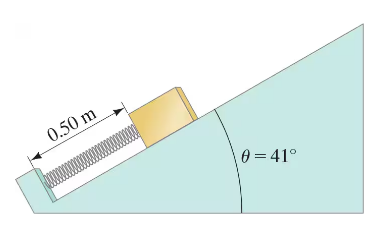
A spring ( k = 75 N/m) has an equilibrium length of 1.00 m. The spring is compressed to a length of 0.50 m and a mass of 2.0 kg is placed at its free end on a frictionless slope which makes an angle of 41° with respect to the horizontal (Fig. 8–41). The spring is then released. Now the incline has a coefficient of kinetic friction μₖ. If the block, attached to the spring, is observed to stop just as it reaches the spring’s equilibrium position, what is the coefficient of friction μₖ?

검증된 단계별 안내
1
Identify the key concepts involved: The problem involves energy conservation, spring potential energy, kinetic energy, gravitational potential energy, and work done by friction. The spring is compressed, and the block moves up the incline, stopping at the spring's equilibrium position due to friction.
Write the energy conservation equation: The initial energy stored in the spring (spring potential energy) is converted into work done against friction and gravitational potential energy. The equation is: \( \frac{1}{2} k x^2 = m g h + f_k d \), where \( f_k \) is the frictional force, \( d \) is the distance traveled, and \( h \) is the height gained.
Express the frictional force: The frictional force is given by \( f_k = \mu_k N \), where \( N \) is the normal force. On an incline, \( N = m g \cos \theta \). Substitute \( f_k \) into the energy equation.
Relate the height \( h \) and distance \( d \): The height gained \( h \) is related to the distance traveled \( d \) along the incline by \( h = d \sin \theta \). Substitute this into the energy equation to eliminate \( h \).
Solve for \( \mu_k \): Rearrange the energy equation to isolate \( \mu_k \). The final expression will be \( \mu_k = \frac{\frac{1}{2} k x^2 - m g d \sin \theta}{m g d \cos \theta} \). Use the given values for \( k \), \( x \), \( m \), \( \theta \), and \( d \) (which is the spring's compression length, 0.50 m) to calculate \( \mu_k \).

비슷한 문제에 대한 검증된 영상 답변:

이 영상 해법은 위 문제에 도움이 된다고 튜터들이 추천한 것입니다.
영상 길이:
7m

주요 개념

질문에 올바르게 답하기 위해 반드시 이해해야 하는 핵심 개념들은 다음과 같습니다.

Hooke's Law

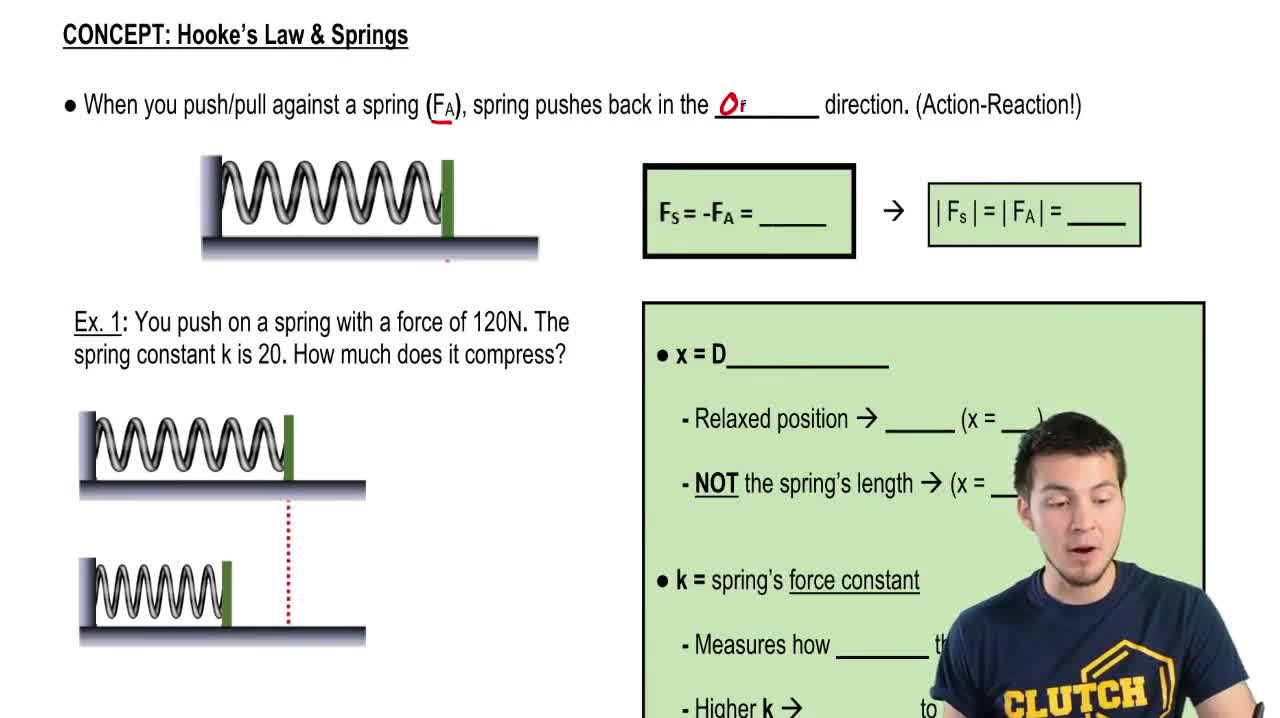
Hooke's Law states that the force exerted by a spring is directly proportional to its displacement from the equilibrium position, expressed as F = -kx, where F is the force, k is the spring constant, and x is the displacement. In this scenario, understanding how the spring's compression affects the force acting on the mass is crucial for analyzing the motion of the block on the incline.
추천 영상:
가이드 코스
05:27
Spring Force (Hooke's Law)

Friction and Coefficient of Friction

Friction is the force that opposes the relative motion of two surfaces in contact. The coefficient of kinetic friction (μₖ) quantifies this force and is defined as the ratio of the frictional force to the normal force. In this problem, determining μₖ is essential to understand how it affects the block's motion as it moves up the incline and eventually stops.
추천 영상:
가이드 코스
08:11
Static Friction & Equilibrium

Energy Conservation

The principle of energy conservation states that energy cannot be created or destroyed, only transformed from one form to another. In this context, the potential energy stored in the compressed spring is converted into kinetic energy of the block and work done against friction as it moves up the incline. Analyzing these energy transformations is key to finding the coefficient of friction.
추천 영상:
가이드 코스
06:24
Conservation Of Mechanical Energy
관련 실천
교과서 질문

Consider the track shown in Fig. 8–39. The section AB is one quadrant of a circle of radius 2.0 m and is frictionless. B to C is a horizontal span 3.0 m long with a coefficient of kinetic friction μₖ = 0.25. The section CD under the spring is frictionless. A block of mass 1.0 kg is released from rest at A. After sliding on the track, it compresses the spring by 0.20 m. Determine the velocity of the block at point C.

1677
views
교과서 질문

Early test flights for the space shuttle used a “glider” (mass of 980 kg including pilot). After a horizontal launch at 480 km/h at a height of 3200 m, the glider eventually landed at sea level with a speed of 210 km/h. What would its landing speed have been in the absence of air resistance?

1583
views
교과서 질문

Determine the escape velocity from the Sun for an object at the average distance of the Earth (1.50 x 10⁸ km). Compare (give factor for each) to the speed of the Earth in its orbit.

1712
views
교과서 질문

Determine the escape velocity from the Sun for an object at the Sun’s surface ( r = 7.0 x 10⁵ km , M = 2.0 x 10³⁰ kg).

1712
views
교과서 질문

A spring ( k = 75 N/m) has an equilibrium length of 1.00 m. The spring is compressed to a length of 0.50 m and a mass of 2.0 kg is placed at its free end on a frictionless slope which makes an angle of 41° with respect to the horizontal (Fig. 8–41). The spring is then released. If the mass is attached to the spring, how far up the slope will the mass move before coming to rest?

1010
views
교과서 질문

Consider the track shown in Fig. 8–39. The section AB is one quadrant of a circle of radius 2.0 m and is frictionless. B to C is a horizontal span 3.0 m long with a coefficient of kinetic friction μₖ = 0.25. The section CD under the spring is frictionless. A block of mass 1.0 kg is released from rest at A. After sliding on the track, it compresses the spring by 0.20 m. Determine the stiffness constant k for the spring.

1467
views