
Ch. 08 - Conservation of Energy
Giancoli Douglas - Physics for Scientists and Engineers 5th edition
Giancoli Douglas5th editionPhysics for Scientists and EngineersISBN: 9780137488179당신이 사용하는 게 아니라요?교과서 변경
8장, 문제 74a

The potential energy of the two atoms in a diatomic (two-atom) molecule can be approximated as (Lennard-Jones potential) U(r) = -(a/r⁶) + (b/r¹²), where r is the distance between the two atoms and a and b are positive constants. At what values of r is U(r) a minimum? A maximum?

검증된 단계별 안내
1
Start by understanding the problem: The Lennard-Jones potential is given as U(r) = -(a/r⁶) + (b/r¹²), where r is the distance between two atoms, and a and b are constants. To find the values of r where U(r) is a minimum or maximum, we need to analyze the derivative of U(r) with respect to r.
Take the first derivative of U(r) with respect to r. Using the power rule for differentiation, the derivative is: dU/dr = 6a/r⁷ - 12b/r¹³.
Set the first derivative equal to zero to find the critical points: 6a/r⁷ - 12b/r¹³ = 0. Simplify this equation to isolate r: 6a/r⁷ = 12b/r¹³. Divide through by 6 and simplify further: a/r⁷ = 2b/r¹³.
Solve for r by multiplying through by r¹³: a * r⁶ = 2b. Then isolate r by dividing both sides by 2b and taking the sixth root: r = (2b/a)^(1/6). This gives the value of r where U(r) is a minimum.
To determine if there is a maximum, take the second derivative of U(r) with respect to r and analyze its sign at the critical points. If the second derivative is positive, the critical point is a minimum; if negative, it is a maximum. For this potential, U(r) has a minimum at r = (2b/a)^(1/6) and no maximum within the physical range of r.

비슷한 문제에 대한 검증된 영상 답변:

이 영상 해법은 위 문제에 도움이 된다고 튜터들이 추천한 것입니다.

주요 개념

질문에 올바르게 답하기 위해 반드시 이해해야 하는 핵심 개념들은 다음과 같습니다.

Lennard-Jones Potential

The Lennard-Jones potential is a mathematical model that describes the interaction between a pair of neutral atoms or molecules. It accounts for both attractive forces, which dominate at longer distances, and repulsive forces, which become significant at very short distances. The potential is expressed as U(r) = -(a/r⁶) + (b/r¹²), where 'a' and 'b' are constants that characterize the strength of these interactions.
추천 영상:
가이드 코스
07:33
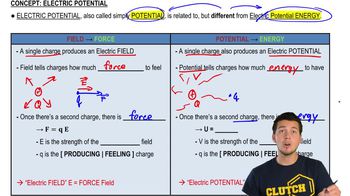
Electric Potential

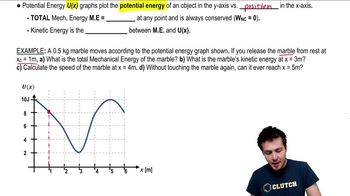
Potential Energy Minimum and Maximum

In the context of potential energy, a minimum occurs at a point where the potential energy is lower than at surrounding points, indicating a stable configuration. Conversely, a maximum occurs where the potential energy is higher than at neighboring points, indicating an unstable configuration. To find these points, one typically takes the derivative of the potential energy function and sets it to zero to solve for critical points.
추천 영상:
가이드 코스
07:24
Potential Energy Graphs

Critical Points and Stability

Critical points in a function occur where the first derivative is zero or undefined, indicating potential minima or maxima. To determine the nature of these critical points, the second derivative test is used: if the second derivative is positive, the point is a minimum (stable), and if negative, it is a maximum (unstable). This analysis is crucial for understanding the stability of molecular configurations in the Lennard-Jones potential.
추천 영상:
관련 실천
교과서 질문

The graph of Fig. 8–43 shows the potential energy curve of a particle moving along the 𝓍 axis under the influence of a conservative force. Note that the total energy E > U(𝓍), so that the particle’s speed is never zero. In which interval(s) of 𝓍 is the force on the particle to the right?

1966
views
교과서 질문

Water flows slowly over a dam at the rate of 320 kg/s and falls vertically 88 m before striking the turbine blades. Calculate the rate at which mechanical energy is transferred to the turbine blades, assuming 55% efficiency.

1632
views
교과서 질문

Proper design of automobile braking systems must account for heat buildup under heavy braking. Calculate the thermal energy dissipated from brakes in a 1500-kg car that descends a 17° hill. The car begins braking when its speed is 95 km/h and slows to a speed of 35 km/h in a distance of 0.30 km measured along the road.

1617
views
교과서 질문

The graph of Fig. 8–43 shows the potential energy curve of a particle moving along the 𝓍 axis under the influence of a conservative force. Note that the total energy E > U(𝓍), so that the particle’s speed is never zero. At what value(s) of 𝓍 is the magnitude of the force a minimum?

1770
views
교과서 질문

The position of a 280-g object is given (in meters) by x = 4.0t³ - 8.0t² - 44t, where t is in seconds. What is the average net power input during the interval from t = 0s to t = 2.0 s, and in the interval from t = 2.0 s to 4.0 s?

2054
views
교과서 질문

If you stand on a bathroom scale, the spring inside the scale compresses 0.60 mm, and it tells you your weight is 760 N. Now if you jump on the scale from a height of 1.0 m, what does the scale read at its peak? Assume Hooke’s law holds.

1306
views