
Ch. 09 - Linear Momentum
Giancoli Douglas - Physics for Scientists and Engineers 5th edition
Giancoli Douglas5th editionPhysics for Scientists and EngineersISBN: 9780137488179당신이 사용하는 게 아니라요?교과서 변경
9장, 문제 41

Croquet ball A moving at 4.3 m/s makes a head-on collision with ball B of equal mass initially at rest. Immediately after the collision, ball B moves forward at 3.0 m/s. What fraction of the initial kinetic energy is lost in the collision?

검증된 단계별 안내
1
Identify the given values: Ball A's initial velocity \( v_{A,i} = 4.3 \; \text{m/s} \), Ball B's initial velocity \( v_{B,i} = 0 \; \text{m/s} \), Ball B's final velocity \( v_{B,f} = 3.0 \; \text{m/s} \), and the masses of both balls are equal (\( m_A = m_B \)).
Use the principle of conservation of momentum to find the final velocity of Ball A (\( v_{A,f} \)). The total momentum before and after the collision must be equal: \( m_A v_{A,i} + m_B v_{B,i} = m_A v_{A,f} + m_B v_{B,f} \). Simplify this equation since \( m_A = m_B \): \( v_{A,i} = v_{A,f} + v_{B,f} \). Solve for \( v_{A,f} \): \( v_{A,f} = v_{A,i} - v_{B,f} \).
Substitute the known values into the equation for \( v_{A,f} \): \( v_{A,f} = 4.3 - 3.0 \; \text{m/s} \). This gives the final velocity of Ball A, which will be used in the next step.
Calculate the initial kinetic energy (\( KE_{initial} \)) and the final kinetic energy (\( KE_{final} \)) of the system. The kinetic energy of an object is given by \( KE = \frac{1}{2} m v^2 \). For the initial kinetic energy: \( KE_{initial} = \frac{1}{2} m_A v_{A,i}^2 \). For the final kinetic energy: \( KE_{final} = \frac{1}{2} m_A v_{A,f}^2 + \frac{1}{2} m_B v_{B,f}^2 \).
Determine the fraction of the initial kinetic energy lost in the collision. The energy lost is \( KE_{lost} = KE_{initial} - KE_{final} \). The fraction of energy lost is then \( \text{Fraction lost} = \frac{KE_{lost}}{KE_{initial}} \). Substitute the expressions for \( KE_{initial} \) and \( KE_{final} \) to find the fraction.

비슷한 문제에 대한 검증된 영상 답변:

이 영상 해법은 위 문제에 도움이 된다고 튜터들이 추천한 것입니다.
영상 길이:
9m
도움이 되었나요?

주요 개념

질문에 올바르게 답하기 위해 반드시 이해해야 하는 핵심 개념들은 다음과 같습니다.

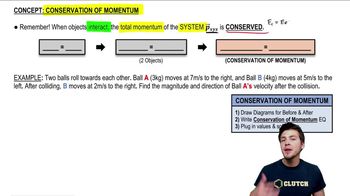
Conservation of Momentum

In a closed system, the total momentum before a collision is equal to the total momentum after the collision. This principle is crucial for analyzing collisions, as it allows us to relate the velocities and masses of the colliding objects. In this scenario, the momentum of ball A before the collision must equal the combined momentum of both balls after the collision.
추천 영상:
가이드 코스
05:58
Conservation Of Momentum

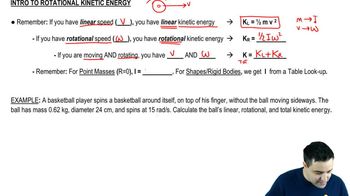
Kinetic Energy

Kinetic energy is the energy an object possesses due to its motion, calculated using the formula KE = 1/2 mv², where m is mass and v is velocity. In collisions, it is important to compare the initial and final kinetic energies to determine how much energy is conserved or lost. This concept helps in understanding the efficiency of the collision and the energy transformations involved.
추천 영상:
가이드 코스
06:07
Intro to Rotational Kinetic Energy

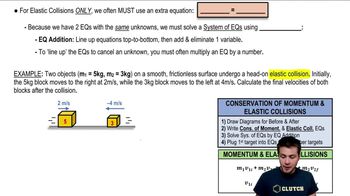
Elastic vs. Inelastic Collisions

Collisions can be classified as elastic or inelastic based on whether kinetic energy is conserved. In elastic collisions, both momentum and kinetic energy are conserved, while in inelastic collisions, momentum is conserved but kinetic energy is not. This question involves an inelastic collision since some kinetic energy is lost, which we need to calculate to find the fraction of energy lost.
추천 영상:
가이드 코스
08:56
Intro To Elastic Collisions
관련 실천
교과서 질문

The force on a bullet along the barrel of a firearm is given by the formula F = [740 ― (2.3 x 10⁵ s⁻¹ ) t] N over the time interval t = 0 to t = 3.0 x 10⁻³ s. Plot a graph of F versus t for t = 0 to t = 3.0 ms. Use the graph to estimate the impulse given the bullet.

1664
views
교과서 질문

A 144-g baseball moving 28.0 m/s strikes a stationary 4.85-kg brick resting on small rollers so it moves without significant friction. After hitting the brick, the baseball bounces straight back, and the brick moves forward at 1.10 m/s. What is the baseball’s speed after the collision?

1265
views
교과서 질문

A 195-kg projectile, fired with a speed of 116 m/s at a 60.0° angle, breaks into three pieces of equal mass at the highest point of its arc (where its velocity is horizontal). Two of the fragments move with the same speed right after the explosion as the entire projectile had just before the explosion; one of these moves vertically downward and the other horizontally. Determine the velocity of the third fragment immediately after the explosion.

1337
views
교과서 질문

A 144-g baseball moving 28.0 m/s strikes a stationary 4.85-kg brick resting on small rollers so it moves without significant friction. After hitting the brick, the baseball bounces straight back, and the brick moves forward at 1.10 m/s. Find the total kinetic energy before and after the collision.

1182
views
교과서 질문

The force on a bullet along the barrel of a firearm is given by the formula F = [740 ― (2.3 x 10⁵ s⁻¹ ) t] N over the time interval t = 0 to t = 3.0 x 10⁻³ s. Plot a graph of F versus t for t = 0 to t = 3.0 ms.

1783
views
교과서 질문

(II) A pendulum consists of a mass M hanging at the bottom end of a massless rod of length ℓ, which has a frictionless pivot at its top end. A mass m, moving horizontally as shown in Fig. 9–44 with velocity v, impacts M and becomes embedded. What is the smallest value of v sufficient to cause the pendulum (with embedded mass m) to swing clear over the top of its arc?

1798
views