Ch. 10 - Rotational Motion
Giancoli Douglas - Physics for Scientists and Engineers 5th edition
Giancoli Douglas5th editionPhysics for Scientists and EngineersISBN: 9780137488179당신이 사용하는 게 아니라요?교과서 변경
10장, 문제 87a

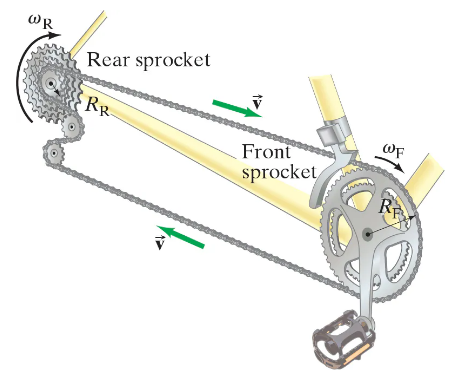
How is the angular velocity ωᵣ of the rear wheel of a bicycle related to the angular velocity ωբ of the front sprocket and pedals? Let Nբ and Nᵣ be the number of teeth on the front and rear sprockets, respectively, Fig. 10–71, and Rբ and Rᵣ their respective radii. The teeth are spaced the same on both sprockets and the rear sprocket is firmly attached to the rear wheel.
Diagram showing the relationship between the angular velocities of a bicycle's rear wheel and front sprocket, with labeled components.

검증된 단계별 안내
1
The problem involves understanding the relationship between the angular velocities of the front sprocket (ωբ) and the rear wheel (ωᵣ) of a bicycle. Start by noting that the chain links engage with the teeth of both sprockets, meaning the linear speed of the chain is the same at both sprockets.
The linear speed of the chain at the front sprocket is given by v = Rբ * ωբ, where Rբ is the radius of the front sprocket and ωբ is its angular velocity. Similarly, the linear speed of the chain at the rear sprocket is v = Rᵣ * ωᵣ, where Rᵣ is the radius of the rear sprocket and ωᵣ is its angular velocity.
Since the linear speed of the chain is the same at both sprockets, equate the two expressions: Rբ * ωբ = Rᵣ * ωᵣ.
The number of teeth on the sprockets (Nբ for the front and Nᵣ for the rear) is proportional to their radii because the teeth are evenly spaced. Thus, Rբ / Rᵣ = Nբ / Nᵣ.
Substitute Rբ / Rᵣ = Nբ / Nᵣ into the equation Rբ * ωբ = Rᵣ * ωᵣ to find the relationship between the angular velocities: ωᵣ = (Nբ / Nᵣ) * ωբ. This shows that the angular velocity of the rear wheel is proportional to the angular velocity of the front sprocket, scaled by the ratio of the number of teeth on the sprockets.

비슷한 문제에 대한 검증된 영상 답변:

이 영상 해법은 위 문제에 도움이 된다고 튜터들이 추천한 것입니다.
영상 길이:
8m
도움이 되었나요?

주요 개념

질문에 올바르게 답하기 위해 반드시 이해해야 하는 핵심 개념들은 다음과 같습니다.

Angular Velocity

Angular velocity (ω) is a measure of how quickly an object rotates around an axis, expressed in radians per second. In the context of a bicycle, it describes the rate at which the pedals and wheels turn. The relationship between the angular velocities of different components, such as the front sprocket and rear wheel, is crucial for understanding how pedaling translates into motion.
추천 영상:
가이드 코스
06:18
Intro to Angular Momentum

Gear Ratio

The gear ratio is the ratio of the number of teeth on two gears that are meshed together. It determines how the angular velocities of the connected gears relate to each other. For a bicycle, the gear ratio between the front and rear sprockets affects how much the rear wheel turns for each pedal rotation, influencing speed and torque.
추천 영상:
가이드 코스
05:32
Ratio of energies of cylinder on surface

Mechanical Advantage

Mechanical advantage refers to the factor by which a mechanism multiplies the force or torque applied to it. In bicycles, the arrangement of gears provides mechanical advantage, allowing the rider to efficiently convert pedaling force into wheel rotation. Understanding this concept helps explain how different gear combinations can optimize performance for various terrains.
추천 영상:
가이드 코스
06:24
Conservation Of Mechanical Energy
관련 실천
교과서 질문

A hollow cylinder (hoop) is rolling on a horizontal surface at speed v = 3.0 m/s when it reaches an 18° incline. How far up the incline will it go?

1206
views

교과서 질문

A cyclist accelerates from rest at a rate of 1.00 m/s². How fast will a point at the top of the rim of the tire (diameter = 68.0 cm) be moving after 2.75 s? [Hint: At any moment, the lowest point on the tire is in contact with the ground and is at rest—see Fig. 10–69.]

1444
views
교과서 질문

Bicycle gears:How is the angular velocity ωᵣ of the rear wheel of a bicycle related to the angular velocity ωբ of the front sprocket and pedals? Let Nբ and Nᵣ be the number of teeth on the front and rear sprockets, respectively, Fig. 10–71, and Rբ and Rᵣ their respective radii. The teeth are spaced the same on both sprockets and the rear sprocket is firmly attached to the rear wheel. Evaluate the ratio ωᵣ / ωբ when the front and rear sprocketshave 42 and 28 teeth.

1476
views
교과서 질문

How is the angular velocity ωᵣ of the rear wheel of a bicycle related to the angular velocity ωբ of the front sprocket and pedals? Let Nբ and Nᵣ be the number of teeth on the front and rear sprockets, respectively, Fig. 10–71, and Rբ and Rᵣ their respective radii. The teeth are spaced the same on both sprockets and the rear sprocket is firmly attached to the rear wheel. Evaluate the ratio ωᵣ / ωբ when the front and rear sprockets have 52 and 13 teeth, respectively.

1509
views
교과서 질문

On a 12.0-cm-diameter audio compact disc (CD), digital bits of information are encoded sequentially along an outward spiraling path. The spiral starts at radius R₁ = 2.5 cm and winds its way out to radius R₂ = 5.8 cm. To read the digital information, a CD player rotates the CD so that the player’s readout laser scans along the spiral’s sequence of bits at a constant linear speed of 1.25 m/s. Thus the player must accurately adjust the rotational frequency ƒ of the CD as the laser moves outward. Determine the values for ƒ (in units of rpm) when the laser is located at R₁ and when it is at R₂.

1462
views
교과서 질문

The 1100-kg mass of a car includes four tires, each of mass 35 kg (including wheels) and diameter 0.80 m. Assume each tire and wheel combination acts as a solid cylinder. Determine the fraction of the kinetic energy in the tires and wheels.

1288
views