

Ch. 10 - Rotational Motion
Giancoli Douglas - Physics for Scientists and Engineers 5th edition
Giancoli Douglas5th editionPhysics for Scientists and EngineersISBN: 9780137488179당신이 사용하는 게 아니라요?교과서 변경
10장, 문제 44

A dad pushes tangentially on a small hand-driven merry-go-round and is able to accelerate it from rest to a frequency of 15 rpm in 10.0 s. Assume the merry-go-round is a uniform disk of radius 2.5 m and has a mass of 330 kg, and two children (each with a mass of 25 kg) sit opposite each other on the edge. Calculate the torque required to produce the acceleration, neglecting frictional torque. What force is required at the edge?

검증된 단계별 안내
1
Step 1: Calculate the angular acceleration (α) of the merry-go-round. First, convert the final frequency from revolutions per minute (rpm) to radians per second (rad/s). Use the formula: \( \omega = \frac{2\pi f}{60} \), where \( f \) is the frequency in rpm. Then, use the formula for angular acceleration: \( \alpha = \frac{\Delta \omega}{\Delta t} \), where \( \Delta \omega \) is the change in angular velocity and \( \Delta t \) is the time interval.
Step 2: Calculate the moment of inertia (I) of the system. The merry-go-round is a uniform disk, so its moment of inertia is given by \( I_{disk} = \frac{1}{2} M R^2 \), where \( M \) is the mass of the disk and \( R \) is its radius. Additionally, the two children sitting on the edge contribute to the moment of inertia as point masses: \( I_{children} = 2 m R^2 \), where \( m \) is the mass of one child. Add these contributions to find the total moment of inertia: \( I_{total} = I_{disk} + I_{children} \).
Step 3: Use the relationship between torque (τ), moment of inertia (I), and angular acceleration (α): \( \tau = I \alpha \). Substitute the values of \( I_{total} \) and \( \alpha \) calculated in the previous steps to find the required torque.
Step 4: Calculate the force (F) required at the edge of the merry-go-round. Torque is related to force and radius by the formula: \( \tau = F R \). Rearrange this formula to solve for force: \( F = \frac{\tau}{R} \). Substitute the values of \( \tau \) and \( R \) to find the force.
Step 5: Summarize the results. The torque required to produce the acceleration is determined in Step 3, and the force required at the edge is determined in Step 4. Ensure all units are consistent and properly labeled for clarity.

비슷한 문제에 대한 검증된 영상 답변:

이 영상 해법은 위 문제에 도움이 된다고 튜터들이 추천한 것입니다.
영상 길이:
8m
도움이 되었나요?

주요 개념

질문에 올바르게 답하기 위해 반드시 이해해야 하는 핵심 개념들은 다음과 같습니다.

Torque

Torque is a measure of the rotational force applied to an object, calculated as the product of the force and the distance from the pivot point (lever arm). In this scenario, the torque is essential for determining how much rotational force the dad needs to apply to accelerate the merry-go-round. The formula for torque (τ) is τ = r × F, where r is the radius and F is the applied force.
추천 영상:
가이드 코스
08:55
Net Torque & Sign of Torque

Moment of Inertia

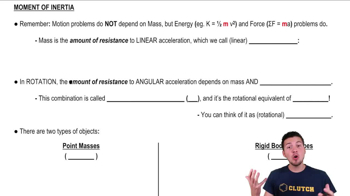
The moment of inertia is a property of a body that quantifies its resistance to rotational acceleration about an axis. For a uniform disk, it is calculated using the formula I = (1/2) m r², where m is the mass and r is the radius. Understanding the moment of inertia is crucial for calculating the angular acceleration of the merry-go-round when torque is applied.
추천 영상:
가이드 코스
11:47
Intro to Moment of Inertia

Angular Acceleration

Angular acceleration is the rate of change of angular velocity over time, typically measured in radians per second squared (rad/s²). It can be calculated using the relationship between torque and moment of inertia, expressed as τ = Iα, where α is the angular acceleration. In this problem, determining the angular acceleration is necessary to find the torque required to achieve the desired frequency of rotation.
추천 영상:
가이드 코스
12:12
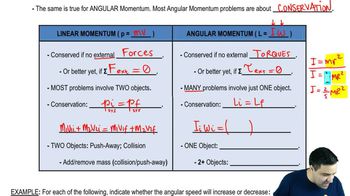
Conservation of Angular Momentum
관련 실천
교과서 질문

Let us treat a helicopter rotor blade as a long thin rod, as shown in Fig. 10–60. If each of the three rotor helicopter blades is 3.75 m long and has a mass of 135 kg, calculate the moment of inertia of the three rotor blades about the axis of rotation.

1436
views
교과서 질문

To get a flat, uniform cylindrical satellite spinning at the correct rate, engineers fire four tangential rockets as shown in Fig. 10–61. Suppose that the satellite has a mass of 3600 kg and a radius of 4.0 m, and that the rockets each add a mass of 250 kg. What is the steady force required of each rocket if the satellite is to reach 28 rpm in 5.0 min, starting from rest?

1561
views
교과서 질문

Calculate the moment of inertia of the array of point objects shown in Fig. 10–58 about the y axis, and the x axis. Assume m = 22kg, M = 3.2kg, and the objects are wired together by very light, rigid pieces of wire. The array is rectangular and is split through the middle by the x axis. About which axis would it be harder to accelerate this array?

1266
views
교과서 질문

Suppose the force Fₜ in the cord hanging from the pulley of Example 10–10, Fig. 10–22, is given by the relation Fₜ = 3.00 t ― 0.20 t² (newtons) where t is in seconds. If the pulley starts from rest, what is the linear speed of a point on its rim 9.0 s later? Ignore friction and use the moment of inertia, calculated in Example 10–10.

1259
views
교과서 질문

The forearm in Fig. 10–57 accelerates a 3.6-kg ball at 7.0 m/s² by means of the triceps muscle, as shown. Calculate the torque needed.

1640
views
교과서 질문

A softball player swings a bat, accelerating it from rest to 2.4 rev/s in a time of 0.20 s. Approximate the bat as a 0.90-kg uniform rod of length 0.95 m, and compute the torque the player applies to one end of it.

1348
views