

Ch. 11 - Angular Momentum; General Rotation
Giancoli Douglas - Physics for Scientists and Engineers 5th edition
Giancoli Douglas5th editionPhysics for Scientists and EngineersISBN: 9780137488179당신이 사용하는 게 아니라요?교과서 변경
11장, 문제 75a

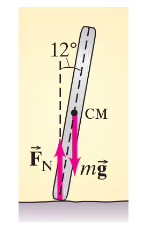
A boy rolls a tire along a straight level street. The tire has mass 8.0 kg, radius 0.32 m and moment of inertia about its central axis of symmetry of 0.83 kg·m². The boy pushes the tire forward away from him at a speed of 2.1 m/s and sees that the tire leans 12° to the right (Fig. 11–49). How will the resultant torque due to gravity and the normal force FN\(\overrightarrow{F_{N}\)} affect the subsequent motion of the tire? 
A tire leaning 12° to the right, with forces of gravity and normal force illustrated, showing rotational dynamics concepts.

검증된 단계별 안내
1
Step 1: Understand the problem. The tire is rolling forward with a given speed, and it is leaning at an angle of 12° to the right. The forces acting on the tire include gravity (acting downward) and the normal force (acting upward from the ground). These forces create a torque about the tire's center of mass due to the lean angle. We need to analyze how this torque affects the tire's motion.
Step 2: Identify the forces and their points of application. The gravitational force (F_g = m * g) acts vertically downward through the tire's center of mass. The normal force (F_N) acts vertically upward at the point of contact between the tire and the ground. Since the tire is leaning, these forces are not aligned, creating a torque.
Step 3: Calculate the torque. The torque (τ) is given by the formula τ = r * F * sin(θ), where r is the perpendicular distance from the axis of rotation (center of mass) to the line of action of the force, F is the magnitude of the force, and θ is the angle between the force and the lever arm. For this problem, the lever arm is the horizontal distance between the center of mass and the point of contact with the ground.
Step 4: Analyze the effect of the torque. The torque will cause the tire to experience an angular acceleration about its center of mass. This angular acceleration will tend to increase the lean of the tire, potentially causing it to topple if the torque is large enough. The direction of the torque (clockwise or counterclockwise) depends on the direction of the lean.
Step 5: Relate the torque to the tire's motion. The angular acceleration (α) can be found using Newton's second law for rotation: τ = I * α, where I is the moment of inertia of the tire about its central axis. The angular acceleration will affect the tire's rotational motion, and combined with the linear motion, it will determine the subsequent trajectory of the tire.

비슷한 문제에 대한 검증된 영상 답변:

이 영상 해법은 위 문제에 도움이 된다고 튜터들이 추천한 것입니다.
영상 길이:
5m
도움이 되었나요?

주요 개념

질문에 올바르게 답하기 위해 반드시 이해해야 하는 핵심 개념들은 다음과 같습니다.

Torque

Torque is a measure of the rotational force applied to an object, which causes it to rotate around an axis. It is calculated as the product of the force applied and the distance from the axis of rotation to the point where the force is applied, multiplied by the sine of the angle between the force vector and the lever arm. In this scenario, the torque due to gravity and the normal force will influence how the tire rotates as it rolls, particularly in relation to its lean.
추천 영상:
가이드 코스
08:55
Net Torque & Sign of Torque

Moment of Inertia

The moment of inertia is a property of a body that quantifies its resistance to angular acceleration about a particular axis. It depends on the mass distribution relative to the axis of rotation; for a solid object like a tire, it is calculated using its mass and the square of the distance from the axis. In this case, the tire's moment of inertia will affect how easily it can be rotated when subjected to the torques from gravity and the normal force.
추천 영상:
가이드 코스
11:47
Intro to Moment of Inertia

Equilibrium of Forces

The equilibrium of forces refers to the condition where the sum of all forces and torques acting on an object is zero, resulting in no net motion. In the context of the tire, the balance between gravitational force, normal force, and the torque they produce will determine whether the tire remains upright or leans. Understanding this concept is crucial for analyzing how the tire will behave as it rolls and leans under the influence of these forces.
추천 영상:
관련 실천
교과서 질문

A merry-go-round with a moment of inertia equal to 860 kg·m² and a radius of 3.0 m rotates with negligible friction at 1.70 rad/s. A child initially standing still next to the merry-go-round jumps onto the edge of the platform straight toward the axis of rotation causing the platform to slow to 1.25 rad/s. What is her mass?

1347
views
교과서 질문

The position of a particle with mass m traveling on a helical path (see Fig. 11–48) is given by r\(\overrightarrow{r}\) = R cos (2πz/d) î + R sin (2πz/d) ĵ + zk̂ where R and d are the radius and pitch of the helix, respectively, and z has time dependence z = v𝓏t where v𝓏 is the (constant) component of velocity in the z direction. Determine the time-dependent angular momentum L\(\overrightarrow{L}\) of the particle about the origin.

1426
views
교과서 질문

A particle of mass m uniformly accelerates as it moves counterclockwise along the circumference of a circle of radius R: r\(\overrightarrow{r}\) = î R cos θ + ĵ R sin θ with θ = ω₀t + (1/2)αt² , where the constants ω₀ and α are the initial angular velocity and angular acceleration, respectively. Determine the object’s tangential acceleration a\(\overrightarrow{a}\)tan and determine the torque acting on the object using τ=r×F\(\overrightarrow{\tau}\)=\(\overrightarrow{r}\]\times\) F.

1207
views
교과서 질문

A radio transmission tower has a mass of 76 kg and is 12 m high. The tower is anchored to the ground by a flexible joint at its base, but it is secured by three cables 120° apart (Fig. 11–52). In an analysis of a potential failure, a mechanical engineer needs to determine the behavior of the tower if one of the cables breaks. The tower would fall away from the broken cable, rotating about its base. Determine the speed of the top of the tower as a function of the rotation angle θ. Start your analysis with the rotational dynamics equation of motion dL\(\overrightarrow{L}\)/dt =τext\(\overrightarrow{\tau_{ext}\)}_{}. Approximate the tower as a tall thin rod.

1547
views
교과서 질문

Water drives a waterwheel (or turbine) of radius R = 3.0 m as shown in Fig. 11–50. The water enters at a speed v₁ = 7.0m/s and exits from the waterwheel at a speed v₂= 3.8 m/s. If the water causes the waterwheel to make one revolution every 6.0 s, how much power is delivered to the wheel?

1541
views
교과서 질문

The time-dependent position of a point object which moves counterclockwise along the circumference of a circle (radius R) in the xy plane with constant speed υ is given by r\(\overrightarrow{r}\) = î R cos ωt + ĵ R sin ωt where the constant ω = v/R. Determine the velocity v\(\overrightarrow{v}\) and angular velocity w\(\overrightarrow{w}\) of this object and then show that these three vectors obey the relationv=ω×r\(\overrightarrow{v}\)=\(\overrightarrow{\omega}\[\times\]\overrightarrow{r}\).

1437
views