
Ch. 11 - Angular Momentum; General Rotation
Giancoli Douglas - Physics for Scientists and Engineers 5th edition
Giancoli Douglas5th editionPhysics for Scientists and EngineersISBN: 9780137488179당신이 사용하는 게 아니라요?교과서 변경
11장, 문제 55a

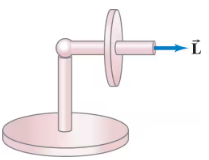
A toy gyroscope consists of a 170-g disk with a radius of 5.5 cm mounted at the center of a thin axle 21 cm long (Fig. 11–42). The gyroscope spins at 45 rev/s. One end of its axle rests on a stand and the other end precesses horizontally about the stand. How long does it take the gyroscope to precess once around?
Illustration of a toy gyroscope on a stand, showing its axle and direction of angular momentum.

검증된 단계별 안내
1
Convert the given quantities into SI units. The mass of the disk is 170 g, which is equivalent to 0.170 kg. The radius of the disk is 5.5 cm, which is 0.055 m. The length of the axle is 21 cm, which is 0.21 m. The angular velocity of the gyroscope is 45 revolutions per second, which is converted to radians per second using the formula: \( \omega = 45 \times 2\pi \) rad/s.
Calculate the moment of inertia of the disk. Since the disk is spinning about its central axis, the moment of inertia is given by \( I = \frac{1}{2} m r^2 \), where \( m \) is the mass of the disk and \( r \) is its radius. Substitute the values of \( m \) and \( r \) to find \( I \).
Determine the angular momentum of the gyroscope. The angular momentum \( L \) is given by \( L = I \omega \), where \( I \) is the moment of inertia and \( \omega \) is the angular velocity. Use the values of \( I \) and \( \omega \) calculated earlier to find \( L \).
Calculate the torque due to the weight of the gyroscope. The torque \( \tau \) is given by \( \tau = r F \), where \( r \) is the distance from the pivot point to the center of mass of the gyroscope (half the length of the axle), and \( F \) is the gravitational force acting on the gyroscope (\( F = mg \), where \( m \) is the mass of the disk and \( g \) is the acceleration due to gravity).
Determine the precession period. The precession angular velocity \( \Omega \) is given by \( \Omega = \frac{\tau}{L} \), where \( \tau \) is the torque and \( L \) is the angular momentum. The precession period \( T \) is the reciprocal of the precession angular velocity, \( T = \frac{2\pi}{\Omega} \). Substitute the values of \( \tau \) and \( L \) to find \( T \).

비슷한 문제에 대한 검증된 영상 답변:

이 영상 해법은 위 문제에 도움이 된다고 튜터들이 추천한 것입니다.
영상 길이:
9m
도움이 되었나요?

주요 개념

질문에 올바르게 답하기 위해 반드시 이해해야 하는 핵심 개념들은 다음과 같습니다.

Gyroscopic Precession

Gyroscopic precession is the phenomenon where a spinning object, like a gyroscope, experiences a change in the orientation of its rotational axis due to an external torque. When a torque is applied perpendicular to the axis of rotation, the gyroscope does not tip over but instead moves in a circular path, resulting in precession. The rate of precession depends on the angular momentum of the gyroscope and the magnitude of the applied torque.

Angular Momentum

Angular momentum is a measure of the rotational motion of an object and is defined as the product of its moment of inertia and its angular velocity. For a gyroscope, the angular momentum vector points along the axis of rotation. The conservation of angular momentum is crucial in understanding how the gyroscope maintains its orientation and how it responds to external forces, such as gravity.
추천 영상:
가이드 코스
06:18
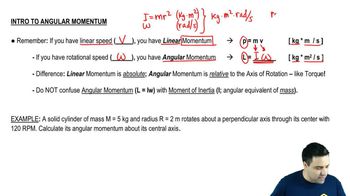
Intro to Angular Momentum

Period of Precession

The period of precession is the time it takes for a gyroscope to complete one full rotation around its precession axis. It can be calculated using the relationship between the angular momentum of the gyroscope and the torque acting on it. The formula involves the gyroscope's mass, radius, and the rate of spin, allowing us to determine how quickly it precesses based on its physical properties and the forces at play.
추천 영상:
가이드 코스
06:28
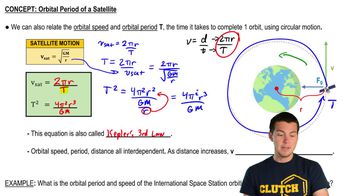
Satellite Period
관련 실천
교과서 질문

A merry-go-round with a moment of inertia equal to 860 kg·m² and a radius of 3.0 m rotates with negligible friction at 1.70 rad/s. A child initially standing still next to the merry-go-round jumps onto the edge of the platform straight toward the axis of rotation causing the platform to slow to 1.25 rad/s. What is her mass?

1347
views
교과서 질문

On a level billiards table a cue ball, initially at rest at point O on the table, is struck so that it leaves the cue stick with a center-of-mass speed v₀ and ω₀ a “reverse” spin of angular speed (see Fig. 11–41). A kinetic friction force acts on the ball as it initially skids across the table. If ω₀ is 10% smaller than ωC , i.e., ω₀ = 0.90ωC, determine the ball’s cm velocity vCM when it starts to roll without slipping.

906
views
교과서 질문

Suppose a 5.2 x 10¹⁰kg meteorite struck the Earth at the equator with a speed v = 2.2 x 10⁴ m/s, as shown in Fig. 11–38 and remained stuck. By what factor would this affect the rotational frequency of the Earth (1 rev/day)?

<IMAGE>

1607
views
교과서 질문

On a level billiards table a cue ball, initially at rest at point O on the table, is struck so that it leaves the cue stick with a center-of-mass speed v₀ and ω₀ a “reverse” spin of angular speed (see Fig. 11–41). A kinetic friction force acts on the ball as it initially skids across the table. Using conservation of angular momentum, find the critical angular speed ωC such that, if ω₀=ωC, kinetic friction will bring the ball to a complete (as opposed to momentary) stop.

1126
views
교과서 질문

The time-dependent position of a point object which moves counterclockwise along the circumference of a circle (radius R) in the xy plane with constant speed υ is given by r\(\overrightarrow{r}\) = î R cos ωt + ĵ R sin ωt where the constant ω = v/R. Determine the velocity v\(\overrightarrow{v}\) and angular velocity w\(\overrightarrow{w}\) of this object and then show that these three vectors obey the relationv=ω×r\(\overrightarrow{v}\)=\(\overrightarrow{\omega}\[\times\]\overrightarrow{r}\).

1437
views
교과서 질문

Suppose the solid wheel of Fig. 11–42 has a mass of 260 g and rotates at 85 rad/s; it has radius 6.0 cm and is mounted at the center of a horizontal thin axle 25 cm long. At what rate does the axle precess?

140
views