Ch. 11 - Angular Momentum; General Rotation
Giancoli Douglas - Physics for Scientists and Engineers 5th edition
Giancoli Douglas5th editionPhysics for Scientists and EngineersISBN: 9780137488179당신이 사용하는 게 아니라요?교과서 변경
11장, 문제 42

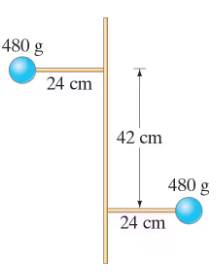
Two lightweight rods 24 cm in length are mounted perpendicular to an axle and at 180° to each other (Fig. 11–35). At the end of each rod is a 480-g mass. The rods are spaced 42 cm apart along the axle. The axle rotates at 4.5 rad/s.
(a) What is the component of the total angular momentum along the axle?
(b) What angle does the vector angular momentum make with the axle? [Hint: Remember that the vector angular momentum must be calculated about the same point for both masses, which could be the cm.]
Two perpendicular rods with 480 g masses at each end, spaced 42 cm apart, mounted on a rotating axle.

검증된 단계별 안내
1
Step 1: Understand the problem. The system consists of two rods with masses at their ends, rotating about an axle. The goal is to calculate (a) the component of the total angular momentum along the axle and (b) the angle the angular momentum vector makes with the axle. The rods are perpendicular to the axle, and the masses are rotating at an angular velocity of 4.5 rad/s.
Step 2: Calculate the moment of inertia for each mass. The moment of inertia for a point mass is given by the formula: I = mr2, where m is the mass and r is the distance from the axis of rotation. For each mass, the distance from the axis is 24 cm (converted to meters: 0.24 m). The mass is 480 g (converted to kilograms: 0.48 kg). Compute the moment of inertia for each mass.
Step 3: Calculate the angular momentum of each mass. The angular momentum is given by the formula: L = Iω, where I is the moment of inertia and ω is the angular velocity (4.5 rad/s). Compute the angular momentum for each mass.
Step 4: Determine the total angular momentum along the axle. Since the two masses are at 180° to each other, their angular momentum components along the axle will add up. Use the geometry of the system to resolve the angular momentum vector of each mass into components along the axle and perpendicular to the axle. Add the components along the axle to find the total angular momentum along the axle.
Step 5: Calculate the angle the angular momentum vector makes with the axle. Use the relationship between the total angular momentum vector and its components. The angle θ can be found using the formula: θ = tan-1(LperpendicularLaxial). Compute the angle using the resolved components of angular momentum.

비슷한 문제에 대한 검증된 영상 답변:

이 영상 해법은 위 문제에 도움이 된다고 튜터들이 추천한 것입니다.
영상 길이:
13m
도움이 되었나요?

주요 개념

질문에 올바르게 답하기 위해 반드시 이해해야 하는 핵심 개념들은 다음과 같습니다.

Angular Momentum

Angular momentum is a vector quantity that represents the rotational inertia and rotational velocity of an object. It is calculated as the product of the moment of inertia and the angular velocity. For point masses, it can be expressed as the cross product of the position vector and the linear momentum vector. Understanding angular momentum is crucial for analyzing rotational motion and its conservation in systems.
추천 영상:
가이드 코스
06:18
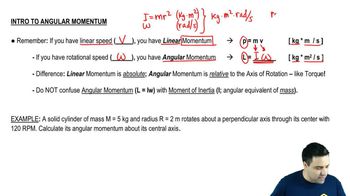
Intro to Angular Momentum

Moment of Inertia

Moment of inertia is a measure of an object's resistance to changes in its rotational motion about an axis. It depends on the mass distribution relative to the axis of rotation. For point masses, it is calculated as the sum of the products of each mass and the square of its distance from the axis. This concept is essential for determining the angular momentum of the system in the given problem.
추천 영상:
가이드 코스
11:47
Intro to Moment of Inertia

Vector Components

Vector components are the projections of a vector along the axes of a coordinate system. In the context of angular momentum, it is important to resolve the total angular momentum into components to analyze its direction and magnitude relative to the axle. This involves using trigonometric functions to find the angles and applying the right-hand rule to determine the orientation of the angular momentum vector.
추천 영상:
가이드 코스
07:30
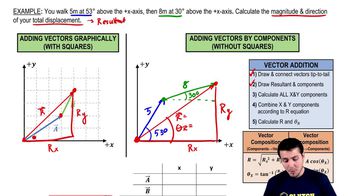
Vector Addition By Components
관련 실천
교과서 질문

Two identical particles have equal but opposite momenta, p\(\overrightarrow{p}\) and p-\(\overrightarrow{p}\), but they are not traveling along the same line. Show that the total angular momentum of this system does not depend on the choice of origin.

1407
views

교과서 질문

Two ice skaters, both of mass 68 kg, approach on parallel paths 1.6 m apart. Both are moving at 3.5 m/s with their arms outstretched. They join hands as they pass, still maintaining their 1.6-m separation, and begin rotating about one another. Treat the skaters as particles with regard to their rotational inertia. If they now pull on each other’s hands, reducing their radius to half its original value, what is their common angular speed after reducing their radius?

915
views
교과서 질문

Two ice skaters, both of mass 68 kg, approach on parallel paths 1.6 m apart. Both are moving at 3.5 m/s with their arms outstretched. They join hands as they pass, still maintaining their 1.6-m separation, and begin rotating about one another. Treat the skaters as particles with regard to their rotational inertia. Calculate the change in kinetic energy for this process.

1493
views
교과서 질문

Calculate the angular momentum of a particle of mass m moving with constant velocity υ for two cases (see Fig. 11–34): about O′.

1042
views
교과서 질문

A particle is at the position (x, y, z) = (1.0, 2.0, 3.0)m. It is traveling with a vector velocity (-5.0 ,+ 2.8, -3.1)m/s. Its mass is 4.3 kg. What is its vector angular momentum about the origin?

1540
views
교과서 질문

Two ice skaters, both of mass 68 kg, approach on parallel paths 1.6 m apart. Both are moving at 3.5 m/s with their arms outstretched. They join hands as they pass, still maintaining their 1.6-m separation, and begin rotating about one another. Treat the skaters as particles with regard to their rotational inertia. They now pull on each other’s hands, reducing their radius to half its original value. Calculate the change in kinetic energy for this process.

1341
views