Ch. 12 - Static Equilibrium; Elasticity and Fracture
Giancoli Douglas - Physics for Scientists and Engineers 5th edition
Giancoli Douglas5th editionPhysics for Scientists and EngineersISBN: 9780137488179당신이 사용하는 게 아니라요?교과서 변경
12장, 문제 20

A 172-cm-tall person lies on a light (massless) board which is supported by two scales, one under the top of her head and one beneath the bottom of her feet (Fig. 12–65). The two scales read, respectively, 35.1 and 31.6 kg. What distance is the center of gravity of this person from the top of her head?
<IMAGE>

검증된 단계별 안내
1
Step 1: Understand the problem. The person is lying on a massless board supported by two scales. The scales measure the forces exerted at the head and feet. The goal is to find the distance of the person's center of gravity from the top of their head. This is a torque equilibrium problem.
Step 2: Define the variables. Let the total weight of the person be \( W = (35.1 + 31.6) \, \text{kg} \times 9.8 \, \text{m/s}^2 \). Let \( x \) be the distance of the center of gravity from the top of the head. The total length of the person is \( L = 1.72 \, \text{m} \).
Step 3: Apply the principle of torque equilibrium. For the board to be in equilibrium, the sum of torques about any point must be zero. Choose the bottom of the feet as the pivot point. The torque due to the weight at the center of gravity is \( W \cdot x \), and the torque due to the scale at the head is \( 35.1 \cdot 9.8 \cdot L \).
Step 4: Write the torque equilibrium equation. The equation is \( 35.1 \cdot 9.8 \cdot L = W \cdot x \). Substitute \( W = (35.1 + 31.6) \cdot 9.8 \) and solve for \( x \).
Step 5: Simplify the equation to find \( x \). Rearrange the equation to isolate \( x \): \( x = \frac{35.1 \cdot 9.8 \cdot L}{(35.1 + 31.6) \cdot 9.8} \). Cancel out \( 9.8 \) and substitute \( L = 1.72 \, \text{m} \) to find the distance of the center of gravity from the top of the head.

비슷한 문제에 대한 검증된 영상 답변:

이 영상 해법은 위 문제에 도움이 된다고 튜터들이 추천한 것입니다.
영상 길이:
9m
도움이 되었나요?

주요 개념

질문에 올바르게 답하기 위해 반드시 이해해야 하는 핵심 개념들은 다음과 같습니다.

Center of Gravity

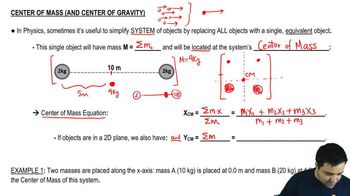
The center of gravity is the point at which the total weight of an object is considered to act. For a uniform object, it is located at its geometric center, but for irregular shapes or distributions of mass, it can be calculated based on the distribution of weight. In this problem, understanding the center of gravity is crucial for determining how the weight is distributed along the person's height.
추천 영상:
가이드 코스
14:02
Intro to Center of Mass

Static Equilibrium

Static equilibrium occurs when an object is at rest and the sum of all forces and torques acting on it is zero. In this scenario, the person lying on the board is in static equilibrium, meaning the forces exerted by the scales must balance the gravitational force acting on the person. This concept is essential for analyzing the forces involved and calculating the position of the center of gravity.
추천 영상:
가이드 코스
08:11
Static Friction & Equilibrium

Torque

Torque is a measure of the rotational force applied to an object, calculated as the product of the force and the distance from the pivot point. In this case, the scales act as pivot points, and the torques created by the weights at the head and feet must balance for the person to remain in equilibrium. Understanding torque is necessary to find the distance from the head to the center of gravity.
추천 영상:
가이드 코스
08:55
Net Torque & Sign of Torque
관련 실천
교과서 질문

A 2300-kg trailer is attached to a stationary truck at point B, Fig. 12–64. Determine the normal force exerted by the road on the rear tires at A, and the vertical force exerted on the trailer by the support B.

1373
views

교과서 질문

The Leaning Tower of Pisa is 55 m tall and about 7.7 m in radius. The top is 4.5 m off center. Is the tower in stable equilibrium? If so, how much farther can it lean before it becomes unstable? Assume the tower is of uniform composition.

1564
views
교과서 질문

A shop sign weighing 215 N hangs from the end of a uniform 135-N beam as shown in Fig. 12–59. Find the tension in the supporting wire (at 35.0°), and the horizontal and vertical forces exerted by the hinge on the beam at the wall.

1910
views
교과서 질문

A refrigerator is approximately a uniform rectangular solid 1.9 m tall, 1.0 m wide, and 0.75 m deep. If it sits upright on a truck with its 1.0-m dimension in the direction of travel, and if the refrigerator cannot slide on the truck, how rapidly can the truck accelerate without tipping the refrigerator over? [Hint: The normal force would act at one corner.]

1563
views
교과서 질문

A uniform rod AB of length 4.5 m and mass M = 3.8 kg is hinged at A and held in equilibrium by a light cord, as shown in Fig. 12–69. A load W = 22 N hangs from the rod at a distance d so that the tension in the cord is 85 N. Draw a free-body diagram for the rod.

1182
views
교과서 질문

Three children are trying to balance on a seesaw, which includes a fulcrum rock acting as a pivot at the center, and a very light board 3.2 m long (Fig. 12–60). Two playmates are already on either end. Boy A has a mass of 45 kg, and boy B a mass of 35 kg. Where should girl C, whose mass is 25 kg, place herself so as to balance the seesaw?

1935
views
1
rank