
Ch. 12 - Static Equilibrium; Elasticity and Fracture
Giancoli Douglas - Physics for Scientists and Engineers 5th edition
Giancoli Douglas5th editionPhysics for Scientists and EngineersISBN: 9780137488179당신이 사용하는 게 아니라요?교과서 변경
12장, 문제 58

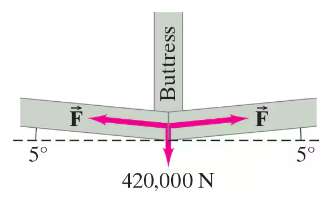
The subterranean tension ring that surrounds the dome in Fig. 12–39 exerts the balancing horizontal force on the abutments for the dome and is 36-sided, so each segment makes a 10° angle with the adjacent one (Fig. 12–83). Calculate the tension F that must exist in each segment so that the required force of 4.2 x 10⁵ N can be exerted at each corner (Example 12–14).
Diagram showing forces acting on a buttress with a downward force of 420,000 N and two horizontal tension forces at 5° angles.

검증된 단계별 안내
1
Understand the problem: The tension ring is a 36-sided polygon, and each segment of the ring makes a 10° angle with the adjacent one. The goal is to calculate the tension F in each segment such that the horizontal force exerted at each corner is 4.2 × 10⁵ N.
Break down the forces: At each corner of the polygon, the horizontal force is the result of the horizontal components of the tensions in the two adjacent segments. Use symmetry to simplify the problem, as the geometry is regular.
Express the horizontal force: The horizontal component of the tension in one segment is given by F × cos(θ/2), where θ = 10° is the angle between adjacent segments. Since there are two segments contributing to the horizontal force at each corner, the total horizontal force is 2 × F × cos(θ/2).
Set up the equation: Equate the total horizontal force to the required force at each corner. This gives the equation 2 × F × cos(θ/2) = 4.2 × 10⁵ N.
Solve for F: Rearrange the equation to isolate F. This gives F = (4.2 × 10⁵ N) / (2 × cos(θ/2)). Substitute θ = 10° into the equation to find the value of F.

비슷한 문제에 대한 검증된 영상 답변:

이 영상 해법은 위 문제에 도움이 된다고 튜터들이 추천한 것입니다.
영상 길이:
6m
도움이 되었나요?

주요 개념

질문에 올바르게 답하기 위해 반드시 이해해야 하는 핵심 개념들은 다음과 같습니다.

Tension in Structures

Tension refers to the pulling force transmitted through a string, rope, or structural element. In the context of the tension ring surrounding the dome, it is crucial to understand how tension is distributed among the segments. Each segment must exert a force that contributes to the overall stability of the structure, ensuring that the required horizontal force is balanced effectively.
추천 영상:
가이드 코스
06:34
Calculating Tension in a Pendulum with Energy Conservation

Force Resolution

Force resolution involves breaking down a force into its components, typically along specified axes. In this problem, the horizontal force exerted by the tension segments must be resolved into components that can be analyzed to find the tension in each segment. Understanding how to resolve forces is essential for calculating the necessary tension to achieve the desired force at the corners.
추천 영상:
가이드 코스
06:48
Intro to Centripetal Forces

Equilibrium of Forces

The equilibrium of forces states that for a system to be in a state of rest or constant motion, the sum of all forces acting on it must equal zero. In this scenario, the tension forces in the segments must balance the external force of 4.2 x 10⁵ N at each corner. Recognizing the conditions for equilibrium is vital for determining the required tension in the segments of the tension ring.
추천 영상:
관련 실천
교과서 질문

A 50-story building is being planned. It is to be 180.0 m high with a base 46.0 m by 76.0 m. Its total mass will be about 1.8 x 10⁷ kg, and its weight therefore about 1.8 x 10⁸ N. Suppose a 200-km/h wind exerts a force of 950N/m² over the 76.0-m-wide face (Fig. 12–86). Calculate the torque about the potential pivot point, the rear edge of the building (where FE\(\overrightarrow{F_{E}\)} acts in Fig. 12–86), and determine whether the building will topple. Assume the total force of the wind acts at the midpoint of the building’s face, and that the building is not anchored in bedrock. [Hint: FE\(\overrightarrow{F_{E}\)} in Fig. 12–86 represents the force that the Earth would exert on the building in the case where the building would just begin to tip.]

1359
views
교과서 질문

A pole projects horizontally from the front wall of a shop. A 6.1-kg sign hangs from the pole at a point 2.2 m from the wall (Fig. 12–88). If the pole is not to fall off, there must be another torque exerted to balance it. What exerts this torque? Use a diagram to show how this torque must act.

1244
views
교과서 질문

Assume the supports of the uniform cantilever shown in Fig. 12–79 (m = 2900 kg) are made of wood. Calculate the minimum cross-sectional area required of each, assuming a safety factor of 9.0.

1755
views
교과서 질문

A steel cable is to support an elevator whose total (loaded) mass is not to exceed 3100 kg. If the maximum acceleration of the elevator is 1.8 m/s² , calculate the diameter of cable required. Assume a safety factor of 8.0.

1535
views
교과서 질문

A heavy load Mg = 62.0 kN hangs at point E of the single cantilever truss shown in Fig. 12–81. Use a torque equation for the truss as a whole to determine the tension FT in the support cable, and then determine the force FA\(\overrightarrow{F_{A}\)} on the truss at pin A. Neglect the weight of the trusses, which is small compared to the load.

1353
views
1
rank
교과서 질문

A pole projects horizontally from the front wall of a shop. A 6.1-kg sign hangs from the pole at a point 2.2 m from the wall (Fig. 12–88). What is the torque due to this sign calculated about the point where the pole meets the wall?

1216
views