Ch. 13 - Fluids
Giancoli Douglas - Physics for Scientists and Engineers 5th edition
Giancoli Douglas5th editionPhysics for Scientists and EngineersISBN: 9780137488179당신이 사용하는 게 아니라요?교과서 변경
13장, 문제 80a

A 3.2-N force is applied to the plunger of a hypodermic needle. If the diameter of the plunger is 1.3 cm and that of the needle is 0.20 mm, with what force does the fluid leave the needle?

검증된 단계별 안내
1
Step 1: Recognize that this problem involves Pascal's principle, which states that pressure applied to a confined fluid is transmitted undiminished throughout the fluid. The pressure at the plunger is equal to the pressure at the needle.
Step 2: Calculate the area of the plunger using the formula for the area of a circle: A = πr². Convert the diameter of the plunger (1.3 cm) to radius in meters (r = diameter/2), and then substitute into the formula.
Step 3: Calculate the pressure exerted by the plunger using the formula P = F/A, where F is the force applied to the plunger (3.2 N) and A is the area of the plunger calculated in Step 2.
Step 4: Calculate the area of the needle using the same formula for the area of a circle: A = πr². Convert the diameter of the needle (0.20 mm) to radius in meters (r = diameter/2), and then substitute into the formula.
Step 5: Use the fact that the pressure at the plunger equals the pressure at the needle (P_plunger = P_needle). Rearrange the pressure formula to solve for the force at the needle: F_needle = P_needle × A_needle. Substitute the pressure from Step 3 and the area of the needle from Step 4 to find the force with which the fluid leaves the needle.

비슷한 문제에 대한 검증된 영상 답변:

이 영상 해법은 위 문제에 도움이 된다고 튜터들이 추천한 것입니다.
영상 길이:
4m
도움이 되었나요?

주요 개념

질문에 올바르게 답하기 위해 반드시 이해해야 하는 핵심 개념들은 다음과 같습니다.

Pascal's Principle

Pascal's Principle states that when pressure is applied to a confined fluid, the pressure change is transmitted undiminished throughout the fluid. This principle is crucial for understanding how forces are transmitted in hydraulic systems, such as a hypodermic needle, where the force applied to the plunger results in a proportional force exerted on the fluid exiting the needle.
추천 영상:
가이드 코스
14:47
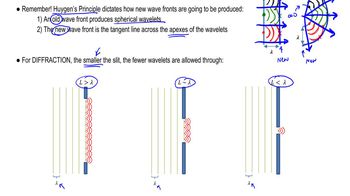
Diffraction with Huygen's Principle

Pressure Calculation

Pressure is defined as the force applied per unit area (P = F/A). In the context of the hypodermic needle, calculating the pressure exerted by the plunger allows us to determine how that pressure translates to the force exerted by the fluid as it exits the needle. The difference in cross-sectional areas between the plunger and the needle plays a critical role in this calculation.
추천 영상:
가이드 코스
13:11
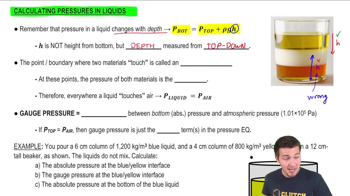
Calculating Pressure in Liquids

Area Ratio

The area ratio between the plunger and the needle is essential for determining the force exerted by the fluid. Since the force exerted by the fluid is related to the pressure and the area through which it flows, understanding how the areas of the plunger and needle compare allows us to calculate the force with which the fluid exits the needle, based on the initial force applied.
추천 영상:
가이드 코스
04:05
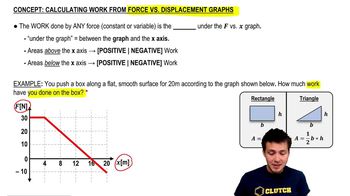
Calculating Work As Area Under F-x Graphs
관련 실천
교과서 질문

Estimate the diameter of a steel needle that can just barely remain on top of water due to surface tension. (See Figs. 13–38 and 13–39a, and Table 13–1.)

1412
views

교과서 질문

A common effect of surface tension is the ability of a liquid to rise up a narrow tube due to capillary action. Show that for a narrow tube of radius r placed in a liquid of density ρ and surface tension γ, the liquid in the tube will reach a height h = 2γ/ρgr above the level of the liquid outside the tube, where g is the gravitational acceleration. Assume that the liquid “wets” the tube and that the liquid surface is vertical at the contact with the inside of the tube.

1462
views
교과서 질문

A 3.2-N force is applied to the plunger of a hypodermic needle. If the diameter of the plunger is 1.3 cm and that of the needle is 0.20 mm, what force on the plunger would be needed to push fluid into a vein where the gauge pressure is 75 mm-Hg? Answer for the instant just before the fluid starts to move.

802
views
교과서 질문

If cholesterol buildup reduces the diameter of an artery by 25%, by what % will the blood flow rate be reduced, assuming the same pressure difference?

1273
views
교과서 질문

A hydraulic lift is used to jack a 960-kg car 52 cm off the floor. The diameter of the output piston is 18 cm, and the input force is 380 N. What is the area of the input piston?

1134
views
교과서 질문

A pump supplies water to a 1.59-cm inner diameter hose that tapers down to a 0.953-cm-diameter nozzle. The nozzle is aimed so water comes out at a 45° angle and lands 3.0 m away. The nozzle is 0.60 m above ground level, and the pump output is essentially at ground level. What pressure is supplied by the pump?

1049
views