Ch. 15 - Wave Motion
Giancoli Douglas - Physics for Scientists and Engineers 5th edition
Giancoli Douglas5th editionPhysics for Scientists and EngineersISBN: 9780137488179당신이 사용하는 게 아니라요?교과서 변경
15장, 문제 93

Estimate the average power of a moving water wave that strikes the chest of an adult standing in the water at the seashore. Assume that the amplitude of the wave is 0.50 m, the wavelength is 2.5 m, and the period is 4.0 s.

검증된 단계별 안내
1
Understand that the power of a water wave can be estimated using the formula: P = 12ρgA2v, where ρ is the density of water, g is the acceleration due to gravity, A is the amplitude of the wave, and v is the wave speed.
Calculate the wave speed v using the relationship v = λT, where λ is the wavelength (2.5 m) and T is the period (4.0 s).
Substitute the given values for the amplitude A = 0.50 m, the density of water ρ = 1000 kg/m³, and the acceleration due to gravity g = 9.8 m/s² into the power formula.
Use the wave speed v calculated in step 2 and substitute it into the power formula to compute the average power.
Simplify the expression to find the average power of the wave striking the chest of the adult. Ensure all units are consistent throughout the calculation.

비슷한 문제에 대한 검증된 영상 답변:

이 영상 해법은 위 문제에 도움이 된다고 튜터들이 추천한 것입니다.
영상 길이:
3m
도움이 되었나요?

주요 개념

질문에 올바르게 답하기 위해 반드시 이해해야 하는 핵심 개념들은 다음과 같습니다.

Wave Properties

Waves are characterized by properties such as amplitude, wavelength, and period. The amplitude is the maximum displacement from the rest position, while the wavelength is the distance between successive crests or troughs. The period is the time it takes for one complete wave cycle to pass a given point. Understanding these properties is essential for analyzing wave behavior and energy transfer.
추천 영상:
가이드 코스
06:32
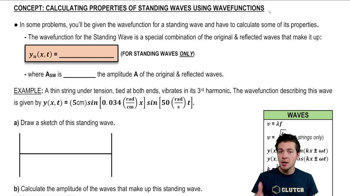
Properties of Standing Waves from Wave Functions

Power of a Wave

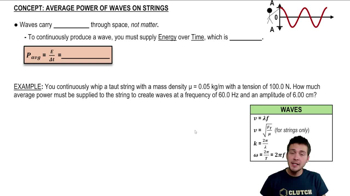
The power of a wave refers to the rate at which energy is transferred by the wave as it propagates through a medium. It can be calculated using the formula P = E/T, where P is power, E is energy, and T is time. In the context of water waves, the energy carried by the wave is related to its amplitude and frequency, making it crucial for estimating the impact on objects in the water.
추천 영상:
가이드 코스
04:39
Energy & Power of Waves on Strings

Energy Transfer in Waves

Energy transfer in waves occurs as the wave propagates through a medium, such as water. The energy carried by a wave is proportional to the square of its amplitude and the square of its frequency. This means that larger waves with greater amplitudes can exert more force and transfer more energy to objects they encounter, such as a person standing in the water.
추천 영상:
가이드 코스
05:14
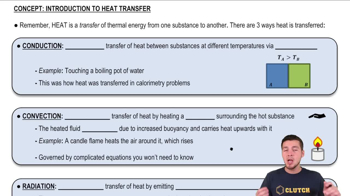
Overview of Heat Transfer
관련 실천
교과서 질문

An earthquake-produced surface wave can be approximated by a sinusoidal transverse wave. Assuming a frequency of 0.60 Hz (typical of earthquakes, which actually include a mixture of frequencies), what amplitude is needed so that objects begin to leave contact with the ground? [Hint: Set the acceleration a > g. Why?]-

1232
views
교과서 질문

Dimensional analysis. Waves on the surface of the ocean do not depend significantly on the properties of water such as density or surface tension. The primary 'return force' for water piled up in the wave crests is due to the gravitational attraction of the Earth. Thus the speed v (m/s) of ocean waves depends on the acceleration due to gravity g. It is reasonable to expect that υ might also depend on water depth h and the wave's wavelength λ. Assume the wave speed is given by the functional form v = Cgᵅ hᵝ λᵞ, where α , β , c and C are numbers without dimension. In deep water, the water deep below the surface does not affect the motion of waves at the surface. Thus υ should be independent of depth h (i.e., β = 0). Using only dimensional analysis (Section 1–7 and Appendix D), determine the formula for the speed of surface ocean waves in deep water.

1660
views
교과서 질문

Two strings on a musical instrument are tuned to play at 392 Hz (G) and 494 Hz (B). What are the frequencies of the first two overtones for each string?

963
views
교과서 질문

A transverse wave pulse travels to the right along a string with a speed v = 2.4 m/s. At t = 0 the shape of the pulse is given by the function D = 4.0m³ / (x² + 2.0m²), where D and x are in meters. Determine a formula for the wave pulse at any time t assuming the pulse is traveling to the left.

1162
views