A sailor strikes the side of his ship just below the surface of the sea. He hears the echo of the wave reflected from the ocean floor directly below 2.4 s later. How deep is the ocean at this point? (Use Tables 12–1 and 13–1.)
Ch. 15 - Wave Motion
Giancoli Douglas5th editionPhysics for Scientists and EngineersISBN: 9780137488179당신이 사용하는 게 아니라요?교과서 변경
15장, 문제 3b
Calculate the speed of longitudinal waves in granite, using Tables in Chapters 12 and 13.
검증된 단계별 안내1
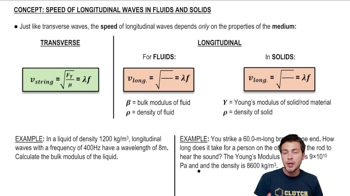
Identify the formula for the speed of longitudinal waves (sound waves) in a solid material. The formula is: , where is the bulk modulus of the material and is the density of the material.
Refer to the tables in Chapters 12 and 13 to find the bulk modulus () and density () of granite. For example, the bulk modulus of granite might be approximately , and its density might be around .
Substitute the values of and into the formula. For example: .
Simplify the expression under the square root to calculate the ratio of the bulk modulus to the density. This step involves dividing the bulk modulus by the density.
Take the square root of the result from the previous step to find the speed of longitudinal waves in granite. Ensure the units are consistent, and the final speed is expressed in meters per second (m/s).

비슷한 문제에 대한 검증된 영상 답변:
이 영상 해법은 위 문제에 도움이 된다고 튜터들이 추천한 것입니다.
영상 길이:
3m도움이 되었나요?
주요 개념
질문에 올바르게 답하기 위해 반드시 이해해야 하는 핵심 개념들은 다음과 같습니다.
Longitudinal Waves
Longitudinal waves are waves in which the particle displacement is parallel to the direction of wave propagation. In these waves, compressions and rarefactions move through the medium, allowing energy to transfer without the bulk movement of matter. Sound waves in air and seismic P-waves are common examples of longitudinal waves.
추천 영상:
가이드 코스
Speed of Longitudinal Waves (Fluids & Solids)
Wave Speed Calculation
The speed of a wave is determined by the properties of the medium through which it travels. For longitudinal waves, the speed can be calculated using the formula v = √(E/ρ), where E is the modulus of elasticity (or bulk modulus) and ρ is the density of the material. This relationship highlights how both the stiffness and density of a medium influence wave speed.
추천 영상:
가이드 코스
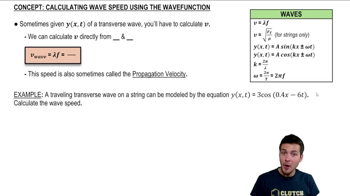
Calculating Wave Speed from Wave Functions
Material Properties of Granite
Granite is an igneous rock composed mainly of quartz, feldspar, and mica, characterized by its density and elasticity. The specific values for the bulk modulus and density of granite are essential for calculating the speed of longitudinal waves in this material. Understanding these properties allows for accurate predictions of wave behavior in geological contexts.
추천 영상:
가이드 코스
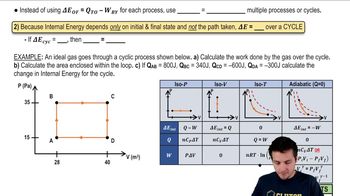
Properties of Cyclic Thermodynamic Processes
관련 실천
교과서 질문
812
views
교과서 질문
A 0.40-kg cord is stretched between two supports 8.7 m apart. When one support is struck by a hammer, a transverse wave travels down the cord and reaches the other support in 0.85 s. What is the tension in the cord?
1183
views
교과서 질문
A ski gondola [pronounced gon–do–la] is connected to the top of a hill by a steel cable of length 710 m and diameter 1.5 cm. As the gondola comes to the end of its run, it bumps into the terminal and sends a transverse wave pulse along the cable. It is observed that it took 17 s for the pulse to return. What is the tension in the cable?
1062
views