Ch. 15 - Wave Motion
Giancoli Douglas - Physics for Scientists and Engineers 5th edition
Giancoli Douglas5th editionPhysics for Scientists and EngineersISBN: 9780137488179당신이 사용하는 게 아니라요?교과서 변경
15장, 문제 68

A longitudinal earthquake wave strikes a boundary between two types of rock at a 41° angle. As the wave crosses the boundary, the specific gravity of the rock changes from 3.6 to 2.8. Assuming that the elastic modulus (Section 15–2)is the same for both types of rock, determine the angle of refraction.

검증된 단계별 안내
1
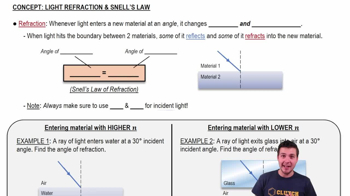
Identify the relevant physics principle: This problem involves the refraction of waves at a boundary, which is governed by Snell's Law. Snell's Law is expressed as: n1sinθ1=n2sinθ2, where n is the refractive index, and θ is the angle of incidence or refraction.
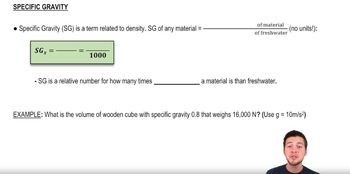
Relate the refractive index to the specific gravity: The refractive index for longitudinal waves in a medium is proportional to the square root of the specific gravity (density) divided by the elastic modulus. Since the elastic modulus is constant, the refractive index is proportional to the square root of the specific gravity. Thus, nρ, where ρ is the specific gravity.
Calculate the ratio of refractive indices: Using the proportionality, the ratio of refractive indices is given by 3.62.8. This ratio will be used in Snell's Law.
Apply Snell's Law: Substitute the known values into Snell's Law. The angle of incidence is 41°, and the ratio of refractive indices is as calculated in the previous step. The equation becomes: sin41°=2.83.6sinθ2, where θ2 is the angle of refraction.
Solve for the angle of refraction: Rearrange the equation to isolate θ2. Use the inverse sine function: θ2=sin13.62.8sin41°. This will give the angle of refraction.

비슷한 문제에 대한 검증된 영상 답변:

이 영상 해법은 위 문제에 도움이 된다고 튜터들이 추천한 것입니다.
영상 길이:
5m
도움이 되었나요?

주요 개념

질문에 올바르게 답하기 위해 반드시 이해해야 하는 핵심 개념들은 다음과 같습니다.

Snell's Law

Snell's Law describes how waves change direction when they pass through different media. It states that the ratio of the sine of the angle of incidence to the sine of the angle of refraction is constant and is equal to the ratio of the velocities of the wave in the two media. This principle is crucial for determining the angle of refraction when an earthquake wave transitions between different types of rock.
추천 영상:

Specific Gravity

Specific gravity is a dimensionless quantity that compares the density of a substance to the density of water. In the context of seismic waves, the specific gravity of the rocks affects their density and, consequently, the speed of the waves traveling through them. Understanding the specific gravities of the two types of rock is essential for applying Snell's Law to find the angle of refraction.
추천 영상:
가이드 코스
4:58
Specific Gravity

Elastic Modulus

The elastic modulus is a measure of a material's stiffness or resistance to deformation under stress. It is a critical property in determining how seismic waves propagate through different materials. In this scenario, the assumption that the elastic modulus is the same for both types of rock simplifies the analysis, allowing us to focus on the effects of specific gravity on wave behavior at the boundary.
추천 영상:
가이드 코스
08:56
Intro To Elastic Collisions
관련 실천
교과서 질문

Destructive interference occurs where two overlapping waves are 1/2 wavelength or 180° out of phase. Explain why 180° is equivalent to 1/2 wavelength.

1403
views

교과서 질문

When you slosh the water back and forth in a tub at just the right frequency, the water alternately rises and falls at each end, remaining relatively calm at the center. Suppose the frequency to produce such a standing wave in a 45-cm-wide tub is 0.85 Hz. What is the speed of the water wave?

1054
views
교과서 질문

A guitar string is supposed to vibrate at 247 Hz, but is measured to actually vibrate at 262 Hz. By what percentage should the tension in the string be changed to get the frequency to the correct value?

1209
views
교과서 질문

(II) For any type of wave that reaches a boundary beyond which its speed is increased, there is a maximum incident angle if there is to be a transmitted refracted wave. This maximum incident angle θiM corresponds to an angle of refraction equal to 90°. If θᵢ > θiM, all the wave is reflected at the boundary and none is refracted, because this would correspond to sin θᵣ > 1 (where is the angle θᵣ of refraction), which is impossible.

(a) Find a formula for θiM using the law of refraction, Eq. 15–19.

1257
views
교과서 질문

A bug on the surface of a pond is observed to move up and down a total vertical distance of 0.10 m, lowest to highest point, as a wave passes. If the amplitude increases to 0.15 m, by what factor does the bug’s maximum kinetic energy change?

945
views