Ch. 15 - Wave Motion
Giancoli Douglas - Physics for Scientists and Engineers 5th edition
Giancoli Douglas5th editionPhysics for Scientists and EngineersISBN: 9780137488179당신이 사용하는 게 아니라요?교과서 변경
15장, 문제 44b

Suppose two linear waves of equal amplitude and frequency have a phase difference ϕ as they travel in the same medium. They can be represented by: D₁ = A sin (kx - ωt); D₂ = A sin ( kx - ωt + ϕ). What is the amplitude of this resultant wave? Is the wave purely sinusoidal, or not?

검증된 단계별 안내
1
Step 1: Represent the two waves mathematically. The first wave is given as \( D_1 = A \sin(kx - \omega t) \), and the second wave is \( D_2 = A \sin(kx - \omega t + \phi) \), where \( A \) is the amplitude, \( k \) is the wave number, \( \omega \) is the angular frequency, and \( \phi \) is the phase difference.
Step 2: Use the principle of superposition to find the resultant wave. The total displacement \( D \) is the sum of the two waves: \( D = D_1 + D_2 = A \sin(kx - \omega t) + A \sin(kx - \omega t + \phi) \).
Step 3: Apply the trigonometric identity for the sum of two sine functions: \( \sin(x) + \sin(y) = 2 \sin\left(\frac{x + y}{2}\right) \cos\left(\frac{x - y}{2}\right) \). Substituting \( x = kx - \omega t \) and \( y = kx - \omega t + \phi \), we get \( D = 2A \cos\left(\frac{\phi}{2}\right) \sin\left(kx - \omega t + \frac{\phi}{2}\right) \).
Step 4: Identify the amplitude of the resultant wave. From the expression above, the amplitude of the resultant wave is \( 2A \cos\left(\frac{\phi}{2}\right) \). This shows that the amplitude depends on the phase difference \( \phi \).
Step 5: Determine if the wave is purely sinusoidal. The resultant wave is of the form \( D = \text{(amplitude)} \times \sin(\text{(argument)}) \), which is a sinusoidal function. Therefore, the wave is purely sinusoidal.

비슷한 문제에 대한 검증된 영상 답변:

이 영상 해법은 위 문제에 도움이 된다고 튜터들이 추천한 것입니다.
영상 길이:
3m
도움이 되었나요?

주요 개념

질문에 올바르게 답하기 위해 반드시 이해해야 하는 핵심 개념들은 다음과 같습니다.

Superposition Principle

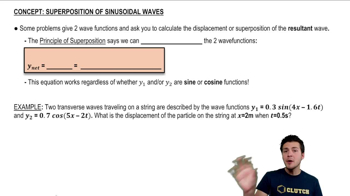
The superposition principle states that when two or more waves overlap in the same medium, the resultant displacement at any point is the sum of the displacements due to each wave. This principle is fundamental in wave theory and allows us to analyze complex waveforms by breaking them down into simpler components.
추천 영상:
가이드 코스
03:32
Superposition of Sinusoidal Wave Functions

Phase Difference

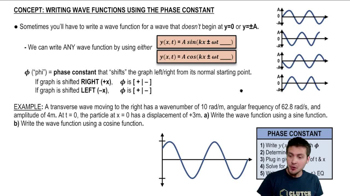
Phase difference refers to the difference in phase angle between two waves at a given point in time. It affects how the waves interfere with each other, leading to constructive or destructive interference, which ultimately influences the amplitude and shape of the resultant wave.
추천 영상:
가이드 코스
08:59
Phase Constant of a Wave Function

Resultant Amplitude

The resultant amplitude of two interfering waves can be calculated using the formula that incorporates their individual amplitudes and the phase difference. For waves of equal amplitude, the resultant amplitude can be expressed as A_r = 2A cos(ϕ/2), where ϕ is the phase difference, indicating that the resultant wave's amplitude varies depending on the phase relationship between the two waves.
추천 영상:
가이드 코스
04:24
Amplitude Decay in an LRC Circuit