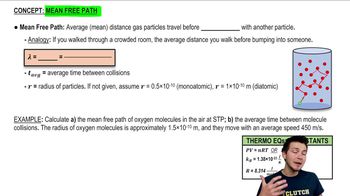
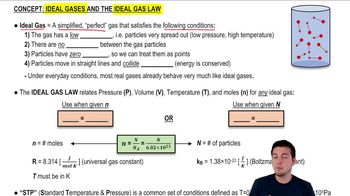
At about what pressure would the mean free path of air molecules be equal to the diameter of air molecules, ≈ 3 x 10⁻¹⁰ m? Assume T = 20° C.
Ch. 18 - Kinetic Theory of Gases
Giancoli Douglas5th editionPhysics for Scientists and EngineersISBN: 9780137488179당신이 사용하는 게 아니라요?교과서 변경
18장, 문제 45
Below a certain threshold pressure, the air molecules (0.3-nm diameter) within a research vacuum chamber are in the “collision-free regime,” meaning that a particular air molecule is as likely to cross the container and collide with the opposite wall as it is to collide with another air molecule. Estimate the threshold pressure for a vacuum chamber of side 1.0 m at 20°C.
검증된 단계별 안내1
Understand the problem: The threshold pressure is the pressure at which the mean free path of air molecules becomes comparable to the dimensions of the vacuum chamber. The mean free path is the average distance a molecule travels before colliding with another molecule. In this case, the mean free path should be approximately 1.0 m, the size of the chamber.
Use the formula for the mean free path (λ): λ = (k_B * T) / (√2 * π * d^2 * P), where k_B is the Boltzmann constant (1.38 × 10^-23 J/K), T is the temperature in kelvins, d is the diameter of the air molecule, and P is the pressure. Rearrange the formula to solve for P: P = (k_B * T) / (√2 * π * d^2 * λ).
Convert the given temperature from Celsius to Kelvin: T = 20°C + 273.15 = 293.15 K. Use this value for T in the formula.
Substitute the given values into the formula: k_B = 1.38 × 10^-23 J/K, T = 293.15 K, d = 0.3 × 10^-9 m (diameter of the air molecule), and λ = 1.0 m (mean free path).
Simplify the expression to calculate the threshold pressure P. Ensure all units are consistent (e.g., meters, kelvins, pascals) and perform the necessary arithmetic to find the result.

비슷한 문제에 대한 검증된 영상 답변:
이 영상 해법은 위 문제에 도움이 된다고 튜터들이 추천한 것입니다.
영상 길이:
4m도움이 되었나요?
주요 개념
질문에 올바르게 답하기 위해 반드시 이해해야 하는 핵심 개념들은 다음과 같습니다.
Collision-Free Regime
The collision-free regime occurs when the mean free path of gas molecules is significantly larger than the dimensions of the container. In this state, molecules travel long distances without colliding with one another, allowing them to interact more frequently with the walls of the container. This concept is crucial for understanding gas behavior in low-pressure environments, where the likelihood of molecular collisions decreases.
추천 영상:
가이드 코스
Mean Free Path
Mean Free Path
Mean free path is the average distance a molecule travels between collisions. It depends on the size of the molecules and the density of the gas. In the context of the vacuum chamber, calculating the mean free path helps determine the conditions under which the air molecules behave as if they are in a collision-free environment, which is essential for estimating the threshold pressure.
추천 영상:
가이드 코스
Mean Free Path
Ideal Gas Law
The Ideal Gas Law relates the pressure, volume, temperature, and number of moles of a gas through the equation PV = nRT. This law is fundamental in thermodynamics and helps in calculating the behavior of gases under various conditions. In this scenario, it can be used to estimate the threshold pressure by considering the volume of the chamber and the temperature of the air molecules.
추천 영상:
가이드 코스
Ideal Gases and the Ideal Gas Law
관련 실천
교과서 질문
1385
views
교과서 질문
Water is in which phase when the pressure is 0.01 atm and the temperature is 90°C?
699
views
교과서 질문
A gas consisting of 14,500 molecules, each of mass 2.00 x 10⁻²⁶ kg, has the following distribution of speeds, which crudely mimics the Maxwell distribution. Determine vᵣₘₛ for this distribution of speeds.
949
views
교과서 질문
At about what pressure would the mean free path of air molecules be 0.30 m? Assume T = 20° C.
1411
views
교과서 질문
For what range of pressures and temperatures can CO₂ be a liquid? Refer to Fig. 18-6.
491
views
교과서 질문
Estimate the time needed for a glycine molecule (see Table 18–3) to diffuse a distance of 25μm in water at 20°C if its concentration varies over that distance from 1.00 mol/m³ to 0.50 mol/m³. Compare this “speed” to its rms (thermal) speed. The molecular mass of glycine is about 75 u.
72
views