Ch. 18 - Kinetic Theory of Gases
Giancoli Douglas - Physics for Scientists and Engineers 5th edition
Giancoli Douglas5th editionPhysics for Scientists and EngineersISBN: 9780137488179당신이 사용하는 게 아니라요?교과서 변경
18장, 문제 19

Estimate how many air molecules rebound from a wall in a typical room per second, assuming an ideal gas of N molecules contained in a cubic room with sides of length ℓ at temperature T and pressure P.
(a) Show that the frequency f with which gas molecules strike a wall is ƒ = (υx\(\overline{\upsilon_{x}\)} /2)(P/kT) ℓ² where υx\(\overline{\upsilon_{x}\)} is the average x component of the molecule’s velocity.
(b) Show that the equation can then be written as ƒ≈ Pℓ² /4mkT\(\sqrt{4mkT}\) where m is the mass of a gas molecule.

검증된 단계별 안내
1
Step 1: Start by understanding the problem. We are tasked with deriving two expressions for the frequency (ƒ) at which gas molecules strike a wall in a cubic room. The first expression involves the average x-component of velocity (υ¯ₓ), pressure (P), temperature (T), and Boltzmann constant (k). The second expression simplifies this further using the mass of a gas molecule (m).
Step 2: Recall the relationship between pressure and molecular motion in an ideal gas. Pressure (P) is related to the average kinetic energy of the molecules. For a single direction (x-direction), the pressure can be expressed as P = (1/3)Nmv²/ℓ³, where N is the number of molecules, m is the mass of a molecule, v² is the mean square velocity, and ℓ³ is the volume of the cubic room.
Step 3: The average x-component of velocity (υ¯ₓ) is related to the root mean square velocity (v_rms) by υ¯ₓ = v_rms/√3. The root mean square velocity is given by v_rms = √(3kT/m), where k is the Boltzmann constant, T is the temperature, and m is the mass of a molecule. Substitute this into the expression for υ¯ₓ.
Step 4: To derive the first expression for ƒ, consider the number of molecules striking a unit area of the wall per second. This depends on the number density of molecules (N/ℓ³), the average x-component of velocity (υ¯ₓ), and the area of the wall (ℓ²). Use the relationship between pressure, temperature, and molecular motion to express ƒ in terms of P, k, T, and ℓ.
Step 5: For the second expression, simplify the result from Step 4 by substituting υ¯ₓ = √(kT/m) and rearranging terms. This will yield ƒ ≈ Pℓ² / √(4mkT), which is the desired simplified form. Ensure all constants and variables are correctly accounted for in the derivation.

비슷한 문제에 대한 검증된 영상 답변:

이 영상 해법은 위 문제에 도움이 된다고 튜터들이 추천한 것입니다.
영상 길이:
9m
도움이 되었나요?

주요 개념

질문에 올바르게 답하기 위해 반드시 이해해야 하는 핵심 개념들은 다음과 같습니다.

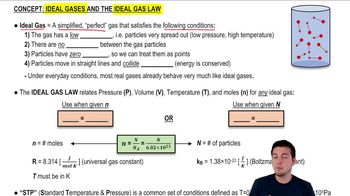
Ideal Gas Law

The Ideal Gas Law relates the pressure (P), volume (V), temperature (T), and number of moles (n) of an ideal gas through the equation PV = nRT. This law assumes that gas molecules do not interact and occupy no volume, allowing for simplified calculations of gas behavior under various conditions. Understanding this law is crucial for estimating the behavior of gas molecules in a confined space, such as a room.
추천 영상:
가이드 코스
07:21
Ideal Gases and the Ideal Gas Law

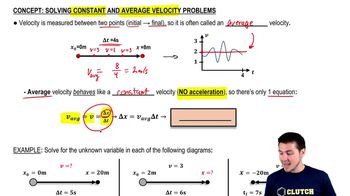
Average Velocity of Gas Molecules

The average velocity of gas molecules, denoted as υ¯ₓ, is a key factor in determining how frequently these molecules collide with the walls of a container. This average is derived from the kinetic theory of gases, which states that the temperature of a gas is proportional to the average kinetic energy of its molecules. Knowing this average velocity helps in calculating the frequency of collisions with the walls.
추천 영상:
가이드 코스
05:44
Solving Constant and Average Velocity Problems

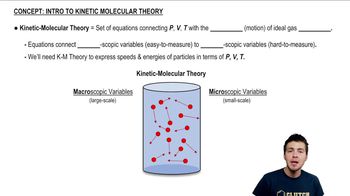
Kinetic Theory of Gases

The Kinetic Theory of Gases provides a microscopic explanation of gas behavior, positing that gases consist of a large number of small particles in constant random motion. This theory helps explain macroscopic properties such as pressure and temperature in terms of molecular motion and collisions. It is essential for deriving equations related to the frequency of molecular impacts on surfaces, as seen in the problem statement.
추천 영상:
가이드 코스
01:50
Introduction to Kinetic-Molecular Theory