
From the van der Waals equation of state, show that the critical temperature and pressure are given by Tcr = 8a / 27bR , Pcr = a / 27b². [Hint: Use the fact that the P versus V curve has an inflection point at the critical point so that the first and second derivatives are zero.]
Ch. 18 - Kinetic Theory of Gases
Giancoli Douglas5th editionPhysics for Scientists and EngineersISBN: 9780137488179당신이 사용하는 게 아니라요?교과서 변경
18장, 문제 74
Using the ideal gas law, find an expression for the mean free path ℓM that involves pressure and temperature instead of (N/V). Use this expression to find the mean free path for nitrogen molecules at a pressure of 7.5 atm and 300 K.
검증된 단계별 안내1
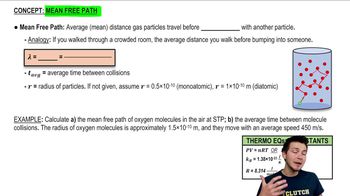
Start with the formula for the mean free path: ℓ_M = (k_B * T) / (√2 * π * d^2 * (N/V)), where k_B is the Boltzmann constant, T is the temperature, d is the diameter of the gas molecules, and (N/V) is the number density of molecules.
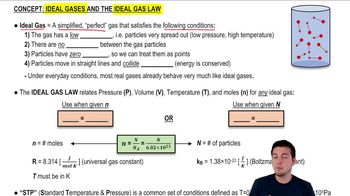
Use the ideal gas law, PV = Nk_B * T, to express (N/V) in terms of pressure (P) and temperature (T). Rearrange the ideal gas law to get (N/V) = P / (k_B * T).
Substitute (N/V) = P / (k_B * T) into the mean free path formula. This gives ℓ_M = (k_B * T) / (√2 * π * d^2 * (P / (k_B * T))).
Simplify the expression by canceling terms. The final expression for the mean free path becomes ℓ_M = (k_B * T^2) / (√2 * π * d^2 * P).
To calculate the mean free path for nitrogen molecules at 7.5 atm and 300 K, substitute the given values into the derived formula. Use the Boltzmann constant (k_B = 1.38 × 10^-23 J/K), the diameter of nitrogen molecules (d ≈ 3.7 × 10^-10 m), and convert pressure to Pascals (1 atm = 1.013 × 10^5 Pa).

비슷한 문제에 대한 검증된 영상 답변:
이 영상 해법은 위 문제에 도움이 된다고 튜터들이 추천한 것입니다.
영상 길이:
5m주요 개념
질문에 올바르게 답하기 위해 반드시 이해해야 하는 핵심 개념들은 다음과 같습니다.
Ideal Gas Law
The ideal gas law is a fundamental equation in thermodynamics that relates the pressure (P), volume (V), number of moles (n), and temperature (T) of an ideal gas. It is expressed as PV = nRT, where R is the ideal gas constant. This law allows us to derive relationships between these variables, which is essential for understanding gas behavior under various conditions.
추천 영상:
가이드 코스
Ideal Gases and the Ideal Gas Law
Mean Free Path
The mean free path (ℓ_M) is the average distance a molecule travels between collisions with other molecules. It is influenced by factors such as the density of the gas and the size of the molecules. Understanding mean free path is crucial for analyzing gas behavior, especially in kinetic theory and applications involving gas dynamics.
추천 영상:
가이드 코스
Mean Free Path
Kinetic Theory of Gases
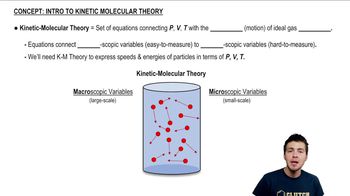
The kinetic theory of gases provides a molecular-level interpretation of gas behavior, explaining properties like pressure and temperature in terms of molecular motion. It posits that gas pressure arises from collisions of molecules with the walls of a container. This theory is foundational for deriving expressions related to mean free path and other gas properties, linking macroscopic observations to microscopic behavior.
추천 영상:
가이드 코스
Introduction to Kinetic-Molecular Theory
관련 실천
교과서 질문
1262
views
교과서 질문
At room temperature, it takes approximately 2.45 x 10³ J to evaporate 1.00 g of water. Estimate the average speed of evaporating molecules. What multiple of vrms (at 20°C) for water molecules is this? (Assume Eq. 18–4 holds.)
961
views
교과서 질문
A sample of cesium vapor is in an oven at 400°C. The volume of the oven is 75 cm³, the vapor pressure of Cs at 400°C is 17 mm-Hg, and the diameter of cesium atoms in the vapor is 0.33 nm. Determine the number of collisions a single Cs atom undergoes with other cesium atoms per second.
1007
views
교과서 질문
Calculate the total water vapor pressure in the air on the following day: a hot summer day, with the temperature 30°C and the relative humidity at 75%.
1212
views
