
Ch. 19 - Heat and the First Law of Thermodynamics
Giancoli Douglas - Physics for Scientists and Engineers 5th edition
Giancoli Douglas5th editionPhysics for Scientists and EngineersISBN: 9780137488179당신이 사용하는 게 아니라요?교과서 변경
19장, 문제 70

A ceramic teapot (e = 0.70) and a shiny metal one (e = 0.10) each hold 0.55 L of tea at 85°C. (a) Estimate the rate of heat loss from each, and (b) estimate the temperature drop after 30 min for each. Consider only radiation, and assume the surroundings are at 20°C.

검증된 단계별 안내
1
Step 1: Understand the problem. The problem involves heat loss due to radiation, which is governed by the Stefan-Boltzmann law: P = eσA(T⁴ - Tₛ⁴), where P is the power (rate of heat loss), e is the emissivity, σ is the Stefan-Boltzmann constant (5.67 × 10⁻⁸ W/m²·K⁴), A is the surface area, T is the temperature of the object in Kelvin, and Tₛ is the temperature of the surroundings in Kelvin.
Step 2: Convert the given temperatures to Kelvin. Use the formula T(K) = T(°C) + 273.15. For the tea, T = 85 + 273.15, and for the surroundings, Tₛ = 20 + 273.15.
Step 3: Estimate the surface area of the teapots. Assume the teapots are approximately spherical. The volume of tea is given as 0.55 L (or 0.55 × 10⁻³ m³). For a sphere, the volume is V = (4/3)πr³, and the surface area is A = 4πr². Solve for the radius r from the volume, then calculate the surface area A.
Step 4: Calculate the rate of heat loss (P) for each teapot using the Stefan-Boltzmann law. Substitute the emissivity (e = 0.70 for the ceramic teapot and e = 0.10 for the shiny metal teapot), the calculated surface area (A), the Stefan-Boltzmann constant (σ), and the temperatures (T and Tₛ) into the formula P = eσA(T⁴ - Tₛ⁴).
Step 5: Estimate the temperature drop after 30 minutes. Use the relationship Q = P × t, where Q is the heat lost, P is the power (rate of heat loss), and t is the time in seconds (30 minutes = 1800 seconds). Then, use the formula Q = mcΔT, where m is the mass of the tea (density of water is approximately 1000 kg/m³, so m = 0.55 kg), c is the specific heat capacity of water (c = 4186 J/kg·K), and ΔT is the temperature change. Solve for ΔT for each teapot.

비슷한 문제에 대한 검증된 영상 답변:

이 영상 해법은 위 문제에 도움이 된다고 튜터들이 추천한 것입니다.
영상 길이:
13m

주요 개념

질문에 올바르게 답하기 위해 반드시 이해해야 하는 핵심 개념들은 다음과 같습니다.

Emissivity

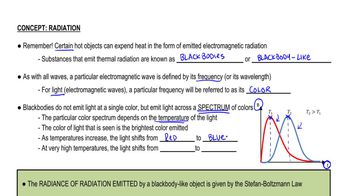
Emissivity is a measure of an object's ability to emit thermal radiation compared to a perfect black body, which has an emissivity of 1. In this context, the ceramic teapot has a higher emissivity (0.70) than the shiny metal teapot (0.10), meaning it will radiate heat more effectively. This property significantly influences the rate of heat loss through radiation.
추천 영상:

Stefan-Boltzmann Law

The Stefan-Boltzmann Law states that the power radiated by a black body is proportional to the fourth power of its absolute temperature. For real objects, this law is modified by the emissivity factor. In this problem, it helps calculate the rate of heat loss from each teapot by considering their temperatures and emissivities, allowing us to estimate how much heat they lose to the surroundings.
추천 영상:

Heat Transfer

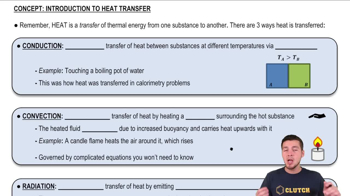
Heat transfer refers to the movement of thermal energy from one object to another due to a temperature difference. In this scenario, the teapots lose heat to the surrounding environment at a temperature of 20°C. Understanding the mechanisms of heat transfer, particularly radiation in this case, is essential for estimating the temperature drop of the tea over time.
추천 영상:
가이드 코스
05:14
Overview of Heat Transfer
관련 실천
교과서 질문

(a) Estimate the total power radiated into space by the Sun, assuming it to be a perfect emitter at T = 5500 K. The Sun’s radius is 7.0 x 10⁸ m.

(b) From this, determine the power per unit area arriving at the Earth, 1.5 x 10¹¹ m away (Fig. 19–37).

1216
views
교과서 질문

What will be the final result when equal masses of ice at 0°C and steam at 100°C are mixed together?

944
views
교과서 질문

Show, using Eqs. 19–7 and 19–16, that the work done by a gas that slowly expands adiabatically from pressure P₁ and volume V₁ , to P₂ and V₂, is given by W = (P₁V₁ - P₂V₂) / (γ - 1).

1079
views
교과서 질문

If a heater supplies 1.8 x 10⁶ J/h to a room 3.5 m x 4.6 m x 3.0 m containing air at 20°C and 1.0 atm, by how much will the temperature rise in one hour, assuming no losses of heat or air mass to the outside? Assume air is an ideal diatomic gas with molecular mass 29.

1142
views
교과서 질문

A 1.0-L volume of air initially at 3.5 atm of (gauge)pressure is allowed to expand isothermally until the (gauge) pressure is 1.0 atm. It is then compressed at constant pressure to its initial volume, and lastly is brought back to its original pressure by heating at constant volume. How much work does the 1.0 L of air do in this process?

1517
views
교과서 질문

A copper rod and an aluminum rod of the same length and cross-sectional area are attached end to end (Fig. 19–35). The copper end is placed in a furnace maintained at a constant temperature of 205°C. The aluminum end is placed in an ice bath held at a constant temperature of 0.0°C. Calculate the temperature at the point where the two rods are joined.

1220
views