
Ch. 20 - Second Law of Thermodynamics
Giancoli Douglas - Physics for Scientists and Engineers 5th edition
Giancoli Douglas5th editionPhysics for Scientists and EngineersISBN: 9780137488179당신이 사용하는 게 아니라요?교과서 변경
20장, 문제 33

How much less per year would it cost a family to operate a heat pump that has a coefficient of performance of 2.9 than an electric heater that costs \$2100 to heat their home for a year? If the conversion to the heat pump costs \$15,000, how long would it take the family to break even on heating costs? How much would the family save in 20 years?

검증된 단계별 안내
1
Determine the energy efficiency of the heat pump compared to the electric heater. The coefficient of performance (COP) of the heat pump is given as 2.9, which means the heat pump delivers 2.9 times the energy it consumes. An electric heater has a COP of 1.0, as it converts all electrical energy into heat. Therefore, the heat pump is 2.9 times more efficient than the electric heater.
Calculate the annual cost of operating the heat pump. Since the heat pump is 2.9 times more efficient, the cost to operate it will be the cost of the electric heater divided by 2.9. Use the formula: \( \text{Cost}_{\text{heat pump}} = \frac{\text{Cost}_{\text{electric heater}}}{\text{COP}} \). Substitute \( \text{Cost}_{\text{electric heater}} = 2100 \) and \( \text{COP} = 2.9 \).
Find the annual savings by subtracting the cost of operating the heat pump from the cost of operating the electric heater. Use the formula: \( \text{Savings}_{\text{annual}} = \text{Cost}_{\text{electric heater}} - \text{Cost}_{\text{heat pump}} \).
Determine the break-even time for the conversion cost. The conversion cost is \$15,000. Divide the conversion cost by the annual savings to find the number of years it will take to recover the initial investment. Use the formula: \( \text{Break-even time} = \frac{\text{Conversion cost}}{\text{Savings}_{\text{annual}}} \).
Calculate the total savings over 20 years. Multiply the annual savings by 20 to find the total savings. Use the formula: \( \text{Savings}_{\text{20 years}} = \text{Savings}_{\text{annual}} \times 20 \).

비슷한 문제에 대한 검증된 영상 답변:

이 영상 해법은 위 문제에 도움이 된다고 튜터들이 추천한 것입니다.
영상 길이:
5m
도움이 되었나요?

주요 개념

질문에 올바르게 답하기 위해 반드시 이해해야 하는 핵심 개념들은 다음과 같습니다.

Coefficient of Performance (COP)

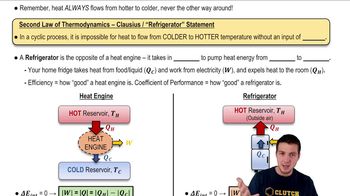
The Coefficient of Performance (COP) is a measure of the efficiency of a heat pump or refrigeration system. It is defined as the ratio of useful heating or cooling provided to the work input required. A higher COP indicates a more efficient system, meaning that for every unit of energy consumed, the system provides more heating or cooling output.
추천 영상:

Break-even Analysis

Break-even analysis is a financial assessment that determines the point at which total costs and total revenues are equal, resulting in neither profit nor loss. In the context of heating systems, it helps to calculate how long it will take for the savings from operating a more efficient system, like a heat pump, to offset the initial investment costs.
추천 영상:
가이드 코스
05:00
Dimensional Analysis

Long-term Savings Calculation

Long-term savings calculation involves estimating the total financial benefits gained over an extended period, typically years. This includes considering initial costs, operational costs, and savings accrued from using a more efficient system. In this scenario, it helps to quantify how much a family would save over 20 years by switching from an electric heater to a heat pump.
추천 영상:
가이드 코스
05:55
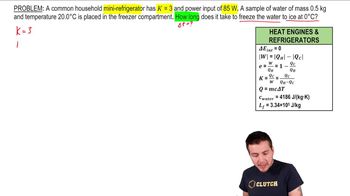
How long to freeze water?