Suppose that you repeatedly shake six coins in your hand and drop them on the floor. Construct a table showing the number of microstates that correspond to each macrostate. What is the probability of obtaining six heads?
Ch. 20 - Second Law of Thermodynamics
Giancoli Douglas5th editionPhysics for Scientists and EngineersISBN: 9780137488179당신이 사용하는 게 아니라요?교과서 변경
20장, 문제 60a
Suppose that you repeatedly shake six coins in your hand and drop them on the floor. Construct a table showing the number of microstates that correspond to each macrostate. What is the probability of obtaining three heads and three tails?
검증된 단계별 안내1
Understand the problem: A macrostate is defined by the number of heads and tails (e.g., 3 heads and 3 tails), while a microstate is a specific arrangement of the coins (e.g., HHTTHT). The goal is to calculate the number of microstates for each macrostate and determine the probability of obtaining 3 heads and 3 tails.
Step 1: Use the binomial coefficient formula to calculate the number of microstates for each macrostate. The formula is: , where is the total number of coins (6 in this case) and is the number of heads.
Step 2: Construct a table for all possible macrostates (0 heads, 1 head, ..., 6 heads). For each macrostate, calculate the number of microstates using the binomial coefficient formula. For example, for 3 heads and 3 tails, calculate: .
Step 3: Calculate the total number of microstates by summing up the microstates for all macrostates. The total number of microstates is given by , since each coin has two possible outcomes (head or tail).
Step 4: Determine the probability of obtaining 3 heads and 3 tails. The probability is given by the ratio of the number of microstates for the desired macrostate (3 heads and 3 tails) to the total number of microstates. Use the formula: .

비슷한 문제에 대한 검증된 영상 답변:
이 영상 해법은 위 문제에 도움이 된다고 튜터들이 추천한 것입니다.
영상 길이:
6m주요 개념
질문에 올바르게 답하기 위해 반드시 이해해야 하는 핵심 개념들은 다음과 같습니다.
Microstates and Macrostates
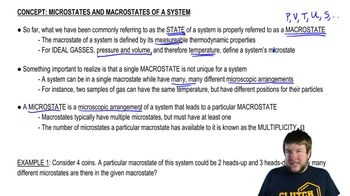
In statistical mechanics, a microstate refers to a specific detailed configuration of a system, while a macrostate is defined by macroscopic properties like temperature or pressure. For example, when flipping coins, each unique arrangement of heads and tails represents a microstate, whereas the overall count of heads and tails (e.g., three heads and three tails) represents a macrostate.
추천 영상:
가이드 코스
Microstates and Macrostates of a System
Combinatorics
Combinatorics is a branch of mathematics dealing with counting, arrangement, and combination of objects. In the context of the coin problem, it helps determine the number of ways to achieve a specific outcome, such as three heads and three tails, by using the binomial coefficient, which calculates the number of ways to choose a subset from a larger set.
Probability
Probability quantifies the likelihood of an event occurring, expressed as a ratio of favorable outcomes to the total number of possible outcomes. In this scenario, the probability of obtaining three heads and three tails can be calculated by dividing the number of favorable microstates (ways to achieve three heads and three tails) by the total number of microstates for six coin flips.
추천 영상:
가이드 코스
Probability Distribution Graph
관련 실천
교과서 질문
919
views
교과서 질문
Use Eq. 20–14 to determine the entropy of each of the five macrostates listed in Table 20–1 on page 595.
969
views
교과서 질문
Why would you expect the total entropy change in a Carnot cycle to be zero? Do a calculation to show that it is zero.
1297
views
교과서 질문
(II) Calculate the probabilities, when you throw two dice, of obtaining a 7.
992
views
교과서 질문
(II) Calculate the probabilities, when you throw two dice, of obtaining an 11.
1066
views
교과서 질문
A general theorem states that the amount of energy that becomes unavailable to do useful work in any process is equal to TL∆S, where TL is the lowest temperature available and ∆S is the total change in entropy during the process. Show that this is valid in the specific cases of a falling rock that comes to rest when it hits the ground.
1385
views