
Ch. 21 - Electric Charge and Electric Field
Giancoli Douglas - Physics for Scientists and Engineers 5th edition
Giancoli Douglas5th editionPhysics for Scientists and EngineersISBN: 9780137488179당신이 사용하는 게 아니라요?교과서 변경
21장, 문제 40

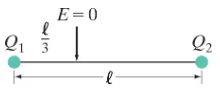
You are given two unknown point charges, Q₁ and Q₂. At a point on the line joining them, one-third of the way from Q₁ to Q₂, the electric field is zero (Fig. 21–64). What is the ratio Q₁/Q₂?
Diagram showing two point charges, Q₁ and Q₂, with electric field E=0 at a point one-third of the distance from Q₁.

검증된 단계별 안내
1
Identify the key concept: The electric field at a point due to a point charge is given by the formula: E = kQr2, where k is Coulomb's constant, Q is the charge, and r is the distance from the charge to the point of interest. The electric field is zero at the given point, meaning the fields due to Q1 and Q2 must cancel each other out.
Define the distances: Let the total distance between Q1 and Q2 be d. The point where the electric field is zero is located one-third of the way from Q1 to Q2. Therefore, the distance from Q1 to the point is d3, and the distance from Q2 to the point is 23d.
Set up the condition for the electric field to be zero: The magnitudes of the electric fields due to Q1 and Q2 must be equal at the point. Using the formula for electric field, this gives: kQ1d32 = kQ2232.
Simplify the equation: Cancel out k on both sides and rearrange the terms to isolate the ratio Q1Q2. This gives: Q1Q2 = 232132.
Evaluate the ratio: Simplify the expression for the ratio Q1Q2 by calculating the squares of the fractions. This will yield the final ratio of Q1Q2.

비슷한 문제에 대한 검증된 영상 답변:

이 영상 해법은 위 문제에 도움이 된다고 튜터들이 추천한 것입니다.
영상 길이:
3m

주요 개념

질문에 올바르게 답하기 위해 반드시 이해해야 하는 핵심 개념들은 다음과 같습니다.

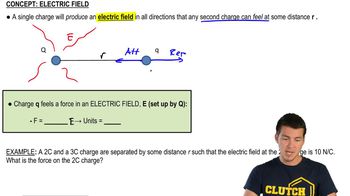
Electric Field

The electric field is a vector field that represents the force exerted by an electric charge on other charges in its vicinity. It is defined as the force per unit charge and is directed away from positive charges and toward negative charges. The strength of the electric field decreases with distance from the charge, following an inverse square law.
추천 영상:
가이드 코스
03:16
Intro to Electric Fields

Superposition Principle

The superposition principle states that the total electric field created by multiple charges is the vector sum of the electric fields produced by each charge independently. This principle allows us to analyze complex charge configurations by considering the contributions of individual charges to the overall electric field at a given point.
추천 영상:
가이드 코스
03:32
Superposition of Sinusoidal Wave Functions

Charge Ratio

The charge ratio, in this context, refers to the relationship between the magnitudes of two point charges, Q₁ and Q₂. To find the ratio Q₁/Q₂, one must consider the conditions under which the electric field is zero at a specific point, which involves balancing the electric fields due to both charges. This ratio is crucial for determining how the magnitudes of the charges influence the electric field at that point.
추천 영상:
가이드 코스
04:12
Find Mass-to-Charge Ratio in Spectrometer
관련 실천
교과서 질문

Draw, approximately, the electric field lines emanating from a uniformly charged straight wire whose length ℓ is not great. The spacing between lines near the wire should be much less than ℓ. [Hint: Also consider points very far from the wire up to 4ℓ \.]

1659
views
교과서 질문

An electron moving to the right at 7.5 x 10⁵ m/s enters a uniform electric field parallel to its direction of motion. If the electron is to be brought to rest in the space of 5.0 cm,

(a) what direction is required for the electric field, and

(b) what is the strength of the field?

1750
views
교과서 질문

Estimate the net force between the CO group and the HN group shown in Fig. 21–72. The C and O have charges ± 0.40e, and the H and N have charges ±0.20e, where e = 1.6 x 10⁻¹⁹ C. [Hint: Do not include the “internal” forces between C and O, or between H and N.]

1390
views
교과서 질문

Two point charges, Q₁ = ― 6.7 μC and Q₂ = 2.6 μC, are located between two oppositely charged parallel plates, as shown in Fig. 21–74. The two charges are separated by a distance of 𝓍 = 0.47 m. Assume that the electric field produced by the charged plates is uniform and equal to E = 53,000 N/C . Calculate the net electrostatic force on Q₁ and give its direction.

1712
views
교과서 질문

Two positive point charges are a fixed distance apart. The sum of their charges is Qₜ. What charge must each have in order to

(a) maximize the electric force between them, and

(b) minimize it?

175
views