
Ch. 23 - Electric Potential
Giancoli Douglas - Physics for Scientists and Engineers 5th edition
Giancoli Douglas5th editionPhysics for Scientists and EngineersISBN: 9780137488179당신이 사용하는 게 아니라요?교과서 변경
22장, 문제 105b

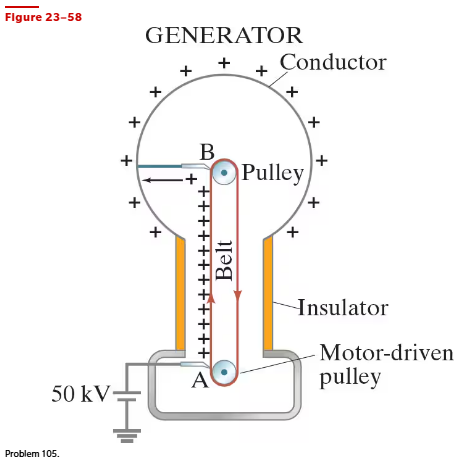
A Van de Graaff generator (Fig. 23–58) can develop a very large potential difference, even millions of volts. Electrons are pulled off the belt by the high voltage pointed electrode (positive) at A, leaving the belt positively charged. (Recall Example 23–5 where we saw that near sharp points the electric field is high and ionization can occur.) The belt carries the positive charge up inside the spherical shell where electrons from the large conducting sphere are attracted over to the pointed conductor at B, leaving the outer surface of the conducting sphere positively charged. As more charge is brought up, the sphere reaches extremely high voltage. Consider a Van de Graaff generator with a sphere of radius 0.20 m.
(b) What is the charge on the sphere for the potential found in part (a)

검증된 단계별 안내
1
Step 1: Understand the relationship between electric potential (V), charge (Q), and radius (r) for a spherical conductor. The formula to use is V = (1 / (4 * π * ε₀)) * (Q / r), where ε₀ is the permittivity of free space (8.85 × 10⁻¹² C²/(N·m²)).
Step 2: Rearrange the formula to solve for the charge Q. This gives Q = V * (4 * π * ε₀ * r).
Step 3: Identify the values given in the problem. The radius of the sphere is r = 0.20 m, and the potential V is the value found in part (a). Substitute these values into the formula.
Step 4: Use the constant value for ε₀ (8.85 × 10⁻¹² C²/(N·m²)) and calculate the product of (4 * π * ε₀ * r). This will give the proportionality factor for the charge.
Step 5: Multiply the proportionality factor by the potential V (from part (a)) to find the charge Q on the sphere. Ensure units are consistent throughout the calculation.

비슷한 문제에 대한 검증된 영상 답변:

이 영상 해법은 위 문제에 도움이 된다고 튜터들이 추천한 것입니다.
영상 길이:
3m
도움이 되었나요?

주요 개념

질문에 올바르게 답하기 위해 반드시 이해해야 하는 핵심 개념들은 다음과 같습니다.

Electric Potential and Voltage

Electric potential, or voltage, is the amount of electric potential energy per unit charge at a point in an electric field. It is measured in volts (V) and indicates how much work would be done to move a charge from a reference point to that point. In the context of the Van de Graaff generator, the high voltage developed indicates a significant potential difference that can influence charge distribution and movement.
추천 영상:
가이드 코스
07:33
Electric Potential

Charge and Capacitance

Charge refers to the property of matter that causes it to experience a force in an electric field, measured in coulombs (C). The capacitance of a conductor, such as the spherical shell of the Van de Graaff generator, determines how much charge it can hold at a given voltage. The relationship between charge (Q), capacitance (C), and voltage (V) is given by the formula Q = C × V, which is essential for calculating the charge on the sphere.
추천 영상:
가이드 코스
08:02
Capacitors & Capacitance (Intro)

Electric Field and Gauss's Law

An electric field is a region around a charged object where other charges experience a force. Gauss's Law relates the electric field to the charge enclosed within a surface, stating that the electric flux through a closed surface is proportional to the enclosed charge. This principle is crucial for understanding how the charge distribution on the Van de Graaff generator's sphere affects the electric field and potential around it.
추천 영상:
관련 실천
교과서 질문

Inside a high-voltage lab, engineers have designed a storage container for electrical energy using a nonconducting sphere of radius r2 that contains a concentric spherical cavity of radius r1. The material between r₁ and r₂ carries a uniform charge density ρE ( C/m³). Determine the electric potential V, relative to V = 0 at r = ∞, as a function of the distance r from the center for r > r₂.

1520
views
교과서 질문

A thin flat disk of radius R₀ carries a total charge Q that is distributed uniformly over its surface. The electric potential at a distance x on the x axis is given by V(x) = Q/ 2π∊₀R₀²[(x² + R²₀) ¹⸍² - x]. (See Example 23–10.) Show that the electric field at a distance x on the x axis is given by E(x) = Q/2π∊₀R₀² ( 1 - ( x / ( x² + R²₀))¹⸍². Make graphs of V(x) and E(x) as a function of x/R₀ for x/R₀ = 0 to 4. (Do the calculations in steps of 0.1.) Use Q = 5.0μC and R₀ = 10 cm for the calculation and graphs.

1735
views
교과서 질문

A Van de Graaff generator (Fig. 23–58) can develop a very large potential difference, even millions of volts. Electrons are pulled off the belt by the high voltage pointed electrode (positive) at A, leaving the belt positively charged. (Recall Example 23–5 where we saw that near sharp points the electric field is high and ionization can occur.) The belt carries the positive charge up inside the spherical shell where electrons from the large conducting sphere are attracted over to the pointed conductor at B, leaving the outer surface of the conducting sphere positively charged. As more charge is brought up, the sphere reaches extremely high voltage. Consider a Van de Graaff generator with a sphere of radius 0.20 m. What is the electric potential on the surface of the sphere when electrical breakdown occurs ( E = 3 x 10⁶ V/m) ? Assume V = 0 at r = ∞.

1900
views