Ch. 24 - Capacitance, Dielectrics, Electric Energy, Storage
Giancoli Douglas - Physics for Scientists and Engineers 5th edition
Giancoli Douglas5th editionPhysics for Scientists and EngineersISBN: 9780137488179당신이 사용하는 게 아니라요?교과서 변경
23장, 문제 19b

Small distances can be measured using a capacitor whose plate separation 𝓍 is variable. Consider an air-filled parallel-plate capacitor with fixed plate area A = 25 mm² separated by a variable distance 𝓍. Assume this capacitor is attached to a capacitance-measuring instrument which can measure capacitance C in the range 1.0 pF to 1000.0 pF with an accuracy of ∆C = 0.1 pF. Define ∆𝓍 to be the accuracy (magnitude) to which 𝓍 can be determined, and determine a formula for ∆𝓍.

검증된 단계별 안내
1
Start by recalling the formula for the capacitance of a parallel-plate capacitor: C=εx, where c is the capacitance, e is permittivity and x distance

비슷한 문제에 대한 검증된 영상 답변:

이 영상 해법은 위 문제에 도움이 된다고 튜터들이 추천한 것입니다.
영상 길이:
4m
도움이 되었나요?

주요 개념

질문에 올바르게 답하기 위해 반드시 이해해야 하는 핵심 개념들은 다음과 같습니다.

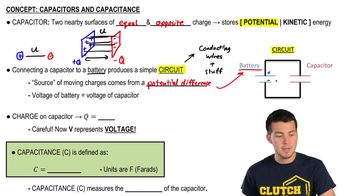
Capacitance

Capacitance is the ability of a capacitor to store electrical charge per unit voltage. It is defined by the formula C = ε(A/x), where C is the capacitance, ε is the permittivity of the dielectric material (air in this case), A is the area of the plates, and x is the separation between them. Understanding this relationship is crucial for determining how changes in plate separation affect the measured capacitance.
추천 영상:
가이드 코스
08:02
Capacitors & Capacitance (Intro)

Measurement Accuracy

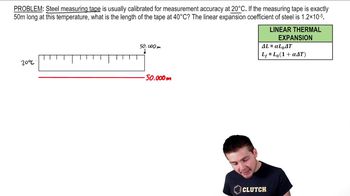
Measurement accuracy refers to the degree to which a measured value reflects the true value. In this context, the accuracy of the capacitance measuring instrument is given as ∆C = 0.1 pF, which indicates the smallest change in capacitance that can be reliably detected. This concept is essential for determining how precisely the plate separation x can be inferred from the measured capacitance.
추천 영상:
가이드 코스
03:47
Expanding Steel Measuring Tape

Error Propagation

Error propagation is the process of determining the uncertainty in a calculated result based on the uncertainties in the measurements used to obtain it. In this case, the uncertainty in the capacitance measurement (∆C) will affect the calculated uncertainty in the plate separation (∆x). Understanding how to propagate these errors is key to deriving a formula for ∆x based on the given ∆C.
추천 영상:
가이드 코스
07:32
Transverse Velocity of Waves
관련 실천
교과서 질문

To get an idea how big a farad is, suppose you want to make a 1-F air-filled parallel-plate capacitor for a circuit you are building. To make it a reasonable size, suppose you limit the plate area to 1.0 cm². What would the gap have to be between the plates? Is this practically achievable?

1373
views
교과서 질문

Suppose in Fig. 24–27 that C₁ = C₃ = 8.0μF, C₂ = C₄ = 16μF, and Q₃ = 21μC. Determine the voltage Vba across the combination.

1438
views
교과서 질문

(II) A 7.7-μF capacitor is charged by a 185-V battery (Fig. 24–21a) and then is disconnected from the battery. When this capacitor (C₁) is then connected (Fig. 24–21b) to a second (initially uncharged) capacitor, C₂, the final voltage on each capacitor is 15 V. What is the value of C₂? [Hint: Charge is conserved.]

1697
views
교과서 질문

Two capacitors connected in parallel produce an equivalent capacitance of 32.9-μF, but when connected in series the equivalent capacitance is only 5.5 μF. What is the individual capacitance of each capacitor?

1499
views
교과서 질문

In an electrostatic air cleaner (“precipitator”), the strong nonuniform electric field in the central region of a cylindrical capacitor (with outer and inner cylindrical radii Rₐ and R₆ ) is used to create ionized air molecules for use in charging dust and soot particles (Fig. 24–22). Under standard atmospheric conditions, if air is subjected to an electric field magnitude that exceeds its dielectric strength Eₛ ≈ 3.0 x 10⁶ N/C, air molecules will dissociate into positively charged ions and free electrons. In a precipitator, the region within which air is ionized (the corona discharge region) occupies a cylindrical volume of radius R that is typically five times that of the inner cylinder. Assume a particular precipitator is constructed with R₆ = 0.10 mm and Rₐ = 10.0 cm. In order to create a corona discharge region with radius R = 5.0 R₆, what potential difference V should be applied between the precipitator’s inner and outer conducting cylinders? [Besides dissociating air, the charged inner cylinder repels the resulting positive ions from the corona discharge region, where they are put to use in charging dust particles, which are then “collected” on the negatively charged outer cylinder.]

1382
views