
Ch. 25 - Electric Current and Resistance
Giancoli Douglas - Physics for Scientists and Engineers 5th edition
Giancoli Douglas5th editionPhysics for Scientists and EngineersISBN: 9780137488179당신이 사용하는 게 아니라요?교과서 변경
24장, 문제 29

The heating element of an electric oven is designed to produce 3.1 kW of heat when connected to a 240-V source. What must be the resistance of the element?

검증된 단계별 안내
1
Identify the relationship between power, voltage, and resistance using the formula: P = V2 / R, where P is power, V is voltage, and R is resistance.
Rearrange the formula to solve for resistance: R = V2 / P.
Substitute the given values into the formula: V = 240 \, V and P = 3.1 \, kW = 3100 \, W.
Calculate the square of the voltage: V2 = 240^2.
Divide the squared voltage by the power to find the resistance: R = 240^2 / 3100.

비슷한 문제에 대한 검증된 영상 답변:

이 영상 해법은 위 문제에 도움이 된다고 튜터들이 추천한 것입니다.
영상 길이:
1m

주요 개념

질문에 올바르게 답하기 위해 반드시 이해해야 하는 핵심 개념들은 다음과 같습니다.

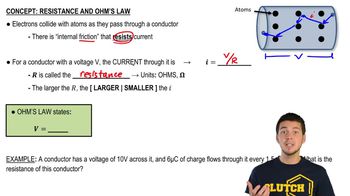
Ohm's Law

Ohm's Law states that the current (I) flowing through a conductor between two points is directly proportional to the voltage (V) across the two points and inversely proportional to the resistance (R) of the conductor. It is mathematically expressed as V = I * R. This relationship is fundamental in electrical circuits and is essential for calculating resistance when voltage and current are known.
추천 영상:
가이드 코스
03:07
Resistance and Ohm's Law

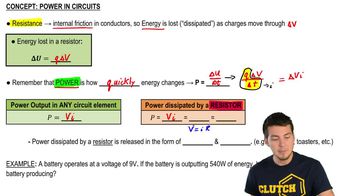
Power in Electrical Circuits

The power (P) consumed by an electrical device is defined as the rate at which it converts electrical energy into another form of energy, such as heat. It is calculated using the formula P = V * I, where P is power in watts, V is voltage in volts, and I is current in amperes. Understanding this concept is crucial for determining the resistance of the heating element based on its power rating and the voltage supplied.
추천 영상:
가이드 코스
06:18
Power in Circuits

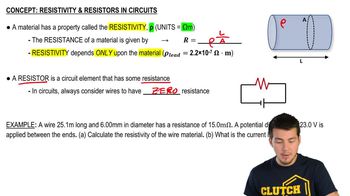
Resistance

Resistance (R) is a measure of the opposition to the flow of electric current in a circuit. It is measured in ohms (Ω) and can be calculated using Ohm's Law. In the context of the heating element, knowing the resistance allows us to understand how much current will flow when a specific voltage is applied, which is necessary for ensuring the element operates safely and effectively at its rated power.
추천 영상:
가이드 코스
05:25
Resistivity & Resistors in Circuits
관련 실천
교과서 질문

You buy a 75-W lightbulb in Europe, where electricity is delivered at 240 V. If you use the bulb in the United States at 120 V (assume its resistance does not change), how bright will it be relative to 75-W 120-V bulbs? [Hint: Assume roughly that brightness is proportional to power consumed.]

1062
views
교과서 질문

An electric car uses a 45-kW (160-hp) motor. If the battery pack is designed for 340 V, what current would the motor need to draw from the battery? Neglect any energy losses in getting energy from the battery to the motor.

1206
views
교과서 질문

The filament of an incandescent lightbulb has a resistance of 12 Ω at 20°C and 140 Ω when hot.

(a) Calculate the temperature of the filament when it is hot, and take into account the change in length and area of the filament due to thermal expansion (assume tungsten for which the thermal expansion coefficient is ≈ 5.5 10⁻⁶ C°⁻¹ ).

(b) In this temperature range, what is the percentage change in resistance due to thermal expansion, and what is the percentage change in resistance due solely to the change in ρ? Use Eq. 25–5.

1045
views
교과서 질문

At \$0.12/kWh, what does it cost to leave a 25-W porch light on day and night for a year?

1020
views
교과서 질문

A rectangular solid made of carbon has sides of lengths 1.0 cm, 2.0 cm, and 4.0 cm, lying along the x, y, and z axes, respectively (Fig. 25–36). Determine the resistance for current that passes through the solid in the y direction, (Assume the resistivity is ρ = 3.0 x 10⁻⁵ Ω•m).

1367
views
교과서 질문

Neglect the internal resistance of a battery unless the problem refers to it. Ten 7.0-W Christmas tree lights are connected in series to each other and to a 120-V source. What is the resistance of each bulb?

1409
views