Ch. 25 - Electric Current and Resistance
Giancoli Douglas - Physics for Scientists and Engineers 5th edition
Giancoli Douglas5th editionPhysics for Scientists and EngineersISBN: 9780137488179당신이 사용하는 게 아니라요?교과서 변경
24장, 문제 55c

A 0.65-mm-diameter copper wire carries a tiny current of 3.2 μA. Estimate the electric field in the wire.

검증된 단계별 안내
1
Determine the cross-sectional area of the wire. The diameter of the wire is given as 0.65 mm, so the radius is half of that. Use the formula for the area of a circle: \( A = \pi r^2 \), where \( r \) is the radius of the wire.
Convert the given current \( I = 3.2 \mu A \) into amperes by using the conversion \( 1 \mu A = 10^{-6} A \).
Use Ohm's Law, \( E = \rho J \), to find the electric field \( E \) in the wire. Here, \( \rho \) is the resistivity of copper (a known material property), and \( J \) is the current density. The resistivity of copper is approximately \( \rho = 1.68 \times 10^{-8} \ \Omega \cdot m \).
Calculate the current density \( J \) using the formula \( J = \frac{I}{A} \), where \( I \) is the current and \( A \) is the cross-sectional area of the wire.
Substitute the values of \( \rho \) and \( J \) into the formula \( E = \rho J \) to estimate the electric field in the wire.

비슷한 문제에 대한 검증된 영상 답변:

이 영상 해법은 위 문제에 도움이 된다고 튜터들이 추천한 것입니다.
영상 길이:
3m
도움이 되었나요?

주요 개념

질문에 올바르게 답하기 위해 반드시 이해해야 하는 핵심 개념들은 다음과 같습니다.

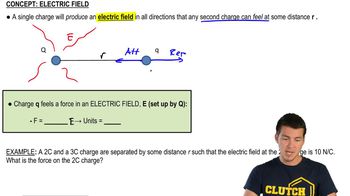
Electric Field

The electric field is a vector field that represents the force per unit charge experienced by a charged particle in a region of space. It is defined as the gradient of the electric potential and is measured in volts per meter (V/m). In conductive materials like copper, the electric field drives the flow of charge carriers, which constitutes an electric current.
추천 영상:
03:16
Intro to Electric Fields

Current Density

Current density is a measure of the electric current flowing per unit area of a cross-section of a conductor. It is expressed in amperes per square meter (A/m²) and is crucial for understanding how current distributes within a wire. The relationship between current density, electric field, and conductivity is given by J = σE, where J is the current density, σ is the conductivity, and E is the electric field.
추천 영상:
8:13
Intro to Density

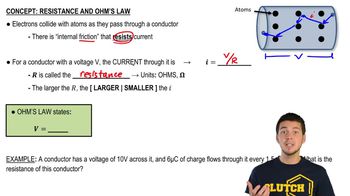
Ohm's Law

Ohm's Law states that the current flowing through a conductor between two points is directly proportional to the voltage across the two points and inversely proportional to the resistance of the conductor. Mathematically, it is expressed as V = IR, where V is voltage, I is current, and R is resistance. This law is fundamental in calculating the electric field in a wire, as it relates the electric field to the current and resistance.
추천 영상:
03:07
Resistance and Ohm's Law