Ch. 25 - Electric Current and Resistance
Giancoli Douglas - Physics for Scientists and Engineers 5th edition
Giancoli Douglas5th editionPhysics for Scientists and EngineersISBN: 9780137488179당신이 사용하는 게 아니라요?교과서 변경
24장, 문제 92

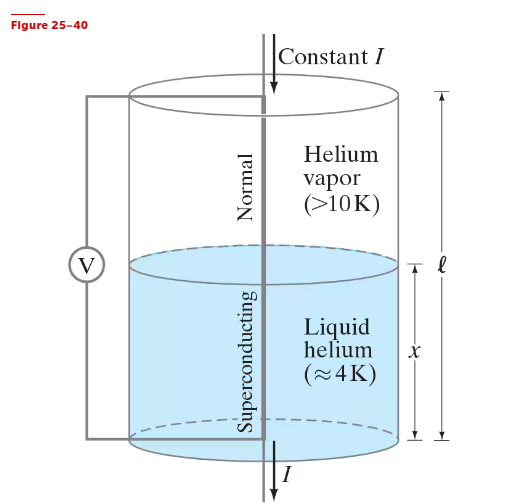
The level of liquid helium (temperature ≈ 4K) in its storage tank can be monitored using a vertically aligned niobium–titanium (NbTi) wire, whose length ℓ spans the height of the tank. In this level-sensing setup, an electronic circuit maintains a constant electrical current I at all times in the NbTi wire and a voltmeter monitors the voltage V across this wire. The NbTi wire is superconducting ( R = 0) if below its transition temperature of 10 K, so the portion of the wire immersed in the liquid helium is in the superconducting state, while the portion above the liquid (in helium vapor with temperature above 10 K) is in the normal state. Define ƒ = x/ℓ to be the fraction of the tank filled with liquid helium (Fig. 25–40) and V₀ to be the value of the voltage V when the tank is empty (ƒ = 0) . Determine the relation between f and V (in terms of V₀).

검증된 단계별 안내
1
Step 1: Understand the physical setup. The NbTi wire is superconducting (R = 0) below its transition temperature of 10 K, meaning no voltage drop occurs in the portion of the wire immersed in liquid helium (temperature ≈ 4 K). The portion of the wire above the liquid helium, in helium vapor (temperature > 10 K), is in the normal state and contributes to the voltage drop.
Step 2: Define the fraction of the tank filled with liquid helium, ƒ = x/ℓ, where x is the length of the wire immersed in liquid helium and ℓ is the total length of the wire spanning the tank. When the tank is empty (ƒ = 0), the entire wire is in the normal state, and the voltage across the wire is V₀.
Step 3: Recognize that the voltage V across the wire is proportional to the resistance of the portion of the wire in the normal state. Since the resistance is proportional to the length of the wire in the normal state, the voltage V will decrease as more of the wire becomes superconducting (immersed in liquid helium).
Step 4: Express the length of the wire in the normal state as ℓ(1 - ƒ), where (1 - ƒ) represents the fraction of the wire above the liquid helium. The voltage V is proportional to this length, so V = V₀(1 - ƒ).
Step 5: Conclude the relationship between ƒ and V. The voltage V across the wire is given by V = V₀(1 - ƒ), where V₀ is the voltage when the tank is empty (ƒ = 0). This equation shows how the voltage decreases as the fraction of the tank filled with liquid helium increases.

비슷한 문제에 대한 검증된 영상 답변:

이 영상 해법은 위 문제에 도움이 된다고 튜터들이 추천한 것입니다.
영상 길이:
7m
도움이 되었나요?

주요 개념

질문에 올바르게 답하기 위해 반드시 이해해야 하는 핵심 개념들은 다음과 같습니다.

Superconductivity

Superconductivity is a phenomenon where certain materials exhibit zero electrical resistance below a critical temperature. In this scenario, the niobium-titanium (NbTi) wire becomes superconducting at temperatures below 10 K, allowing for the flow of electrical current without energy loss. This property is crucial for understanding how the wire behaves when immersed in liquid helium, as it affects the voltage readings monitored by the voltmeter.

Voltage and Resistance Relationship

The relationship between voltage (V), current (I), and resistance (R) is described by Ohm's Law, which states V = I × R. In the context of the NbTi wire, when it is in the superconducting state (R = 0), the voltage across the wire is zero regardless of the current. However, when the wire is in the normal state (above 10 K), it exhibits resistance, and the voltage will vary depending on the fraction of the wire that is in the superconducting state versus the normal state.
추천 영상:
가이드 코스
07:14
RMS Current and Voltage

Fraction of Liquid Helium (ƒ)

The fraction of liquid helium (ƒ) is defined as the ratio of the length of the wire submerged in the liquid to the total length of the wire (ℓ). This dimensionless quantity provides a way to quantify how much of the tank is filled with liquid helium. As the level of liquid helium changes, so does the fraction ƒ, which directly influences the voltage measured across the wire, allowing for the determination of the liquid level in the tank.
추천 영상:
가이드 코스
13:11
Calculating Pressure in Liquids
관련 실천
교과서 질문

Household wiring has sometimes used aluminium instead of copper.Typical copper wire used for home wiring in the U.S. has a diameter of 1.63 mm. What is the resistance of 125 m of this wire?

1136
views

교과서 질문

Lightbulb A is rated at 120 V and 40 W for household applications. Lightbulb B is rated at 12 V and 40 W for automotive applications. What is the resistance of each bulb?

1016
views
교과서 질문

Lightbulb A is rated at 120 V and 40 W for household applications. Lightbulb B is rated at 12 V and 40 W for automotive applications. What is the current through each bulb?

1256
views
교과서 질문

Estimate how far can an average electron move along one of the connecting wires of a 750-W toaster during an alternating current cycle? The power cord has copper wires of diameter 1.7 mm and is plugged into a 60-Hz 120-V ac outlet. [Hint: For sinusoidal motion, Chapter 14, we saw that the maximum distance traveled from equilibrium (amplitude A) is proportional to the maximum (drift) speed (Eq. 14–9a). This maximum drift speed is related to the maximum current (Section 25–8), which is calculated as the first step here; see Chapter 14.]

1187
views
교과서 질문

Household wiring has sometimes used aluminium instead of copper. What would be the resistance of the same wire if it were made of aluminum?

1130
views
교과서 질문

Copper wire of diameter 0.259 cm is used to connect a set of appliances at 120 V, which draw 1250 W of power total. What power is wasted in 25.0 m of this wire?

1103
views