
Ch. 27 - Magnetism
Giancoli Douglas - Physics for Scientists and Engineers 5th edition
Giancoli Douglas5th editionPhysics for Scientists and EngineersISBN: 9780137488179당신이 사용하는 게 아니라요?교과서 변경
26장, 문제 14

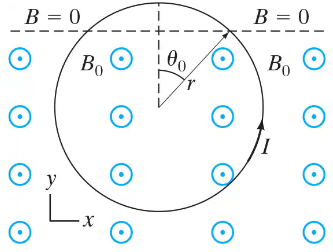
(II) A current-carrying circular loop of wire (radius r, current I) is partially immersed in a magnetic field of constant magnitude B₀ directed out of the page as shown in Fig. 27–43. Determine the net force on the loop due to the field in terms of θ₀. (Note that θ₀ points to the dashed line, above which B = 0.)

검증된 단계별 안내
1
Understand the problem: A circular loop of wire carrying a current I is partially immersed in a uniform magnetic field B₀. The goal is to determine the net force on the loop due to the magnetic field in terms of the angle θ₀, which defines the portion of the loop in the field.
Recall the formula for the magnetic force on a current-carrying wire: The force on a small segment of the wire is given by **dF = I (dL × B)**, where dL is the infinitesimal length vector of the wire and B is the magnetic field vector. The cross product ensures that the force is perpendicular to both dL and B.
Break the loop into segments: The loop is symmetric, so the forces on opposite segments of the loop will cancel out in certain directions. Focus on the vertical components of the force, as the horizontal components will cancel due to symmetry.
Integrate the force over the portion of the loop in the magnetic field: The magnetic field is present only in the region defined by the angle θ₀. The force on a small segment of the loop can be expressed as **dF = I B₀ r dθ**, where r is the radius of the loop and dθ is the angular width of the segment. The vertical component of the force is **dF_y = dF sin(θ)**.
Set up and evaluate the integral: To find the net vertical force, integrate the vertical component of the force over the range of angles where the magnetic field is present (from -θ₀ to θ₀). The integral is **F_net = ∫_{-θ₀}^{θ₀} I B₀ r sin(θ) dθ**. Solve this integral to express the net force in terms of θ₀, I, B₀, and r.

비슷한 문제에 대한 검증된 영상 답변:

이 영상 해법은 위 문제에 도움이 된다고 튜터들이 추천한 것입니다.
영상 길이:
3m
도움이 되었나요?

주요 개념

질문에 올바르게 답하기 위해 반드시 이해해야 하는 핵심 개념들은 다음과 같습니다.

Magnetic Force on a Current-Carrying Wire

When a current-carrying wire is placed in a magnetic field, it experiences a magnetic force. This force is given by the equation F = I(L × B), where F is the force, I is the current, L is the length vector of the wire segment in the field, and B is the magnetic field vector. The direction of the force can be determined using the right-hand rule, which states that if you point your thumb in the direction of the current and your fingers in the direction of the magnetic field, your palm will face the direction of the force.

Lorentz Force Law

The Lorentz force law describes the force experienced by a charged particle moving in an electromagnetic field. It combines both electric and magnetic forces and is expressed as F = q(E + v × B), where F is the total force, q is the charge, E is the electric field, v is the velocity of the charge, and B is the magnetic field. In the context of a current-carrying loop, the law helps to analyze how different segments of the loop interact with the magnetic field, leading to a net force.

Magnetic Field and Its Direction

A magnetic field is a vector field that exerts a force on moving charges and magnetic dipoles. The direction of the magnetic field is defined by the orientation of the field lines, which indicate the direction a north pole of a magnet would move. In this problem, the magnetic field B₀ is directed out of the page, and understanding its direction is crucial for determining how the current in the loop interacts with the field, particularly in calculating the net force on the loop.
관련 실천
교과서 질문

A stiff wire 50.0 cm long is bent at a right angle in the middle. One section lies along the z axis and the other is along the line y = 2x in the xy plane. A current of 20.0 A flows in the wire—down the z axis and out the wire in the xy plane. The wire passes through a uniform magnetic field given by = (0.285î ) T. Determine the magnitude and direction of the total force on the wire.

1396
views
교과서 질문

(III) A curved wire, connecting two points a and b, lies in a plane perpendicular to a uniform magnetic field B\(\overrightarrow{B}\) and carries a current I. Show that the resultant magnetic force on the wire, no matter what its shape, is the same as that on a straight wire connecting the two points carrying the same current I. See Fig. 27–44.

1526
views
교과서 질문

The magnetic force per meter on a wire is measured to be only 55% of its maximum possible value. What is the angle between the wire and the magnetic field?

1409
views
교과서 질문

(a) What is the force per meter of length on a straight wire carrying a 7.40-A current when perpendicular to a 0.90-T uniform magnetic field?

(b) What if the angle between the wire and field is 35.0°?

1757
views
교과서 질문

A particle of charge q moves in a circular path of radius r in a uniform magnetic field B\(\overrightarrow{B}\). If the magnitude of the magnetic field is doubled, and the kinetic energy of the particle remains constant, what happens to the angular momentum of the particle?

1838
views
교과서 질문

A 720-KeV (kinetic energy) proton enters a 0.20-T field, in a plane perpendicular to the field. What is the radius of its path? See Section 23–8.

1505
views