
Ch. 27 - Magnetism
Giancoli Douglas - Physics for Scientists and Engineers 5th edition
Giancoli Douglas5th editionPhysics for Scientists and EngineersISBN: 9780137488179당신이 사용하는 게 아니라요?교과서 변경
26장, 문제 76

Suppose the Earth’s magnetic field at the equator has magnitude 0.50 x 10⁻⁴ T and a northerly direction at all points. Estimate the speed a singly ionized uranium ion ( m = 238 u, q = e) would need to circle the Earth 5.0 km above the equator. Can you ignore gravity? [Ignore relativity.]

검증된 단계별 안내
1
Step 1: Recognize that the problem involves a charged particle (a singly ionized uranium ion) moving in a circular path due to the magnetic force exerted by the Earth's magnetic field. The magnetic force provides the centripetal force required for circular motion.
Step 2: Write the equation for the centripetal force: \( F_c = \frac{m v^2}{r} \), where \( m \) is the mass of the ion, \( v \) is its speed, and \( r \) is the radius of the circular path. The radius \( r \) is the Earth's radius plus the height above the equator (\( r = R_E + h \)).
Step 3: Write the equation for the magnetic force: \( F_B = q v B \), where \( q \) is the charge of the ion, \( v \) is its speed, and \( B \) is the magnetic field strength. Since the magnetic force provides the centripetal force, set \( F_B = F_c \): \( q v B = \frac{m v^2}{r} \).
Step 4: Simplify the equation to solve for the speed \( v \): \( v = \frac{q B r}{m} \). Substitute \( r = R_E + h \), where \( R_E \) is the Earth's radius (approximately \( 6.37 \times 10^6 \ \text{m} \)) and \( h = 5.0 \ \text{km} = 5.0 \times 10^3 \ \text{m} \).
Step 5: Substitute the known values into the equation: \( q = e = 1.6 \times 10^{-19} \ \text{C} \), \( B = 0.50 \times 10^{-4} \ \text{T} \), \( m = 238 \ \text{u} = 238 \times 1.66 \times 10^{-27} \ \text{kg} \), and \( r = R_E + h \). Perform the calculation to find \( v \). Note that gravity can be ignored because the magnetic force dominates in this scenario.

비슷한 문제에 대한 검증된 영상 답변:

이 영상 해법은 위 문제에 도움이 된다고 튜터들이 추천한 것입니다.
영상 길이:
8m

주요 개념

질문에 올바르게 답하기 위해 반드시 이해해야 하는 핵심 개념들은 다음과 같습니다.

Magnetic Force on a Charged Particle

A charged particle moving in a magnetic field experiences a magnetic force perpendicular to both its velocity and the magnetic field direction. This force can be calculated using the equation F = qvB sin(θ), where F is the magnetic force, q is the charge, v is the velocity, B is the magnetic field strength, and θ is the angle between the velocity and the magnetic field. For a particle moving perpendicular to the field, θ is 90 degrees, simplifying the equation to F = qvB.
추천 영상:
가이드 코스
09:08
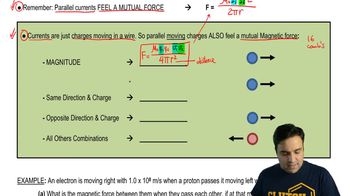
Magnetic Force Between Two Moving Charges

Centripetal Force

When an object moves in a circular path, it requires a centripetal force directed towards the center of the circle to maintain its motion. This force can be expressed as F_c = mv²/r, where m is the mass of the object, v is its speed, and r is the radius of the circular path. In this scenario, the magnetic force acting on the uranium ion provides the necessary centripetal force to keep it in circular motion around the Earth.
추천 영상:
가이드 코스
06:48
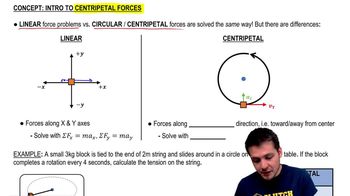
Intro to Centripetal Forces

Radius of Circular Motion in a Magnetic Field

The radius of the circular path of a charged particle in a magnetic field can be determined by equating the magnetic force to the centripetal force. This leads to the formula r = mv/(qB), where r is the radius, m is the mass of the particle, v is its speed, q is its charge, and B is the magnetic field strength. In this problem, the radius is the distance from the center of the Earth to the ion's altitude above the equator, which is crucial for calculating the required speed.
추천 영상:
가이드 코스
11:33
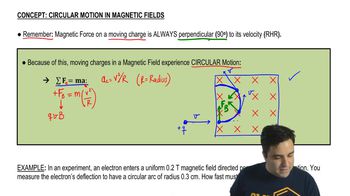
Circular Motion of Charges in Magnetic Fields