
Ch. 28 - Sources of Magnetic Field
Giancoli Douglas - Physics for Scientists and Engineers 5th edition
Giancoli Douglas5th editionPhysics for Scientists and EngineersISBN: 9780137488179당신이 사용하는 게 아니라요?교과서 변경
27장, 문제 19

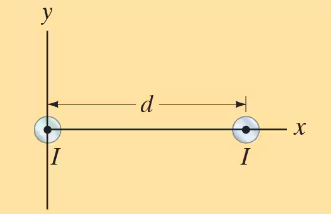
(II) Let two long parallel wires, a distance d apart, carry equal dc currents I in the same direction. One wire is at 𝓍 = 0, the other at 𝓍 = d, Fig. 28–41. Determine B\(\overrightarrow{B}\) along the 𝓍 axis between the wires as a function of 𝓍.

검증된 단계별 안내
1
Step 1: Understand the problem. Two long parallel wires separated by a distance d carry equal currents I in the same direction. We are tasked with finding the magnetic field B⃗ along the x-axis between the wires as a function of x, where x is the position along the axis between the wires.
Step 2: Recall the formula for the magnetic field produced by a long straight current-carrying wire at a distance r from the wire. The magnetic field is given by: B = μI2πr, where μ₀ is the permeability of free space, I is the current, and r is the distance from the wire.
Step 3: Consider the contributions to the magnetic field at a point x along the x-axis from both wires. The wire at x = 0 produces a magnetic field at x due to the current I, and the wire at x = d also produces a magnetic field at x. Use the right-hand rule to determine the direction of the magnetic fields from each wire.
Step 4: Write the expressions for the magnetic fields from each wire. For the wire at x = 0, the distance to the point x is |x|, so the magnetic field is: B1 = μI2πx. For the wire at x = d, the distance to the point x is |d - x|, so the magnetic field is: B2 = μI2π|d-x|.
Step 5: Combine the magnetic field contributions. Since the currents are in the same direction, the magnetic fields from the two wires will oppose each other along the x-axis. The net magnetic field at a point x is the difference between the magnitudes of the two fields: B = |B1 - B2|. Substitute the expressions for B₁ and B₂ to find the net magnetic field as a function of x.

비슷한 문제에 대한 검증된 영상 답변:

이 영상 해법은 위 문제에 도움이 된다고 튜터들이 추천한 것입니다.
영상 길이:
5m
도움이 되었나요?

주요 개념

질문에 올바르게 답하기 위해 반드시 이해해야 하는 핵심 개념들은 다음과 같습니다.

Magnetic Field Due to a Current-Carrying Wire

A long straight wire carrying a current generates a magnetic field around it, described by Ampère's Law. The magnetic field strength (B) at a distance (r) from the wire is given by the formula B = (μ₀I)/(2πr), where μ₀ is the permeability of free space and I is the current. The direction of the magnetic field can be determined using the right-hand rule, which states that if you point your thumb in the direction of the current, your fingers curl in the direction of the magnetic field.
추천 영상:
가이드 코스
09:57
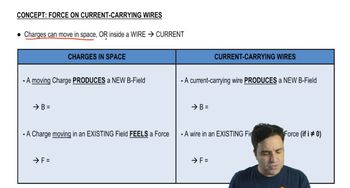
Magnetic Force on Current-Carrying Wire

Superposition of Magnetic Fields

When multiple sources generate magnetic fields, the total magnetic field at a point is the vector sum of the individual fields. In this scenario, the magnetic fields produced by each wire will interact, and their contributions must be added together to find the resultant magnetic field at any point along the x-axis. This principle is crucial for determining the net magnetic field between the two wires, as the fields will have both magnitude and direction.
추천 영상:
가이드 코스
05:30
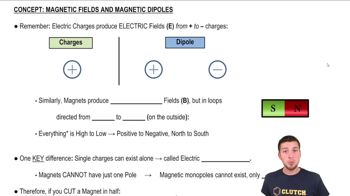
Magnetic Fields and Magnetic Dipoles

Distance and Magnetic Field Variation

The magnetic field strength varies with distance from the current-carrying wires. As you move along the x-axis between the two wires, the distance from each wire changes, affecting the magnetic field contributions from each. Specifically, the magnetic field will be stronger closer to the wire and weaker as you move away, which must be accounted for when calculating the total magnetic field at any given point between the wires.
추천 영상:
가이드 코스
05:30
Magnetic Fields and Magnetic Dipoles
관련 실천
교과서 질문

(II) Two long parallel wires 8.20 cm apart carry 19.5-A dc currents in the same direction. Determine the magnetic field vector at a point P, 12.0 cm from one wire and 13.0 cm from the other. See Fig. 28–43. [Hint: Use the law of cosines. See Appendix A or inside rear cover.]

591
views
교과서 질문

(II) An electron enters a uniform magnetic field B = 0.28 T at a 45° angle to B\(\overrightarrow{B}\). Determine the radius r and pitch p (distance between loops) of the electron’s helical path assuming its speed is 2.2 x 10⁶ m/s. See Fig. 27–48.


1226
views
교과서 질문

"(II) A rectangular loop of wire is placed next to a straight wire, as shown in Fig. 28–40. There is a dc current of 3.5 A in both wires. Determine the magnitude and direction of the net force on the loop.


1101
views
교과서 질문

(II) Two long straight wires each carry a dc current I out of the page toward the viewer, Fig. 28–38. Indicate, with appropriate arrows, the direction of B\(\overrightarrow{B}\) at each of the points 1 to 6 in the plane of the page. State if the field is zero at any of the points.

720
views
교과서 질문

(II) Two long thin parallel wires 13.0 cm apart carry 25-A currents in the same direction. Determine the magnetic field vector at a point 10.0 cm from one wire and 6.0 cm from the other (Fig. 28–37). [Hint: You could try using the law of cosines, Appendix A.]

550
views
교과서 질문

(II) Two long wires are oriented so that they are perpendicular to each other. At their closest, they are 20.0 cm apart (Fig. 28–42). What is the magnitude of the magnetic field at a point midway between them if the top one carries a current of 18.0 A and the bottom one carries 12.0 A?

510
views