
Ch. 29 - Electromagnetic Induction and Faraday's Law
Giancoli Douglas - Physics for Scientists and Engineers 5th edition
Giancoli Douglas5th editionPhysics for Scientists and EngineersISBN: 9780137488179당신이 사용하는 게 아니라요?교과서 변경
28장, 문제 1

The magnetic flux through a coil of wire containing two loops changes at a constant rate from -68 Wb to +48 Wb in 0.42 s. What is the emf induced in the coil?

검증된 단계별 안내
1
Understand the problem: The problem involves calculating the induced electromotive force (emf) in a coil of wire due to a change in magnetic flux. This is governed by Faraday's Law of Electromagnetic Induction.
Recall Faraday's Law: The induced emf (ε) in a coil is given by the formula: ε=−N ΔΦΔt, where N is the number of loops, ΔΦ is the change in magnetic flux, and Δt is the time interval over which the change occurs.
Identify the given values: The number of loops in the coil is N=2. The initial magnetic flux is Φi=−68Wb, the final magnetic flux is Φf=+48Wb, and the time interval is Δt=0.42s.
Calculate the change in magnetic flux: Use the formula ΔΦ=ΦfΦi. Substitute the given values to find ΔΦ.
Substitute into Faraday's Law: Plug the values of N, ΔΦ, and Δt into the formula for ε to calculate the induced emf. Remember to take the absolute value of the result, as emf is typically expressed as a positive quantity.

비슷한 문제에 대한 검증된 영상 답변:

이 영상 해법은 위 문제에 도움이 된다고 튜터들이 추천한 것입니다.
영상 길이:
1m
도움이 되었나요?

주요 개념

질문에 올바르게 답하기 위해 반드시 이해해야 하는 핵심 개념들은 다음과 같습니다.

Magnetic Flux

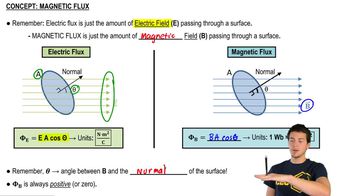
Magnetic flux is a measure of the quantity of magnetism, taking into account the strength and extent of a magnetic field. It is defined as the product of the magnetic field (B) and the area (A) through which the field lines pass, and is expressed in webers (Wb). The change in magnetic flux through a coil is crucial for understanding how electromagnetic induction occurs.
추천 영상:

Faraday's Law of Electromagnetic Induction

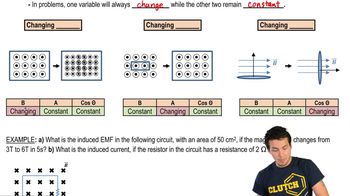
Faraday's Law states that the induced electromotive force (emf) in a closed loop is directly proportional to the rate of change of magnetic flux through the loop. Mathematically, it can be expressed as emf = -dΦ/dt, where dΦ is the change in magnetic flux and dt is the change in time. This principle is fundamental in determining how much emf is generated when the magnetic environment of a coil changes.
추천 영상:

Induced EMF

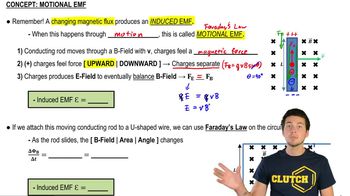
Induced electromotive force (emf) is the voltage generated in a circuit due to a change in magnetic flux. It is a key concept in electromagnetism, as it explains how electric currents can be produced without direct contact with a power source. The magnitude of the induced emf can be calculated using Faraday's Law, which relates it to the rate of change of magnetic flux through the coil.
추천 영상:
관련 실천
교과서 질문

(III) Suppose a conducting rod (mass m, resistance R) rests on two frictionless and resistanceless parallel rails a distance ℓ apart in a uniform magnetic field B\(\overrightarrow{B}\) (⊥ to the rails and to the rod) as in Fig. 29–53. At t = 0, the rod is at rest and a source of emf is connected to the points a and b. Determine the speed of the rod as a function of time if (a) the source puts out a constant current I, (b) the source puts out a constant emf ε₀. (c) Does the rod reach a terminal speed in either case? If so, what is it?

143
views
교과서 질문

(II) A conducting rod rests on two long frictionless parallel rails in a magnetic field B\(\overrightarrow{B}\) (⊥ to the rails and rod) as in Fig. 29–53. (a) If the rails are horizontal and the rod is given an initial push, will the rod travel at constant speed even though a magnetic field is present? (b) Suppose at t = 0, when the rod has speed v = v0, the two rails are connected electrically by a wire from point a to point b. Assuming the rod has resistance R and the rails have negligible resistance, determine the speed of the rod as a function of time. Discuss your answer.

1698
views
교과서 질문

A circular loop in the plane of the paper lies in a 0.65-T uniform magnetic field pointing into the paper. The loop’s diameter changes from 20.0 cm to 8.0 cm in 0.50 s. What is (a) the direction of the induced current, (b) the magnitude of the average induced emf, and (c) the average induced current if the coil resistance is 2.5Ω?

1650
views