
Ch. 30 - Inductance, Electromagnetic Oscillations, and AC Circuits
Giancoli Douglas - Physics for Scientists and Engineers 5th edition
Giancoli Douglas5th editionPhysics for Scientists and EngineersISBN: 9780137488179당신이 사용하는 게 아니라요?교과서 변경
29장, 문제 23

(II) (a) Determine the energy stored in the inductor L as a function of time for the LR circuit of Fig. 30–6a. (b) After how many time constants does the stored energy reach 99.9% of its maximum value?

검증된 단계별 안내
1
Step 1: Begin by recalling the formula for the energy stored in an inductor, which is given by \( U = \frac{1}{2} L I^2 \), where \( L \) is the inductance and \( I \) is the current through the inductor. The current \( I \) in an LR circuit as a function of time is \( I(t) = I_0 (1 - e^{-t/\tau}) \), where \( \tau = \frac{L}{R} \) is the time constant of the circuit.
Step 2: Substitute \( I(t) \) into the energy formula \( U \). This gives \( U(t) = \frac{1}{2} L \left[ I_0 (1 - e^{-t/\tau}) \right]^2 \). Expand the square term to express \( U(t) \) explicitly as a function of time.
Step 3: Simplify the expression for \( U(t) \). After expanding, you will have \( U(t) = \frac{1}{2} L I_0^2 \left[ 1 - 2e^{-t/\tau} + e^{-2t/\tau} \right] \). This represents the energy stored in the inductor as a function of time.
Step 4: To determine the time at which the energy reaches 99.9% of its maximum value, note that the maximum energy is \( U_{\text{max}} = \frac{1}{2} L I_0^2 \). Set \( U(t) = 0.999 U_{\text{max}} \) and solve for \( t \). This involves solving \( 0.999 = 1 - 2e^{-t/\tau} + e^{-2t/\tau} \). Use numerical or iterative methods to find \( t \).
Step 5: Express the result in terms of the time constant \( \tau \). The solution will yield \( t \approx n \tau \), where \( n \) is the number of time constants required for the energy to reach 99.9% of its maximum value. This step concludes the analysis.

비슷한 문제에 대한 검증된 영상 답변:

이 영상 해법은 위 문제에 도움이 된다고 튜터들이 추천한 것입니다.
영상 길이:
8m
도움이 되었나요?

주요 개념

질문에 올바르게 답하기 위해 반드시 이해해야 하는 핵심 개념들은 다음과 같습니다.

Inductance and Energy Storage

Inductance is a property of an electrical component, typically a coil, that quantifies its ability to store energy in a magnetic field when an electric current flows through it. The energy (W) stored in an inductor is given by the formula W = (1/2) L I^2, where L is the inductance and I is the current. Understanding this relationship is crucial for determining how energy varies with time in an LR circuit.
추천 영상:
가이드 코스
12:59
Mutual Induction

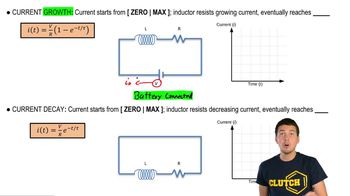
Time Constant in LR Circuits

The time constant (τ) in an LR circuit is defined as τ = L/R, where L is the inductance and R is the resistance. It represents the time it takes for the current to reach approximately 63.2% of its maximum value after a voltage is applied. This concept is essential for analyzing the transient response of the circuit and how quickly the energy stored in the inductor approaches its maximum value.
추천 영상:

Exponential Growth in Current

In an LR circuit, the current increases over time according to an exponential function, specifically I(t) = (V/R)(1 - e^(-t/τ)), where V is the voltage, R is the resistance, and τ is the time constant. This behavior indicates that the current approaches its maximum value asymptotically, which is critical for calculating the energy stored in the inductor as a function of time and determining when it reaches a specified percentage of its maximum value.
추천 영상:
가이드 코스
05:38
Intro to Current
관련 실천
교과서 질문

Two tightly wound solenoids have the same length and circular cross-sectional area. But solenoid 1 uses wire that is 1.5 times as thick as solenoid 2. What is the ratio of their inductive time constants? (Assume the only resistance in the circuits is that of the wire itself.)

97
views
교과서 질문

(II) For the toroid of Fig. 30–26, determine the energy density in the magnetic field as a function of r(r₁ < r < r₂) and integrate this over the volume to obtain the total energy stored in the toroid, which carries a current I in each of its N loops.


<IMAGE>

124
views
교과서 질문

Two tightly wound solenoids have the same length and circular cross-sectional area. But solenoid 1 uses wire that is 1.5 times as thick as solenoid 2.

(a) What is the ratio of their inductances?

(b) What is the ratio of their inductive time constants? (Assume the only resistance in the circuits is that of the wire itself.)

1362
views
교과서 질문

(III) Determine the emf induced in the square loop in Fig. 29–52 if the loop stays at rest and the current in the straight wire is given by I(t) = (15.0 A) sin (2200 t) where t is in seconds. The distance a is 12.0 cm, and b is 15.0 cm.

175
views
교과서 질문

What is the energy density at the center of a circular loop of wire carrying a 19.0-A current if the radius of the loop is 28.0 cm?

155
views
교과서 질문

(II) (a) In Fig. 30–28, assume that the switch has been in position A for sufficient time so that a steady current I₀ = V₀/R flows through the resistor R. At time t = 0, the switch is quickly switched to position B and the current decays through resistor R' (which is much greater than R) according to I=I0et/τI = I_0 e^{-t/\(\tau\)'}I=I0et/τI = I_0 e^{-t/\(\tau\)'}. Show that the maximum emf εmax induced in the inductor during this time period is (R'/R)Vo. (b) If R' = 45R and Vo = 145 V, determine εmax. [When a mechanical switch is opened, a high-resistance air gap is created, which is modeled as R' here. This Problem illustrates why high-voltage sparking can occur if a current-carrying inductor is suddenly cut off from its power source. The very high voltage can produce an electric field great enough to ionize atoms of air, which emit light when electrons recombine with the ions.]

1378
views