
Ch. 31 - Maxwell's Equations and Electromagnetic Waves
Giancoli Douglas - Physics for Scientists and Engineers 5th edition
Giancoli Douglas5th editionPhysics for Scientists and EngineersISBN: 9780137488179당신이 사용하는 게 아니라요?교과서 변경
30장, 문제 34a

(III) (a) When a circular parallel-plate capacitor is being charged as in Example 31–1, show that the Poynting vector S\(\overrightarrow{S}\) points radially inward toward the center of the capacitor, parallel to the plates.

검증된 단계별 안내
1
Understand the Poynting vector: The Poynting vector \( \mathbf{S} \) represents the flow of electromagnetic energy and is given by \( \mathbf{S} = \mathbf{E} \times \mathbf{B} / \mu_0 \), where \( \mathbf{E} \) is the electric field, \( \mathbf{B} \) is the magnetic field, and \( \mu_0 \) is the permeability of free space.
Analyze the electric field \( \mathbf{E} \): In a parallel-plate capacitor, the electric field \( \mathbf{E} \) is uniform and directed perpendicular to the plates, pointing from the positively charged plate to the negatively charged plate.
Examine the magnetic field \( \mathbf{B} \): During charging, the current flowing into the capacitor creates a magnetic field \( \mathbf{B} \) that encircles the current path. Using the right-hand rule, \( \mathbf{B} \) forms concentric circles around the axis of the capacitor plates.
Determine the direction of \( \mathbf{S} \): The Poynting vector \( \mathbf{S} \) is the cross product of \( \mathbf{E} \) and \( \mathbf{B} \). Since \( \mathbf{E} \) is perpendicular to the plates and \( \mathbf{B} \) is tangential to the circular path, \( \mathbf{S} \) points radially inward toward the center of the capacitor.
Conclude the energy flow: The inward direction of \( \mathbf{S} \) indicates that electromagnetic energy flows into the capacitor, parallel to the plates, as it is being charged.

비슷한 문제에 대한 검증된 영상 답변:

이 영상 해법은 위 문제에 도움이 된다고 튜터들이 추천한 것입니다.
영상 길이:
5m
도움이 되었나요?

주요 개념

질문에 올바르게 답하기 위해 반드시 이해해야 하는 핵심 개념들은 다음과 같습니다.

Poynting Vector

The Poynting vector, denoted as →S, represents the directional energy flux (the rate of energy transfer per unit area) of an electromagnetic field. It is calculated using the cross product of the electric field vector (→E) and the magnetic field vector (→B), expressed as →S = (1/μ₀) →E × →B. In the context of a capacitor, the Poynting vector indicates the flow of electromagnetic energy, which is crucial for understanding how energy is transferred during the charging process.
추천 영상:
가이드 코스
06:44
Adding 3 Vectors in Unit Vector Notation

Electric Field in Capacitors

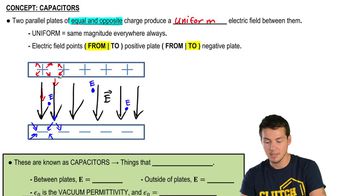
In a parallel-plate capacitor, an electric field (→E) is established between the plates when a voltage is applied. This field is uniform and directed from the positive plate to the negative plate, with a strength proportional to the voltage and inversely proportional to the distance between the plates. Understanding the behavior of the electric field is essential for analyzing how it interacts with the magnetic field during the charging process.
추천 영상:
가이드 코스
06:13
Intro to Capacitors

Magnetic Field and Charging

When a capacitor is charged, a changing electric field generates a magnetic field (→B) around the capacitor, as described by Maxwell's equations. This magnetic field is oriented in a direction that is perpendicular to the electric field and the direction of energy flow. The relationship between the electric and magnetic fields is fundamental to understanding the dynamics of electromagnetic waves and the behavior of the Poynting vector in the context of the charging capacitor.
추천 영상:
가이드 코스
10:47
Magnetic Field Produced by Moving Charges
관련 실천
교과서 질문

Suppose you have a car with a 100-hp engine. How large a solar panel would you need to replace the engine with solar power? Assume that the solar panels can utilize 20% of the maximum solar energy that reaches the Earth’s surface (1000 W/m²). Explain why or why not this is practical.

6
views
교과서 질문

Suppose that a circular parallel-plate capacitor has radius r₀ = 3.0 cm and plate separation d = 5.0 mm. A sinusoidal potential difference V = V₀ sin (2𝝅ft) is applied across the plates, where V₀ = 180 V and f = 60 Hz. Determine the expression for the amplitude B₀(r) of this time-dependent (sinusoidal) field when r ≤ r₀ and when r > r₀.

1061
views
교과서 질문

In an EM wave traveling west, the B field oscillates up and down vertically and has a frequency of 85.0 kHz and an rms strength of 7.75 x 10⁻⁹ T. Determine the frequency and rms strength of the electric field. What is the direction of the electric field oscillations?

3
views
교과서 질문

Compare 1030 on the AM dial to 103.1 on FM. Which has the longer wavelength, and by what factor is it larger?

4
views
교과서 질문

(II) Laser light can be focused (at best) to a spot with a radius r equal to its wavelength ⋋. Suppose a 1.0-W beam of green laser light (⋋ = 5 x 10⁻⁷ m) forms such a spot and illuminates a cylindrical object of radius r and length r (Fig. 31–25). Estimate (a) the radiation pressure and force on the object, and (b) its acceleration, if its density equals that of water and it absorbs all the radiation. [This order-of-magnitude calculation convinced researchers of the feasibility of “optical tweezers,” page 916.]

1305
views
교과서 질문

(a) When a circular parallel-plate capacitor is being charged as in Example 31–1, show that the Poynting vector S\(\overrightarrow{S}\) points radially inward toward the center of the capacitor, parallel to the plates.

(b) Integrate S\(\overrightarrow{S}\) over the cylindrical boundary of the capacitor gap to show that the rate at which energy enters the capacitor is equal to the rate at which electrostatic energy is being stored in the electric field of the capacitor (Section 24–4). Ignore fringing of E\(\overrightarrow{E}\).

6
views