
How large an emf (rms) will be generated in an antenna that consists of a circular coil 2.2 cm in diameter having 280 turns of wire, when an EM wave of frequency 810 kHz transporting energy at an average rate of 1.0 x 10⁻⁴ W/m² passes through it? [Hint: You can use Eq. 29–4 (for a generator) because that equation can be applied to an observer moving with the generator’s coil as it rotates at ω = 2𝝅f with f the frequency of the magnetic field.]
Ch. 31 - Maxwell's Equations and Electromagnetic Waves
Giancoli Douglas5th editionPhysics for Scientists and EngineersISBN: 9780137488179당신이 사용하는 게 아니라요?교과서 변경
30장, 문제 78b
Suppose that a right-moving EM wave overlaps with a left-moving EM wave so that, in a certain region of space, the total electric field in the y direction and magnetic field in the z direction are given by Eᵧ = E₀ sin(kx - ωt) + E₀ sin(kx + ωt) and Bz = B₀ sin(kx - ωt) - B₀ sin(kx + ωt). Determine the Poynting vector and find the x locations at which it is zero at all times.
검증된 단계별 안내1
Step 1: Recall the formula for the Poynting vector, which represents the energy flux of an electromagnetic wave. It is given by **S = E × B / μ₀**, where E is the electric field, B is the magnetic field, and μ₀ is the permeability of free space. Here, we are tasked with finding the Poynting vector using the given expressions for Eᵧ and Bz.
Step 2: Substitute the given expressions for Eᵧ and Bz into the formula for the Poynting vector. The electric field is **Eᵧ = E₀ sin(kx - ωt) + E₀ sin(kx + ωt)**, and the magnetic field is **Bz = B₀ sin(kx - ωt) - B₀ sin(kx + ωt)**. The cross product of these fields will give the Poynting vector.
Step 3: Simplify the expressions for the electric and magnetic fields using trigonometric identities. For the electric field, use the identity **sin(A) + sin(B) = 2 sin((A + B)/2) cos((A - B)/2)**. Similarly, for the magnetic field, use **sin(A) - sin(B) = 2 cos((A + B)/2) sin((A - B)/2)**. This will help express the fields in terms of simpler trigonometric functions.
Step 4: Compute the cross product **E × B**. Since the electric field is in the y-direction and the magnetic field is in the z-direction, the resulting Poynting vector will point in the x-direction. After simplifying, determine the conditions under which the Poynting vector is zero. This occurs when the product of the electric and magnetic field components is zero.
Step 5: Analyze the resulting expression for the Poynting vector to find the x-locations where it is zero at all times. This will involve solving for the positions where the trigonometric terms in the simplified expression cancel out. Specifically, identify the values of x that satisfy the condition for zero energy flux.

비슷한 문제에 대한 검증된 영상 답변:
이 영상 해법은 위 문제에 도움이 된다고 튜터들이 추천한 것입니다.
영상 길이:
7m도움이 되었나요?
주요 개념
질문에 올바르게 답하기 위해 반드시 이해해야 하는 핵심 개념들은 다음과 같습니다.
Electromagnetic Waves
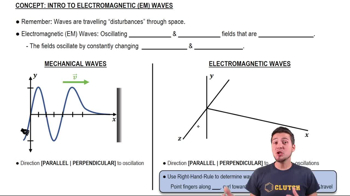
Electromagnetic (EM) waves are oscillations of electric and magnetic fields that propagate through space. They are characterized by their wavelength, frequency, and speed, which is the speed of light in a vacuum. The electric field (E) and magnetic field (B) are perpendicular to each other and to the direction of wave propagation, following Maxwell's equations. Understanding the behavior of these waves is crucial for analyzing their interactions and superpositions.
추천 영상:
가이드 코스
Introduction to Electromagnetic (EM) Waves
Superposition Principle
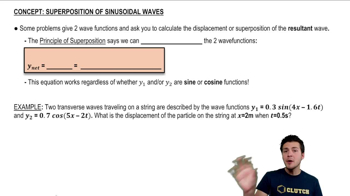
The superposition principle states that when two or more waves overlap in space, the resultant wave is the sum of the individual waves. This principle applies to all types of waves, including EM waves, and allows for the analysis of complex wave patterns. In the given problem, the total electric and magnetic fields are derived from the superposition of two EM waves moving in opposite directions, leading to interference patterns that can be analyzed mathematically.
추천 영상:
가이드 코스
Superposition of Sinusoidal Wave Functions
Poynting Vector
The Poynting vector represents the directional energy flux (the rate of energy transfer per unit area) of an electromagnetic field. It is calculated using the formula S = (1/μ₀)(E × B), where E is the electric field, B is the magnetic field, and μ₀ is the permeability of free space. The Poynting vector is essential for understanding how energy is transported by EM waves, and finding locations where it is zero indicates points of destructive interference in the wave patterns.
추천 영상:
가이드 코스
Adding 3 Vectors in Unit Vector Notation
관련 실천
교과서 질문
7
views
교과서 질문
Imagine that a steady current I flows in a straight cylindrical wire of radius R₀ and resistivity ρ.
(a) If the current is then changed at a rate dI/dt, show that a displacement current ID exists in the wire of magnitude ε₀ρ(dI/dt).
(b) If the current in a copper wire is changed at the rate of 1.0 A/ms, determine the magnitude of ID.
(c) Determine the magnitude of the magnetic field BD created by ID at the surface of a copper wire with R₀ = 1.00 mm. Compare (as a ratio) BD with the field created at the surface of the wire by a steady current of 1.0 A.
65
views
교과서 질문
Suppose a 25-kW radio station emits EM waves uniformly in all directions. What is the rms voltage induced in a 1.0-m-long vertical car antenna (c) 1.0 km away, (d) 50 km away?
1174
views
