

Ch. 32 - Light: Reflection and Refraction
Giancoli Douglas - Physics for Scientists and Engineers 5th edition
Giancoli Douglas5th editionPhysics for Scientists and EngineersISBN: 9780137488179당신이 사용하는 게 아니라요?교과서 변경
31장, 문제 38

A flashlight beam strikes the surface of a pane of glass (n = 1.56) at a 69° angle to the normal. What is the angle of refraction?

검증된 단계별 안내
1
Identify the given values: The angle of incidence (θ₁) is 69°, and the refractive index of the glass (n₂) is 1.56. The refractive index of air (n₁) is approximately 1.00.
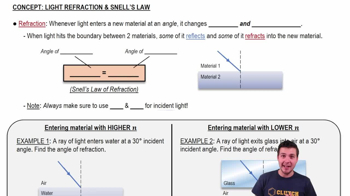
Recall Snell's Law, which relates the angles of incidence and refraction to the refractive indices: n1sinθ1=n2sinθ2, where θ₁ is the angle of incidence, θ₂ is the angle of refraction, n₁ is the refractive index of the first medium, and n₂ is the refractive index of the second medium.
Rearrange Snell's Law to solve for the sine of the angle of refraction (sin(θ₂)): sinθ2=n1sinθ1n2.
Substitute the known values into the equation: sinθ2=1.00sin69°1.56. Calculate the sine of 69° and divide by 1.56.
Finally, use the inverse sine function (arcsin) to find the angle of refraction (θ₂): θ2=arcsin1.00sin69°1.56. This will give you the angle of refraction in degrees.

비슷한 문제에 대한 검증된 영상 답변:

이 영상 해법은 위 문제에 도움이 된다고 튜터들이 추천한 것입니다.
영상 길이:
2m
도움이 되었나요?

주요 개념

질문에 올바르게 답하기 위해 반드시 이해해야 하는 핵심 개념들은 다음과 같습니다.

Snell's Law

Snell's Law describes the relationship between the angles of incidence and refraction when light passes between two different media. It is mathematically expressed as n1 * sin(θ1) = n2 * sin(θ2), where n represents the refractive indices of the media and θ represents the angles relative to the normal. This law is fundamental for calculating how light bends when entering a new medium.
추천 영상:

Refractive Index

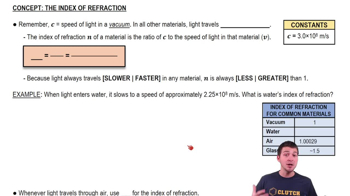
The refractive index (n) of a material quantifies how much light slows down as it travels through that material compared to its speed in a vacuum. A higher refractive index indicates that light travels more slowly in that medium. In this question, the glass has a refractive index of 1.56, which is essential for applying Snell's Law to find the angle of refraction.
추천 영상:
가이드 코스
03:46
Index of Refraction

Angle of Incidence and Angle of Refraction

The angle of incidence is the angle between the incoming light ray and the normal line at the surface of the medium, while the angle of refraction is the angle between the refracted ray and the normal. These angles are crucial for applying Snell's Law, as they determine how much the light will bend when transitioning from one medium to another.
추천 영상:
관련 실천
교과서 질문

(III) A light ray is incident on a flat piece of glass with index of refraction n as in Fig. 32–24. Show that if the incident angle θ is small, the emerging ray is displaced a distance d = tθ(n - 1)/n , where t is the thickness of the glass, θ is in radians, and d is the perpendicular distance between the incident ray and the (dashed) line of the emerging ray (Fig. 32–24).

1307
views
교과서 질문

(II) In searching the bottom of a pool at night, a watchman shines a narrow beam of light from his flashlight, 1.3 m above the water level, onto the surface of the water at a point 2.8 m from his foot at the edge of the pool (Fig. 32–53). Where does the spot of light hit the bottom of the pool which is 2.1 m deep? Measure from the bottom of the wall beneath his foot.


<IMAGE>

1323
views
교과서 질문

A light beam strikes a 2.5-cm-thick piece of plastic with a refractive index of 1.62 at a 45° angle. The plastic is on top of a 3.8-cm-thick piece of glass for which n = 1.47. What is the distance D in Fig. 32–51?

1193
views
교과서 질문

An object is placed a distance r in front of a wall, where r exactly equals the radius of curvature of a certain concave mirror. At what distance from the wall should this mirror be placed so that a real image of the object is formed on the wall? What is the lateral magnification of the image?

1447
views
교과서 질문

When walking toward a concave mirror you notice that your image flips at a distance of 0.80 m from the mirror. What is the radius of curvature of the mirror? [Hint: Carefully examine Section 32–4.]

1539
views
교과서 질문

A shaving or makeup mirror is designed to magnify your face by a factor of 1.8 (when compared to a flat mirror) when your face is placed 20.0 cm in front of it.

(a) What type of mirror is it?

(b) Describe the type of image that it makes of your face.

(c) Calculate the required radius of curvature for the mirror.

1809
views