
Ch. 34 - The Wave Nature of Light: Interference and Polarization
Giancoli Douglas - Physics for Scientists and Engineers 5th edition
Giancoli Douglas5th editionPhysics for Scientists and EngineersISBN: 9780137488179당신이 사용하는 게 아니라요?교과서 변경
33장, 문제 88

Two polarizers are oriented at 55° to each other and plane-polarized light is incident on them. If only 25% of the light gets through both of them, what was the initial polarization direction of the incident light?

검증된 단계별 안내
1
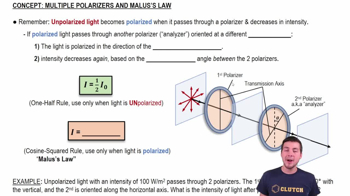
Start by recalling Malus's Law, which states that the intensity of light passing through a polarizer is given by: \( I = I_0 \cos^2(\theta) \), where \( I_0 \) is the initial intensity, \( \theta \) is the angle between the light's polarization direction and the polarizer's axis, and \( I \) is the transmitted intensity.
Since there are two polarizers, the light first passes through the first polarizer, reducing its intensity to \( I_1 = I_0 \cos^2(\theta_1) \), where \( \theta_1 \) is the angle between the initial polarization direction of the light and the first polarizer's axis.
The light then passes through the second polarizer, which is oriented at an angle of 55° relative to the first polarizer. The intensity after the second polarizer is given by \( I_2 = I_1 \cos^2(55°) \). Substituting \( I_1 \), we get \( I_2 = I_0 \cos^2(\theta_1) \cos^2(55°) \).
We are told that only 25% of the initial light intensity gets through both polarizers, so \( I_2 = 0.25 I_0 \). Substituting this into the equation, we have \( 0.25 I_0 = I_0 \cos^2(\theta_1) \cos^2(55°) \). Cancel \( I_0 \) from both sides to get \( 0.25 = \cos^2(\theta_1) \cos^2(55°) \).
Solve for \( \cos^2(\theta_1) \) by dividing both sides by \( \cos^2(55°) \): \( \cos^2(\theta_1) = \frac{0.25}{\cos^2(55°)} \). Finally, take the square root to find \( \cos(\theta_1) \), and use the inverse cosine function to determine \( \theta_1 \), which represents the initial polarization direction of the incident light relative to the first polarizer.

비슷한 문제에 대한 검증된 영상 답변:

이 영상 해법은 위 문제에 도움이 된다고 튜터들이 추천한 것입니다.
영상 길이:
5m
도움이 되었나요?

주요 개념

질문에 올바르게 답하기 위해 반드시 이해해야 하는 핵심 개념들은 다음과 같습니다.

Malus's Law

Malus's Law states that when polarized light passes through a polarizer, the intensity of the transmitted light is proportional to the cosine square of the angle between the light's polarization direction and the polarizer's axis. Mathematically, it is expressed as I = I0 * cos²(θ), where I0 is the initial intensity, I is the transmitted intensity, and θ is the angle between the light's polarization direction and the polarizer's axis.
추천 영상:
09:47
Multiple Polarizers & Malus's Law

Polarization of Light

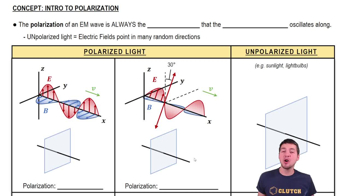
Polarization of light refers to the orientation of the light waves' oscillations in a particular direction. Natural light consists of waves vibrating in multiple planes, while polarized light has waves oscillating predominantly in one direction. This property is crucial in understanding how light interacts with polarizers, as only the component of light aligned with the polarizer's axis can pass through.
추천 영상:
05:32
Introduction to Polarization

Intensity Ratio in Polarizers

When light passes through multiple polarizers, the intensity of the transmitted light can be calculated using the angles between the light's polarization direction and each polarizer. For two polarizers at an angle θ to each other, the transmitted intensity can be found using the formula I = I0 * cos²(θ1) * cos²(θ2), where θ1 is the angle between the incident light and the first polarizer, and θ2 is the angle between the first and second polarizer. This relationship helps determine the initial polarization direction based on the final intensity.
추천 영상:
05:32
Introduction to Polarization
관련 실천
교과서 질문

Consider two antennas radiating 6.8-MHz radio waves in phase with each other. They are located at points S₁ and S₂, separated by a distance d = 175 m, Fig. 34–50. Determine the points on the positive y-axis where the signals from the two sources will be out of phase (crests of one meet troughs of the other).

64
views
교과서 질문

At what angle should the axes of two Polaroids be placed so as to reduce the intensity of the incident unpolarized light by an additional factor (after the first Polaroid cuts it in half) of (a) 4, (b) 10, (c) 100?

658
views
교과서 질문

Two narrow slits 0.070 mm apart are illuminated by a very bright 488-nm light source forming an interference pattern on a screen 4.0 m away. Calculate (a) the distance between the m = 0 and m = 1 lines in the pattern and (b) the distance between the m = 100 and m = 101 lines.

1231
views
교과서 질문

Describe how to rotate the plane of polarization of a plane-polarized beam of light by 90° and produce only a 10% loss in intensity, using polarizers. Let N be the number of polarizers and θ be the (same) angle between successive polarizers.

3
views
교과서 질문

Unpolarized light falls on two polarizer sheets whose axes are at right angles. (a) What fraction of the incident light intensity is transmitted? (b) What fraction is transmitted if a third polarizer is placed between the first two so that its axis makes a 58° angle with the axis of the first polarizer? (c) What if the third polarizer is in front of the other two?

65
views
교과서 질문

"Two identical sources S₁ and S₂, separated by distance d, coherently emit light of wavelength λ uniformly in all directions. Defining the x axis with its origin at S₁ as shown in Fig. 34–52, find the locations (expressed as multiples of λ ) where the signals from the two sources are out of phase along this axis for x > 0 , if d = 3λ.

79
views